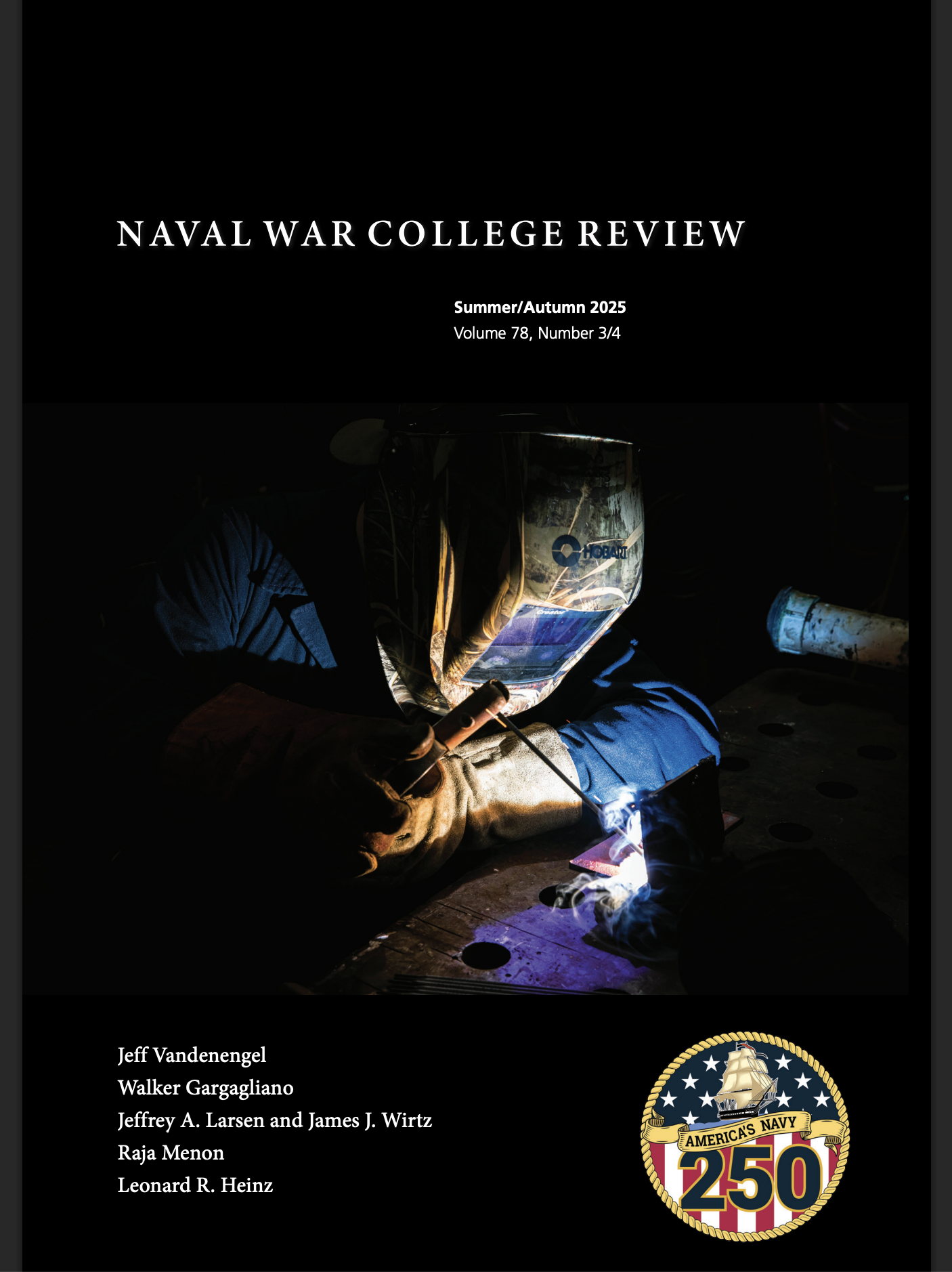
Honored to Review “U.S.-China Rivalry: Great Power Competition in the Indo-Pacific”—in Special U.S. Navy 250th Anniversary Double Issue of Naval War College Review!
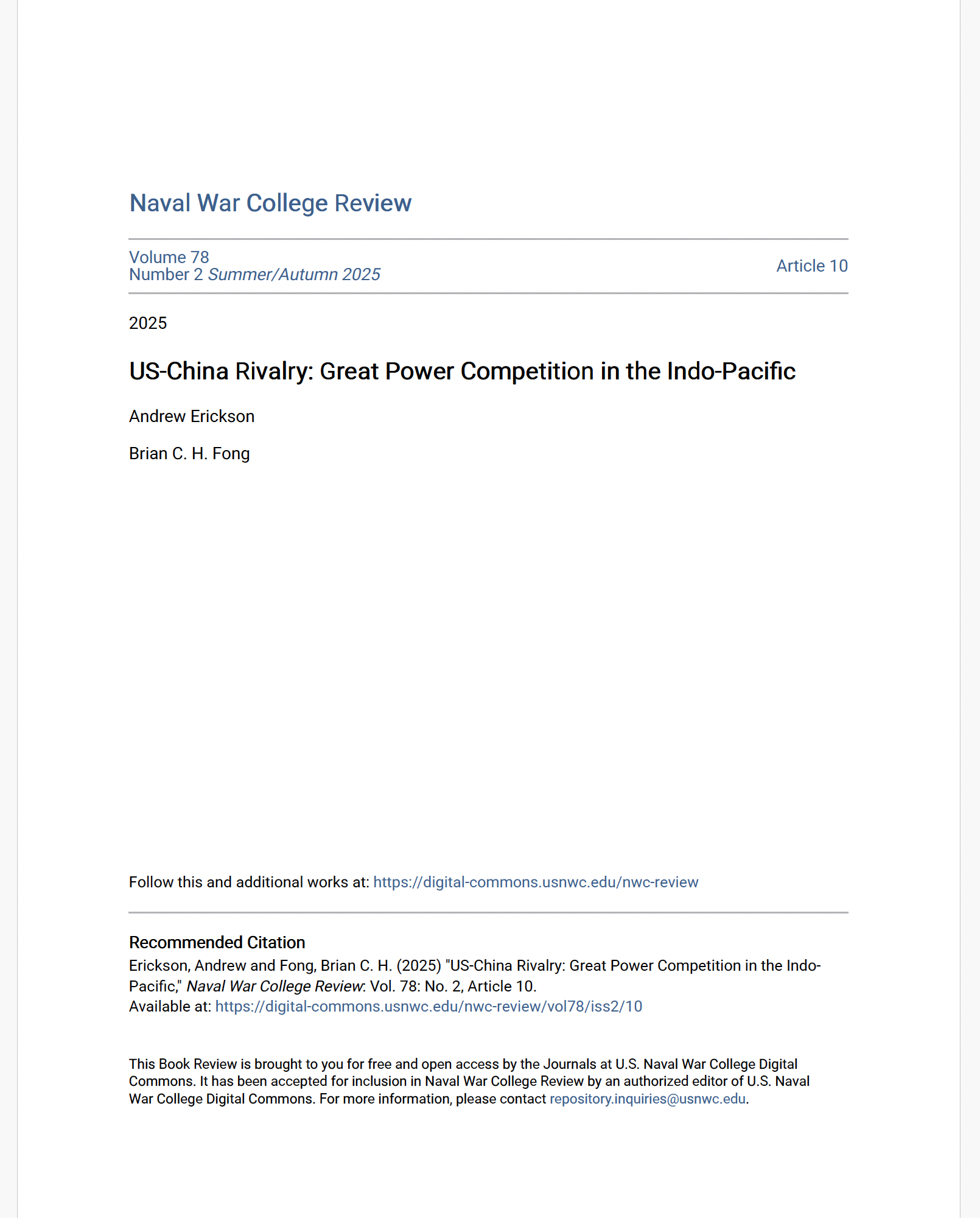
Andrew S. Erickson, Review of Brian C.H. Fong, U.S.-China Rivalry: Great Power Competition in the Indo-Pacific (Edinburgh, Scotland, UK: Edinburgh University Press, November 2024); in Naval War College Review 78.2 (Summer/Fall 2025): 145–46.
CLICK HERE TO DOWNLOAD A CACHED COPY.
US-China Rivalry: Great Power Competition in the Indo-Pacific, by Brian C. H. Fong. Edinburgh Univ. Press, 2024. 344 pages. $125.
Why, where, and how do Washington and Beijing compete in the Indo-Pacific? How do regional actors participate in the Sino-American competition? And where may this all lead?
To address these important questions, author Brian Fong identifies and traces essential elements of which policy makers must possess an understanding that extends beyond fleeting manifestations in a single context within the world’s most contested, high-stakes region. He does so within a “neo-offensive realism” theory that he credibly tests against patterns of Sino-American competition in the post–Cold War Indo-Pacific.
Fong selects and analyzes his case studies within a bi-level international-domestic framework. He characterizes and covers the most-significant U.S. Indo-Pacific allies and partners in sobering but accurate fashion. Japan, Australia, India, and South Korea are involved individually and in various combinations within multilateral alignments. Their differing orientations impose challenges for the United States in its efforts as an offshore balancer to thwart People’s Republic of China (PRC) attempts at regional hegemony.
Fong covers the Indo-Pacific in logical subregions, centered on key dynamics of each. Such empirical attention is more than justified: this is a vast, populous, multifarious region, one that is home to contested core and peripheral areas as well as diverse polities. It sits atop complex geography, including the world’s longest land border, shared by China with its neighbors, and the prominent island chains ringing the PRC.
Fong devotes intense individual attention to two high-friction geostrategic zones most assertively claimed by the PRC: Hong Kong and its “territorial autonomy” as well as the “contested state” of Taiwan. He does so within a taxonomy of the world’s nearly one hundred quasi states, “non-sovereign, post-sovereign, or quasi-sovereign political entities that exercise sovereign powers at distinct scale but not full scale.” Such complicated actors are critically important because they “are increasingly becoming critical domains of great power competition” yet remain extremely understudied. Fong brings impartial analysis informed both intellectually and experientially. Born, raised, and educated in Hong Kong, he began his work in government and academia there, but moved to Taiwan in 2022 to continue his academic career.
Fong’s coverage of Taiwan stands out in multiple respects. Theoretically, it offers unusual scholarly consideration of a complex, disproportionately influential polity. Empirically, Fong’s analysis of Taiwan reveals the very center of U.S.-China competition: the most consequential of geopolitical flash points, whose contestation and status have nothing short of global implications. Fong cogently explains Taiwan’s extreme strategic significance for both the United States and China.
Fong underscores Washington’s long-standing vital interests vis-à-vis Taiwan, drawing parallels between General Douglas MacArthur’s memo of June 1950 and Assistant Secretary of Defense for Indo-Pacific Affairs Ely Ratner’s congressional testimony just over seventy years later. Fong emphasizes that vital American security, technological, economic, and democratic-political interests, as well as Washington’s “global prestige in defending international and regional order,” are “closely tied to Taiwan’s future.”
In parallel, Fong underscores how all PRC leaders from Mao onward have held “reunifying” Taiwan as fundamental to regime legitimacy and national security. Defensive concerns include Taiwan’s historical status as a “bridgehead” for successive foreign powers to threaten mainland-based regimes. Offensive objectives advocated by some PRC strategists and military stakeholders involve capturing Taiwan to use as a springboard for “breaking through” the first island chain and denying the United States as well as its allies and partners control of regional spaces—undersea, on the sea, and in the air. By this logic, Fong explains, “unifying Taiwan is an offensive step that China can take in order to shift the regional military power balance in its favor.”
Irreconcilable Sino-American interests will continue to make Taiwan a flash point; the only question is to what degree. “Taiwan is now at the centre of US-China great power politics,” Fong stresses. “It is not only at the centre of great power competition, but it is also at the centre of a possible great power war.” The Sino-American “strategic standoff ” over Taiwan’s future could well get significantly worse: “The gathering storm is now casting a shadow across the Taiwan Strait, making it one of the most dangerous places in the world.”
Fong concludes by bounding the unpredictability scholars and policy makers face by offering four major potential future scenarios for U.S.-China competition in the Indo-Pacific. “Unbalanced Multipolarity” presages regional turbulence and intense Sino-American contention that increases the chances of great-power war. “Towards Unipolarity” fleshes out a PRC achievement of regional hegemony. Fong envisages “a reverse version of ‘1898 Spanish-American War in the Western hemisphere.’” “Towards Balanced Multipolarity” returns China—through protracted economic lethargy and consequent military spending constraints—to its relative position of the early years of this century as the region’s most powerful nation, but not positioned to dominate it. “Towards Bipolarity” entails a neo–Cold War. The propensity toward a given scenario is determined by changes in relative power and geopolitical alignments, which Fong calculates thoughtfully in this pioneering book.
ANDREW ERICKSON