Latest Pentagon Report: China’s Military Advancing Amid Churn
Andrew S. Erickson, “Latest Pentagon Report: China’s Military Advancing Amid Churn,” War on the Rocks, 9 January 2026.
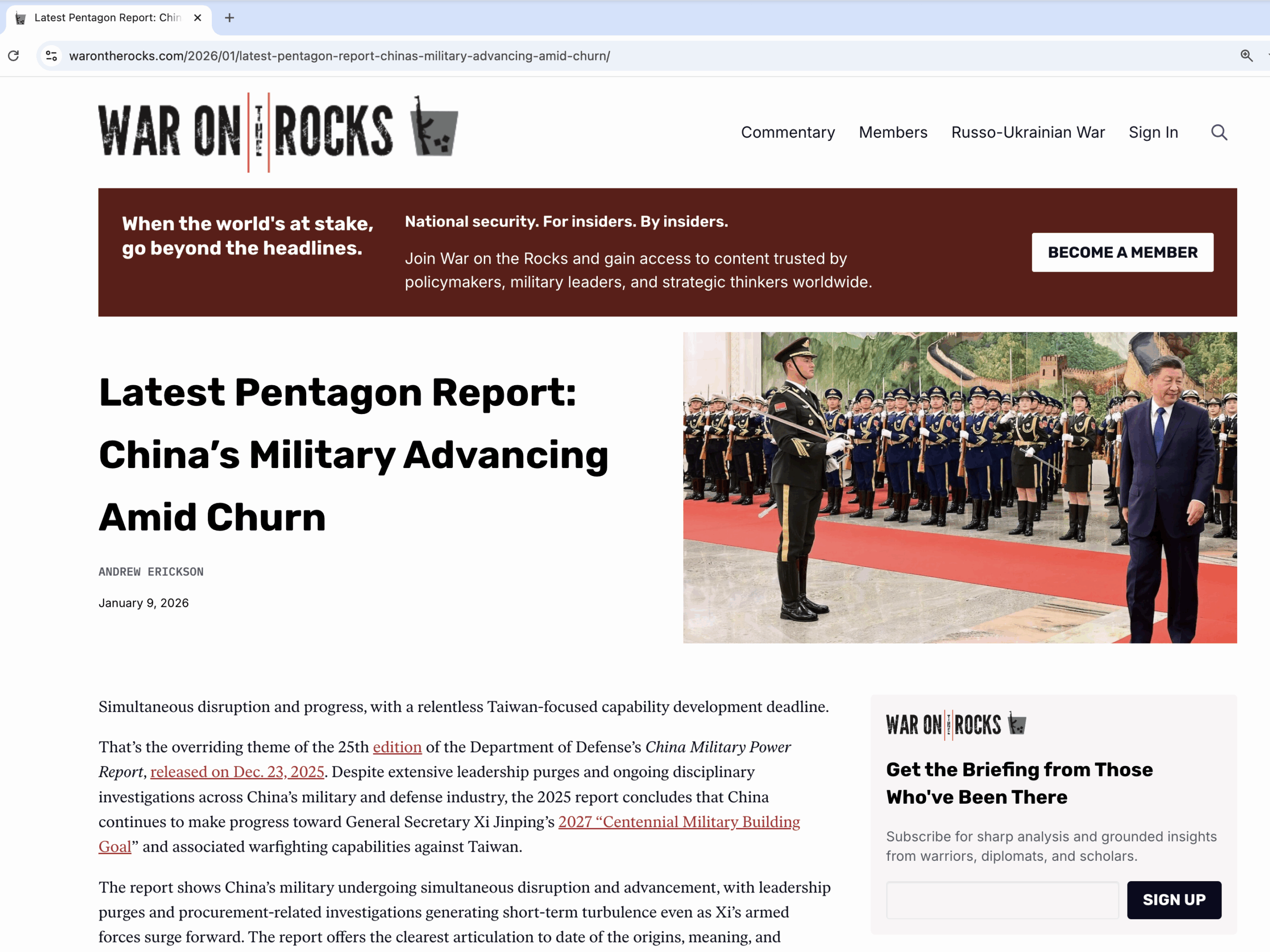
Simultaneous disruption and progress, with a relentless Taiwan-focused capability development deadline.
That’s the overriding theme of the 25th edition of the Department of Defense’s China Military Power Report, released on Dec. 23, 2025. Despite extensive leadership purges and ongoing disciplinary investigations across China’s military and defense industry, the 2025 report concludes that China continues to make progress toward General Secretary Xi Jinping’s 2027 “Centennial Military Building Goal” and associated warfighting capabilities against Taiwan.
The report shows China’s military undergoing simultaneous disruption and advancement, with leadership purges and procurement-related investigations generating short-term turbulence even as Xi’s armed forces surge forward. The report offers the clearest articulation to date of the origins, meaning, and operational implications of Xi’s 2027 goal, framing it as a capabilities-based requirement oriented toward coercion and potential warfighting against Taiwan and U.S. and allied intervention forces. It documents significant progress in nuclear posture enhancement, long-range conventional strike, and capability and resilience of supporting architecture. Moreover, it situates gray-zone coercion, Chinese coast guard and maritime militia activity, and expanding overseas access within a broader pattern of progress. Finally, while leadership investigations and removals have imposed immediate readiness and continuity costs, the Pentagon judges that such actions may ultimately yield a more disciplined, coherent, and capable Chinese military. This underscores the central conclusion: Organizational churn should not obscure continued Chinese military modernization momentum toward 2027 and beyond.
As it has for a quarter century, the report offers detailed information not typically available to the public. Many 2025 report datapoints reflect developments only through late 2024 or early 2025. This lag effect is an unavoidable reality of information cutoff and internal review timelines for a U.S. government document prepared systematically for public release, but it is likely accentuated by this year’s record-late publication. … … …