China Maritime Report #58—“Tightening the Institutional Cage: The PLA Navy’s Discipline Inspection Commission”
Eric Hundman and Connor Akiyama, Tightening the Institutional Cage: The PLA Navy’s Discipline Inspection Commission, China Maritime Report 58 (Newport, RI: Naval War College China Maritime Studies Institute, 28 September 2026).
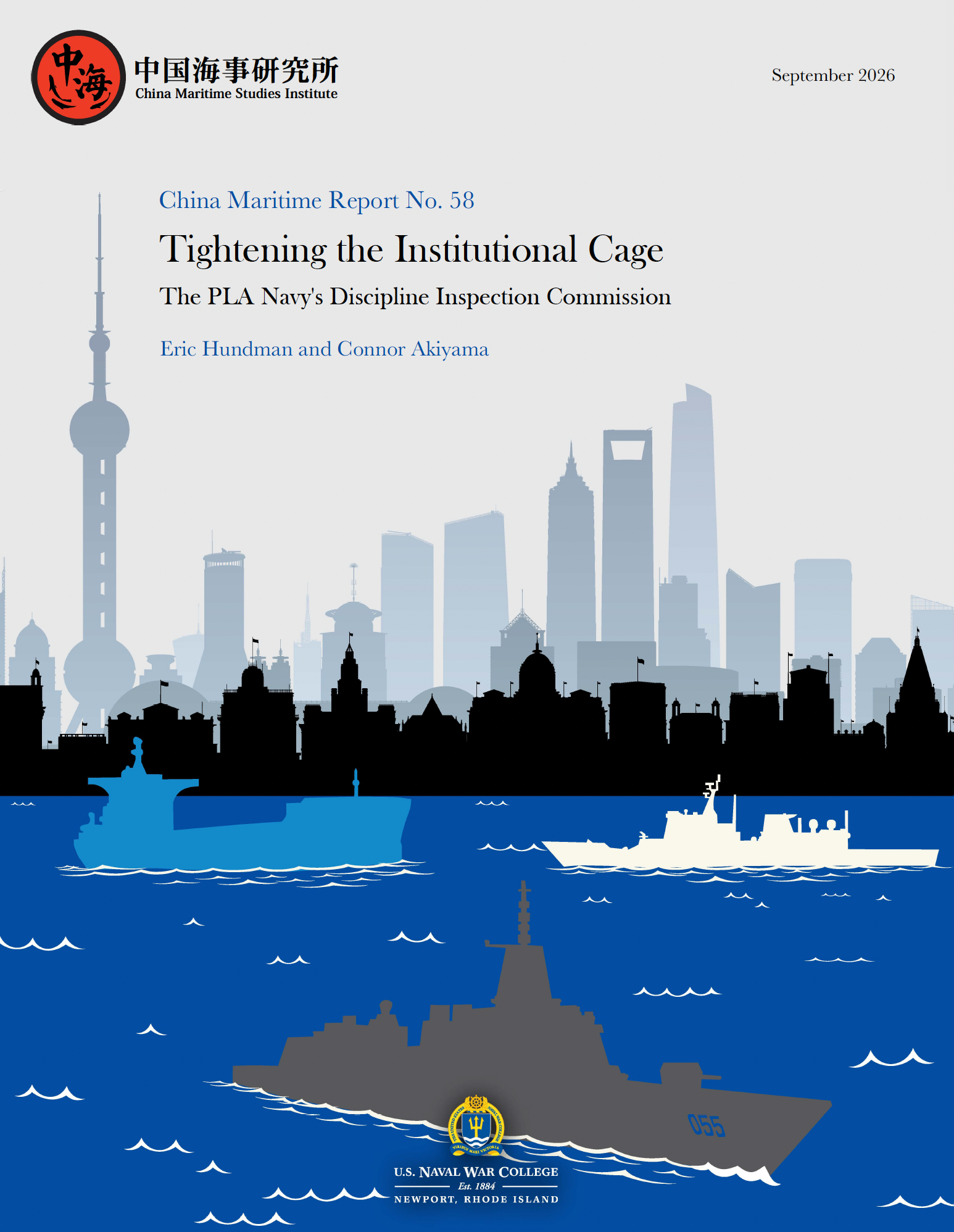
CLICK HERE TO DOWNLOAD A CACHED COPY.
From CMSI Director Christopher Sharman:
China Navy Watchers: Who polices the people who police the PLAN?
The Chinese Communist Party (CCP) operates a pervasive system of Discipline Inspection Commissions (DICs) throughout the Party and military hierarchy, designed to enforce political discipline and loyalty.
The PLA Navy (PLAN) has its own DIC at Navy headquarters, overseeing a broader system of discipline inspection organizations extending down into naval units.
Yet despite its importance, the PLAN DIC is an organization that has received remarkably little attention … until now.
The China Maritime Studies Institute (CMSI) China Maritime Report #58, “Tightening the Institutional Cage: The PLA Navy’s Discipline Inspection Commission,” takes a close look at this little-studied organization.
Drawing on publicly available Chinese-language sources, the report examines the PLAN Headquarters DIC in as much detail as these sources allow.
The report begins by examining the mission of the PLAN Headquarters DIC, then explores its personnel and internal organization, details its publicly reported activities, and concludes by assessing its impact, strengths and weaknesses, and implications for the United States.
One of the report’s most important findings is that “corruption” within the PLAN DIC is much broader than financial misconduct. The DIC is also concerned with political and moral discipline and with ensuring that personnel set an example that can “contribute to creating a clean and upright environment for the troops.”
So what does that mean in practice?
PLAN disciplinary priorities appear to encompass investigating a wide range of violations. From lax implementation of regulations, inappropriate commentary on major policies, insufficient attention to training, misuse of public funds, improper gifts, lavish weddings or funerals, bribery, drunk driving, online gambling, expensive vehicles, oversized housing, and preferential access to entertainment venues and tourist attractions … to name just a few.
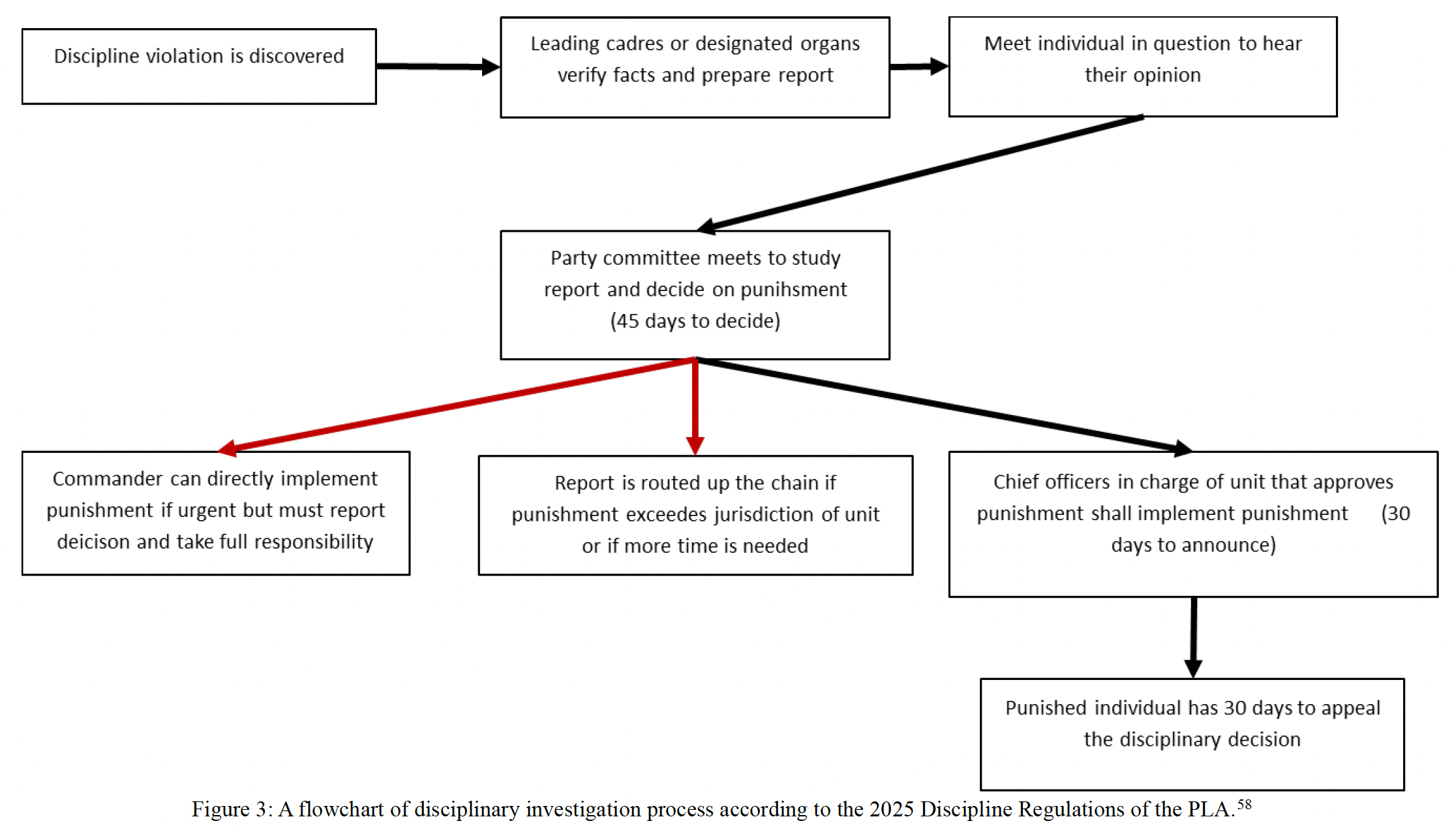
The report also provides a fascinating look at how the DIC actually does its job.
It examines the process for identifying and investigating violations, the role of Party committees in deciding punishments, and the timelines established by the Central Military Commission.
See the flowchart on page 13 for a useful visualization of this process.
This CMR is authored by two experts in the field — Dr. Eric Hundman, Director of Research at BluePath Labs, and Connor Akiyama, a civilian analyst for the Department of the Navy who covers PLA military capabilities and leadership.
For anyone seeking to better understand the inner workings and the mechanisms for enforcing discipline within the PLAN, this CMR provides a rare look inside an important but often underappreciated component of the Navy’s organizational structure.
About the Authors
Dr. Eric Hundman is Director of Research at BluePath Labs. He has over 15 years of experience managing and conducting a wide variety of research projects for defense, business, and academic customers. He is a globally recognized expert on China’s military and foreign policy who, more broadly, specializes in defense policy, military organizations, emerging technologies, and research methods. His research, analysis, and commentary have been published in peer-reviewed journals such as International Security, Journal of Global Security Studies, and Journal of Contemporary China, as well as in public-facing outlets such as Foreign Policy, ChinaFile, Wired, and Political Violence at a Glance. He is fluent in Mandarin Chinese and spent eight years living in China and Taiwan. He received a Ph.D. and M.A. in political science from the University of Chicago and a B.S. in physics and political science from Yale University.
Conor Akiyama currently works as a civilian analyst for the Department of the Navy where he covers PLA military capabilities and leadership. Connor grew up in the California Bay Area and holds a bachelor’s degree in international relations and economics from Tufts University.
Main Findings
- The Chinese Communist Party (CCP) operates a pervasive system of discipline inspection commissions (DICs) spanning the Party and military hierarchy to enforce political discipline and loyalty.
- The PLAN headquarters DIC supervises a system of subordinate PLAN DIC organizations located in major units across the navy. Broadly speaking, that system is designed to enforce party discipline among PLAN personnel.
- The CCP’s specific priorities for discipline in the PLAN have shifted over the years, and they currently center on failure to adhere to (or succeed in implementing) political priorities, lax training, financial impropriety, and abuse of military benefits.
- Corruption in the PLAN DIC context is much broader than commonly thought and includes not only financial corruption but also political and moral concerns.
- Enforcing discipline gives the PLAN DIC a role in personnel selection and management.
- Disciplinary measures imposed by DICs can, per CMC guidance, include anything from dismissal from the military altogether to warnings, demotions, and records of demerit.
- Annoyance with discipline inspection officials seems likely to be substantial. According to some PLA accounts, this annoyance has translated into passive resistance.
- The activities of the PLAN DIC and its subordinate DICs may have resulted in a higher degree of professionalism among PLAN personnel, although the magnitude of the change is not clear based on publicly available information.
- For the PLAN, as well as the rest of the PLA, political loyalty in contemporary China means personal control by and loyalty to Xi Jinping himself.