China Maritime Report #60: “PLA Naval Aviation Personnel: Training and Career Paths for a Modern Force”
Eli Tirk and Qi Xiaoke, PLA Naval Aviation Personnel: Training and Career Paths for a Modern Force, China Maritime Report 60 (Newport, RI: Naval War College China Maritime Studies Institute, 2 November 2026).
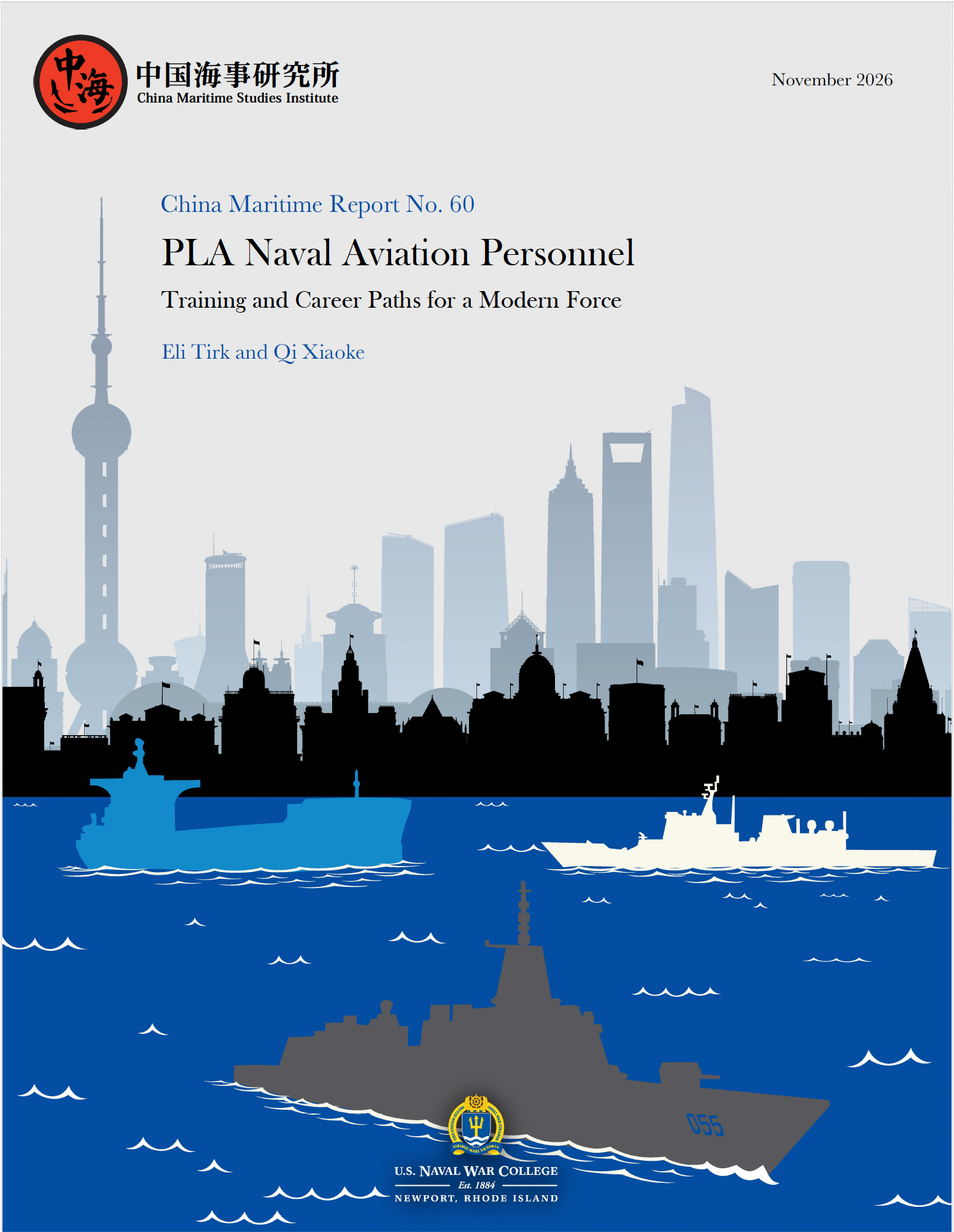
CLICK HERE TO DOWNLOAD A CACHED PDF COPY.
From CMSI Director Christopher Sharman:
China Navy (and Aviation) Watchers: What does it take to build a new generation of naval aviators capable of supporting the PLA Navy’s (PLAN) expanding carrier force?
Building a carrier navy requires more than ships and aircraft. It requires a pipeline of trained pilots, aviation crews, and technical personnel capable of sustaining increasingly complex maritime operations in the near and far seas.
Authored by our China Aerospace Studies Institute (CASI) colleagues, Eli Tirk and Qi Xiaoke, China Maritime Studies Institute (CMSI) China Maritime Report (CMR) No. 60, “PLA Naval Aviation Personnel: Training and Career Paths for a Modern Force,” examines how the PLAN has overhauled its aviation personnel development system to meet these demands.
What does it actually take to qualify a pilot to fly from an aircraft carrier?
This CMR walks readers through the training pipeline, from initial flight instruction and advanced training to operational transition and carrier qualification. It identifies the aircraft used at different stages, examines efforts to shorten and improve the training process, and highlights how China’s Navy is incorporating more realistic, operationally focused training.
The report also introduces readers to the Naval Teenagers Aviation School, an initiative launched in 2015 to cultivate future naval aviators by recruiting junior high school graduates into specialized programs at 14 selected high schools across China.
And this isn’t just about fighter pilots. The report examines the development of helicopter, special mission, and transport aviation personnel, including the training of airborne combat support crews.
It also profiles senior PLAN aviators, traces their career progression, and explores the promotion opportunities available to officers in this increasingly important community.
For anyone interested in understanding how the PLAN is building the human capital behind its expanding naval aviation capabilities, this report offers a particularly insightful look inside the training pipeline, the aviation education challenges the PLAN has addressed, and what it takes to be promote to the senior naval ranks from within the PLAN naval aviation community.
Main Findings
- PLA Naval Aviation has undergone substantial institutional transformation over the past two decades. This transformation is driven by the goal of becoming a carrier-based force capable of effective joint operations in the maritime domain.
- This transformation has been accompanied by reforms to pilot education, training, and career management systems, aimed at producing a qualified force capable of conducting long-range maritime operations.
- Despite significant progress, there are still areas that require improvements, particularly the Naval Aviation University.
- The PLAN likely aims to further professionalize pilot education and shorten the carrier pilot training pipeline by equipping Naval Aviation University training units with carrier-capable training aircraft to reduce reliance on operational units.
- PLAN authors have praised the U.S. Navy’s tactical training, suggesting the PLAN may seek to incorporate more combat-realistic training content.
- It is likely that the PLA Naval Aviation’s transition training phase will continue to improve, building on the initial progress in adoption of complex force-on-force training scenarios.
- Understanding the career progression of officers in this community adds context to the desirability of this career field.
- Close attention to how PLA Naval Aviation grows and changes with the adoption of carrier-based KJ-600s and future land-based systems will be important to understanding how the PLAN will fight.
- Overall, improvements to Naval Aviation pilot training and joint training by the operational force clearly suggest that the PLAN is increasingly providing its aviation branch with the opportunities to develop technical acumen and tactical competencies required to conduct the missions the PLAN has been tasked with.
About the Authors
Mr. Eli Tirk is a Researcher at the China Aerospace Studies Institute (CASI). His main research areas include the PLA Air Force, PLA naval aviation, and the PRC defense industry. Eli has been at CASI since 2021. Prior to joining CASI, Eli was an analyst at Exovera’s Center for Intelligence, Research, and Analysis (CIRA). Eli holds a BA from the George Washington University and an MA from the Hopkins-Nanjing Center, a joint degree granting program of Johns Hopkins SAIS and Nanjing University. From 2017–18, Eli was a National Security Education Program David L. Boren Fellow to China.
Ms. Xiaoke Qi is a research analyst at the China Aerospace Studies Institute (CASI), Air University, specializing in PLA Training and Personnel. Her work focuses on analyzing the PLA’s evolving training doctrine, force development, and personnel policies. Before joining CASI, Xiaoke served as a language specialist on the Chinese Counterintelligence Team at the Federal Bureau of Investigation (FBI) and the National Virtual Translation Center (NVTC) from 2022 to 2024. Prior to that, she worked as a research specialist for the Drug Enforcement Administration (DEA) from 2021 to 2022. From 2011 to 2020, she served in the U.S. Army as an intelligence analyst, supporting U.S. Northern Command (NORTHCOM) and Central Command (CENTCOM). She currently serves in the U.S. Army Reserve as an intelligence operations officer with a focus on U.S. Army Africa Command (AFRICOM). Born and raised in Hebei, China, Xiaoke moved to the United States in 2010. She earned a Bachelor of Science in Physics and Nuclear Science from the University of Colorado and is currently pursuing graduate studies in Applied Physics at Johns Hopkins University.
The opinions and views expressed are those of the authors alone and do not necessarily represent those of the U.S. Government, U.S. Department of War or its components, to include the Department of the Navy or the U.S. Naval War College.