Corruption, Cashiering, Continued Progress: New China Military Power Report Probes PLA Leadership and Organizational Trends
Corruption, Cashiering, Continued Progress:
New China Military Power Report Probes PLA Leadership and Organizational Trends
Andrew S. Erickson[1]
Disclaimer: The views expressed here are those of the author alone, based solely on open sources. They do not necessarily represent the views, policies, or positions of the U.S. Department of War or its components, to include the Department of the Navy or the U.S. Naval War College.
Andrew S. Erickson, “Corruption, Cashiering, Continued Progress: New China Military Power Report Probes PLA Leadership and Organizational Trends,” China Analysis from Original Sources 以第一手资料研究中国, 28 December 2025.
Welcome to my third article unpacking the most important revelations from the Pentagon’s 23 December 2025 China Military Power Report! Here I probe the report’s unique findings concerning recent removals of numerous high-level People’s Liberation Army (PLA) officers and defense industry principals for what Western sources, and sometimes PRC releases, often term “corruption.”
- My first article unwrapped what is arguably the report’s biggest single reveal: that the People’s Republic of China (PRC) has now deployed its 5,000-8,000 km range DF-27 ballistic missile, with a conventional intercontinental ballistic missile (ICBM) variant ranging part of the Continental United States (CONUS); as well as an anti-ship ballistic missile (ASBM) variant, part of China’s fourth family of ground-launched ASBMs.[2]
- My second article surveyed the report’s disclosures concerning China’s nuclear warheads and their triad of delivery vehicles.[3] The report cited a “low 600s” operational warhead count through 2024, and assessed slower but still rapid growth toward 1,000+ by 2030. It offered exquisite Early-Warning Counterstrike (EWCS) performance and posture data and identified China’s DF-26 intermediate-range ballistic missile (IRBM) and H-6N air-launched ballistic missile (ALBM) as preferred carriers for low-yield (<10 kt) precision nuclear strikes. The report confirms Beijing’s September 2024 Pacific test as a DF-31B ICBM launch, and deems it doctrinally a rehearsal for nuclear signaling launches. More broadly, the report interprets Xi Jinping’s nationally-prioritized 2027 Centennial Military Building Goal[4] as requiring three “strategic capabilities” (strategic decisive victory, counterbalance, deterrence and control) and explicitly links strategic counterbalance to nuclear modernization.
Now for the subject of my third article regarding the Department of War’s 2025 report. This latest Pentagon contribution brings welcome data and context to the important, complex, and all-too-opaque subject of the removal of numerous high-ranking PLA officers and defense industry principals for alleged disciplinary violations—a trend that has felled officials in organizations across China’s Party-State-Military system.
Key Findings
- Like the China Maritime Studies Institute (CMSI)’s series of analyses on the removals of PLA officers, which has focused on PLA Navy (PLAN) Admirals,[5] the Pentagon’s 2025 report sees the likelihood of near-term churn, the possibility of longer-term gains, and a reality of continued progress.
- “These investigations very likely risk short term disruptions in the operational effectiveness of the PLA. Alternatively, the PLA could emerge as a more proficient fighting force in the future….”
- Whatever the cost, the bottom line up front for American and its allies and partners is sobering: China is advancing toward Xi’s ambitious and aggressive military objectives for 2027 and beyond regardless.
Extensive Removals: Across the Board
There’s no question that this is an unusual time for the PLA. On 22 December 2025, the day before the Pentagon report’s release, Xi presided over a Central Military Commission (CMC) ceremony promoting Generals Yang Zhibin and Han Shengyan officers to full 3-star rank. (Whereas since World War II U.S. military officers have top out at 4-star rank, PLA officers top out at 3-star rank.)
Two things in particular made this ceremony stand out. First, thanks to removals and lack of replacements, the CMC is unusually small. Second, setting aside 2018, during which there were no 3-star promotions, this is the latest that China’s first 3-star promotion of the year has occurred in the fourteen calendar years and counting during which Xi has been in power. As Appendix A at the end of this article tabulates, the second latest such date in the previous dozen years, 2012–24, is 23 November 2012—back when Xi was just getting started. July has been the most common month for China’s first 3-star promotion of the year, and recent years have witnessed up to several “batches” of such ceremonies. Clearly these are unusual times, which demand particularly analytical scrutiny.
The Pentagon’s 2025 report delivers with extensive, substantive sections covering the subject. It documents that dozens of PLA Flag and General Officers (FOGOs) in every service and every theater command have been removed, together with many defense industry principals. “With [former Defense Minister General] Li Shangfu’s and [former PLARF commander General] Li Yuchao’s expulsion from the party in July 2024,” the report underscores, “of the 42 military Central Committee members chosen at the October 2022 party congress, eight—19%—have already either been removed or are under investigation.”
Following extensive investigation and purging of PLARF officers and related rocket and missile industry officials in 2023, efforts expanded in 2024 to include China’s nuclear and shipbuilding industries, as well as other industries such as aviation. Shipbuilding industry casualties, not detailed in the report, included none other than former China Shipbuilding Industry Corporation (CSIC) Chairman (2012–19) Hu Wenming. In that capacity, as head of China’s aircraft carrier program, he oversaw development of China’s first two aircraft carriers: Liaoning and Shandong, now fielded and engaged in increasingly sophisticated operations. On 26 December 2023, Hu was sentenced “to thirteen years in prison for bribery and abuse of power.”[6] Hu’s former subordinate General Manager Sun Bo was sentenced to 12 years in prison 4 July 2019.[7]
As part of this second wave, “The number of ‘tigers’—individuals at the vice-ministerial level or above—investigated by the Central Commission for Discipline Investigation in 2024 rose by almost a third, with much of that increase coming from the defense sector. At least 26 top and former managers with state-owned arms suppliers have been placed under investigation or removed from their positions. The number of heads of state-owned enterprises officially under investigation doubled, from three in 2023 to six in 2024.” “In addition to the three defense industry leaders dismissed from the Chinese People’s Political Consultative Conference (CPPCC) in December 2024, at least two more individuals were dismissed in 2024,” the report continues, “The lead designer for the PLA’s J-20 fighter and his company’s general manager were placed under investigation in January 2025.” The profiles of Chief Designer Yang Wei, nothing short of a superstar prodigy, and his Aviation Industry Corporation of China (AVIC) colleague General Manager Hao Zhaoping were reportedly removed from AVIC’s website in January 2025.[8]
The report supports CMSI’s previous analytical conclusions, while adding specific examples that CMSI was unable to locate in open sources. The most prominent examples cited in the report, publicly known for some time, have been covered in CMSI analysis. These include former CMC second Vice Chairman He Weidong; former CMC Political Work Department (PWD) Head Admiral Miao Hua, the PLA’s lead political officer;[9] former PLARF Commander VADM/General Wang Houbin;[10] former PLAN Political Commissar Admiral Yuan Huazhi;[11] and the two previous Southern Theater Command Navy (STCN) Commanders VADM Li Pengcheng and VADM Ju Xinchun.[12] Of note, available PRC official sources do not reveal a currently serving STCN replacement.
The report’s coverage of Miao combines what is well known with what CMSI has long suspected but not been able to substantiate with reliable open sources, suggesting an expansion of the public knowledge frontier via government information release. By the very definition of his capstone position, Miao’s “responsibilities extended to human resources management, including recommending senior officers for promotion….” To this the report adds, “…possibly in exchange for bribes. Miao’s detention calls into question the qualifications of any officers he has recommended during his seven years as head of the CMC PWD as well as his decades of service as a political commissar before then.”
The report identifies investigations and removals that were not previously revealed in demonstrably authoritative open sources, at least those that CMSI was able to locate. CMSI previously profiled Politics and Law Commission Secretary Admiral Wang Renhua (王仁华), an erstwhile loyalty enforcer for Xi,[13] but was unaware of credible evidence that his career had cratered; the report states that he was “removed/detained” in May 2025. “Senior PLA Leaders Investigated and Removed or Punished, May 2023-May 2025” per the report also include a former PLAN Deputy Commander, VADM Feng Danyu (冯丹宇), and the former Eastern Theater Command Navy Commander, VADM Wang Zhongcai (王仲才). CMSI had not seen reliable open source evidence that they had run into trouble, and such sensitive information remains extremely sparse. Appendix B profiles three PLAN Admirals assessed to hold Theater Command leadership positions as of 31 December 2024.
Additionally, “multiple senior officers and defense industry executives have not been seen attending public events, suggesting that additional corruption investigations remain in progress.” 2025 report’s data were generally truncated by the end of calendar year 2024, and there is no indication that personnel data were updated after May 2025. More recent potential examples identified in CMSI research include the replacement by Vice Admiral Leng Shaojie in an acting capacity of dismissed Political Commissar Admiral Yuan Huazhi.[14] PLAN Commander Admiral Hu Zhongming has missed recent high-profile events but Deputy Commander Vice Admiral Cui Yuzhong has been filling in.[15]
In a substantial section entitled “Lengthy Processes to Investigate and Punish Corruption,” the report explains the time consuming steps that are typically involved in scrutinizing and prosecuting PLA officers suspected and/or accused of disciplinary violations. For instance, “The disciplinary process for Central Committee members or alternate members especially can be extremely lengthy, as their cases apparently need to be reviewed at a Central Committee plenum.” The “military members of the 20th Central Committee…in a state of limbo until CMC investigations are completed and [the] politburo decision on expelling them is endorsed by the next party plenum” now can be seen to have included Admiral Miao.
As long as PLA processes are, the report emphasizes, “civilians experience a much longer time between initial detention and the issuance of a formal referral for criminal investigation. It is unclear whether the relative slowness stems from procedural differences for military and civilian leaders or reflects limited bureaucratic capacity.” The report offers a telling example of this military-civilian procedural disparity: “Tan Ruisong, the head of the Aviation Industry Corporation of China (AVIC), was removed from his position in March 2023. The Central Commission for Discipline Investigation only announced in August 2024 that he was under investigation. Tan was finally expelled from the party in February 2025 and arrested the next month for formal prosecution – some eight months after Li Shangfu, even though his investigation had likely begun four months earlier. The lengthy process may prolong disruption within the defense industry.”
Costs vs. Progress: Anticorruption Drive Net Assessment
The report never suggests that Xi’s supreme position is at all in question, or that any other elite actors are able to amass sufficient power to challenge Xi’s exercise of power. It consistently depicts China as a unitary actor under Xi’s authority, with the paramount leader driving hard in disciplinary efforts. The report recounts the CMC’s holding a political work conference on 19 June 2024 in the symbolic CCP redoubt of Yan’an, “calling for increased anti-corruption and discipline inspection to be done at the lower levels as part of efforts to eliminate conditions that breed corruption.”
The below photo, from CMSI research separate from the Pentagon report, shows the audience when Xi delivered a major speech at the conference. Of note, the first three individuals sitting in the front row, from left, are two now-since-removed former officers—PLARF Commander General Wang Houbin[16] and PLAN Political Commissar Yuan Huazhi[17]—as well as PLAN Commander Admiral Hu Zhongming,[18] who has missed recent events at which his presence would be expected.[19]

What the report does suggest is that the sheer breadth and depth of the removals has disruptive effects, at least in the short term. “Beijing is pursuing a zero-tolerance approach to corruption and is willing to purge the military of perceived disloyalty regardless of the disruptive impact on the PLA,” the report suggests.
The report identifies two near-term areas of specific negative impact. “The ongoing removal of senior PLA officers has caused uncertainty over organizational priorities and lack of continuity in those priorities as leadership changes and is gapped,” the report judges. “These removals have reverberated throughout the ranks of the PLA as well, as there are reports that some new recruits question the PLA’s absolute loyalty to the party.” CMSI has similarly identified concerns regarding commitment to Communism among some new-generation personnel.[20]
“Corruption in defense procurement has contributed to observed instances of capability shortfalls, such as malfunctioning lids installed on missile silos or possibly the pier side sinking of the PLAN’s first Zhou-class [Type 041] submarine as it prepared for sea trials,” the report adds. “Speaking to military delegates at the March 2024 NPC session, CMC Vice Chairman He Weidong criticized low-quality equipment being provided to the PLA and false reports made to CMC leadership.” Problems with missile silo lids were identified in a section in the 2024 report entitled, “Special Topic: Impacts of Corruption on the PLA” (pp. 159–60). Discussion of the lids concludes with an important conjecture: “This investigation likely resulted in the PLARF repairing the silos, which would have increased the overall operational readiness of its silo-based force.” The reason for the Zhou-class submarine’s sinking was not previously addressed directly in credible open sources,[21] but the status of future hulls should be visible to non-government analysts.
Great Ambitions, Relentless Progress: 2027… and 2035 and 2049
The Pentagon’s 2025 report acknowledges the significant removals of PLA officers and defense industry principals, which have been particularly extensive since 2023. It judges that such a space of cashiering creates challenges including short-term churn. It traces the long investigation and prosecution process for PLA officers, and explains how the equivalent processes are still longer for their administrative counterparts in PRC military industry. Yet the report concludes that China’s military and defense complex may well emerge the stronger for it. Whatever the cost, the bottom line up front for American and its allies and partners is sobering: China is advancing toward Xi’s ambitious and aggressive military objectives for 2027 and beyond regardless.
- “The PLA continues to make steady progress toward its 2027 goals, whereby the PLA must be able to achieve ‘strategic decisive victory’ over Taiwan, ‘strategic counterbalance’ against the United States in the nuclear and other strategic domains, and ‘strategic deterrence and control’ against other regional countries. In other words, China expects to be able to fight and win a war on Taiwan by the end of 2027.”
- “The recent removal of Vice Chairman He, Admiral Miao, political commissars of three of the four services, and the head of China’s internal security forces for corruption has decreased China’s leaders’ confidence in the reliability of PLA leadership. The number of personnel removed likely has implications for the PLA’s progress towards its 2027 modernization goals. Given the PLA’s continued progress against these goals, it is difficult to ascertain how significant these implications have been. Despite plausible short-term impacts to readiness, China remains committed to its strategic goals, with the ongoing anticorruption campaign having the potential to improve PLA readiness in the long term.”
While dedicated coverage is beyond the scope of this particular article, it’s important to recognize the larger context: that Xi’s 2027 goal is a waypoint to a waypoint—far from the end of the story of China’s military development, or its critical challenges to the United States and its allies and partners. Beijing is simultaneously working to essentially complete its desired military force structure by 2035, on the way to achieving its complete “China dream” of a fully “world-class” military and attendant capabilities by 2049.
In one of its few projections for 2035, and one of its few mentions of PLAN force structure, the Pentagon’s 2025 report makes a staggering pronouncement: “The PLAN aims to produce six aircraft carriers by 2035 for a total of nine.” Building six aircraft carriers by 2035 would head Beijing toward some semblance of blue water force structure parity with Washington, but would be a heavy lift indeed. China’s latest and greatest aircraft carrier Fujian (CV 18)—its third—took ten years to produce from start to finish. Laid down during March 2015–February 2016, it was commissioned on 5 November 2025. Nevertheless, China has already achieved the world’s most dramatic military buildup since World War II. As the report shows extensively, this buildup proceeds relentlessly, with no signs of slowing. Anticorruption investigations and resulting removals, whatever their specific motivations, are not thwarting or derailing China’s military progress. Instead, Xi continues to push ahead with great ambitions and determination. China’s announced defense budget has nearly doubled on Xi’s watch already. We cannot afford to bet on him stumbling or losing power.
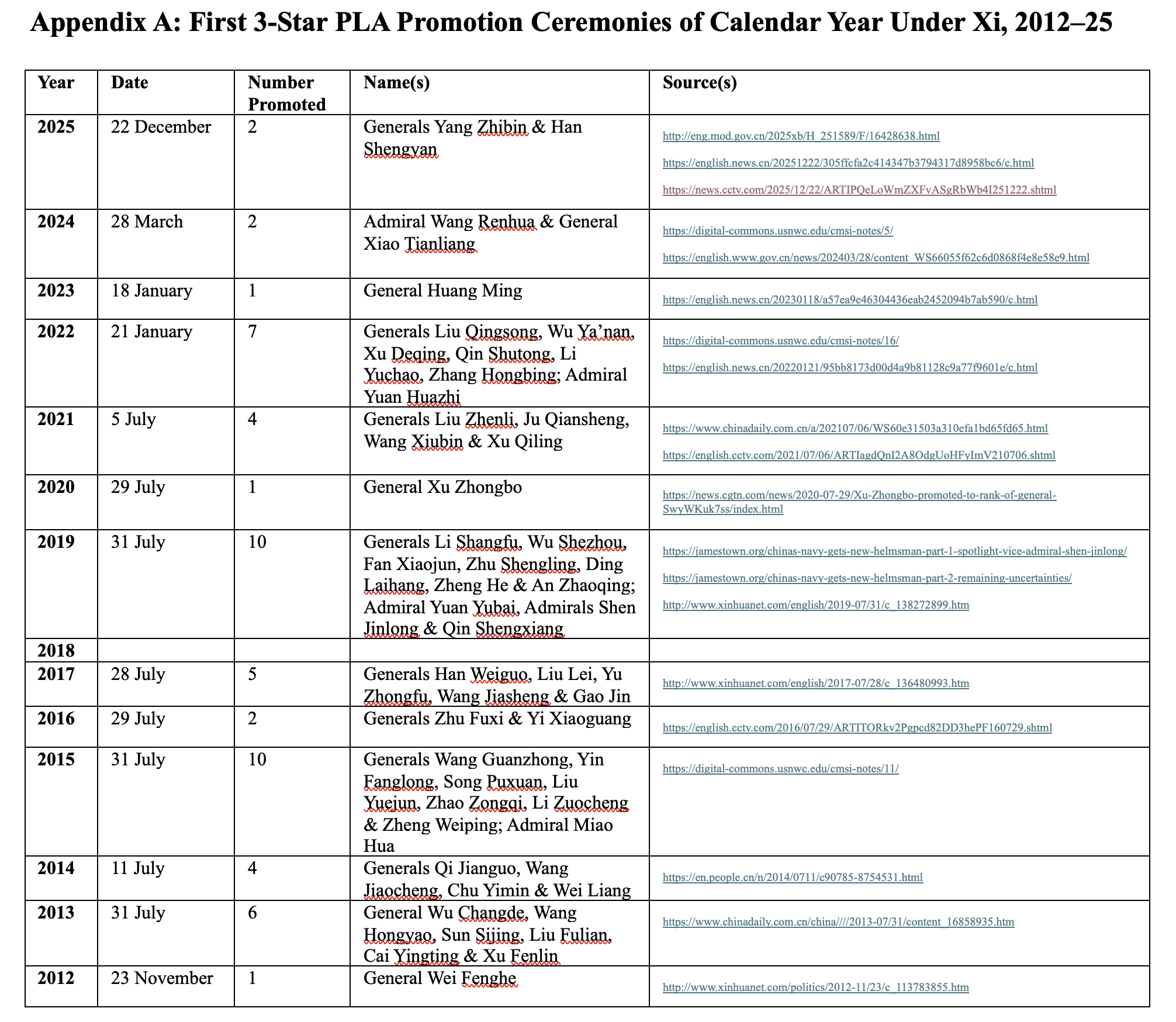
Appendix A: First 3-Star PLA Promotion Ceremonies of Calendar Year Under Xi, 2012–25
Appendix B: PLAN Officers in Theater Command Leadership Positions
Per 2025 China Military Power Report, names and positions were current as of 31 December 2024. Theater Commands are listed in official protocol order.
Eastern Theater Command Leadership
Political Commissar– Admiral Liu Qingsong [刘青松]
Previous Position; Political Commissar, Northern Theater Command DOB: November 1963
Age: 61
Birthplace: Jinan, Shandong Province
Education: Unknown
Northern Theater Command Leadership
Chief of Staff– Vice Admiral Jiang Guoping [姜国平]
Previous position: Assistant to the Chief, Joint Staff Department, CMC
DOB: ~October 1962
Age: 62
Birthplace: Weihai, Shandong Province
Education: Dalian Naval Ship Academy
Central Theater Command Leadership
Chief of Staff– Vice Admiral Wang Changjiang [王长江]
Previous position: Deputy Commander, Northern Theater Command
DOB: February 1959
Age: 66
Birthplace: Tangshan, Hebei Province
Education: The PLA Air Force’s Fourth Aviation Academy
ENDNOTES:
[1] The author thanks Ken Allen and Christopher Sharman for helpful inputs. Any errors are his alone.
[2] Andrew S. Erickson, “China’s DF-27 Missile: Threatening Pacific Ships and the U.S. Homeland,” The Maritime Executive, 26 December 2025, https://maritime-executive.com/editorials/china-s-df-27-missile-threatening-pacific-ships-and-the-u-s-homeland.
[3] Andrew S. Erickson, “World’s Fastest Nuclear Force Ramp-Up: Strengthening for China’s 2027 Goal Despite Disciplinary Removals,” China Analysis from Original Sources 以第一手资料研究中国, 27 December 2025, https://www.andrewerickson.com/2025/12/worlds-fastest-nuclear-force-ramp-up-strengthening-for-chinas-2027-goal-despite-disciplinary-removals/.
[4] Andrew S. Erickson, “PRC Pursuit of 2027 ‘Centennial Military Building Goal’ (建军一百年奋斗目标): Sources & Analysis,” China Analysis from Original Sources 以第一手资料研究中国, 19 December 2021, updated 18 April 2023, https://www.andrewerickson.com/2021/12/prc-pursuit-of-2027-centennial-military-building-goal-sources-analysis/.
[5] Andrew S. Erickson, “The China Navy Leadership Bookshelf,” China Analysis from Original Sources 以第一手资料研究中国, 8 September 2025, https://www.andrewerickson.com/2025/09/the-china-navy-leadership-bookshelf-2/; Andrew S. Erickson, “China’s Naval Leadership: Corruption and Capabilities,” Keynote Address at Defense Innovation Days; organized by SENEDIA, The Alliance for Defense Tech, Talent, and Innovation; Newport, Rhode Island, 26 August 2025, https://www.youtube.com/watch?v=l6uBBilAkoo; Andrew S. Erickson, “Confirmed: ADM Yuan Huazhi Removed as the PLAN’s Political Commissar,” CMSI Note 16 (Newport, RI: Naval War College China Maritime Studies Institute, 4 September 2025), https://digital-commons.usnwc.edu/cmsi-notes/16/; Andrew S. Erickson and Christopher H. Sharman, “Replacement Removed: VADM/General Wang Houbin—Naval Star Turned Rocket Force Commander’s Terminal Trajectory,” CMSI Note 17 (Newport, RI: Naval War College China Maritime Studies Institute, 20 October 2025; officially published 13 November 2025), https://digital-commons.usnwc.edu/cmsi-notes/17/.
[6] Huaxia, “Former CSIC chairman Sentenced to 13 Years in Jail for Bribery, Abuse of Power,” Xinhua, 26 December 2023, https://english.news.cn/20231226/cf9e858311094d4e937c220caccce3c8/c.html.
[7] “Hu Wenming Ex-Head of China’s Aircraft Carrier Program Investigated for Corruption,” The Standard (Hong Kong), 13 May 2020, https://www.thestandard.com.hk/china-news/article/147164/.
[8] Hayley Wong, “Chinese Aircraft Maker AVIC Removes Website Profiles of Top Executives,” South China Morning Post, 20 January 2025, https://www.scmp.com/news/china/politics/article/3295491/chinese-aircraft-maker-avic-removes-website-profiles-top-executives.
[9] Andrew S. Erickson and Christopher H. Sharman, “Admiral Miao Hua’s Fall: Further Navy Fallout?” CMSI Note 11 (Newport, RI: Naval War College China Maritime Studies Institute, 28 November 2024), https://digital-commons.usnwc.edu/cmsi-notes/11/.
[10] Erickson and Sharman, “Replacement Removed: VADM/General Wang Houbin—Naval Star Turned Rocket Force Commander’s Terminal Trajectory.”
[11] Erickson, “Confirmed: ADM Yuan Huazhi Removed as the PLAN’s Political Commissar.”
[12] Christopher H. Sharman and Andrew S. Erickson, Dirty But Preparing to Fight: VADM Li Pengcheng’s Downfall Amid Increasing PLAN Readiness, China Maritime Report 44 (Newport, RI: Naval War College China Maritime Studies Institute, 24 January 2025), https://digital-commons.usnwc.edu/cmsi-maritime-reports/44/.
[13] Andrew S. Erickson, “Admiral Wang Renhua: Exemplifying Jointness and Oversight for China’s Navy amid Xi’s Grade-and-Rank Reforms,” CMSI Note 5 (Newport, RI: Naval War College China Maritime Studies Institute, 11 April 2024), https://digital-commons.usnwc.edu/cmsi-notes/5/.
[14] Erickson, “Confirmed: ADM Yuan Huazhi Removed as the PLAN’s Political Commissar.”
[15] “中国共产党第二十届中央委员会第四次全体会议公报 | CCTV「新闻联播」20251023” [Communiqué of the Fourth Plenary Session of Chinese Communist Party’s 20th Central Committee, CCTV “News Broadcast,” 23 October 2025], 30:40–31:15, https://www.youtube.com/watch?v=r0j6Dh__Ou8&t=1840s; “Commander-in-Chief (Navy)-led Delegation Visits Naval HQs, Landmarks in China,” Myanmar News Agency, 22 September 2025, https://web.archive.org/web/20250922073721/https:/www.gnlm.com.mm/commander-in-chief-navy-led-delegation-visits-naval-hqs-landmarks-in-china/.
[16] Erickson and Sharman, “Replacement Removed: VADM/General Wang Houbin—Naval Star Turned Rocket Force Commander’s Terminal Trajectory.”
[17] Erickson, “Confirmed: ADM Yuan Huazhi Removed as the PLAN’s Political Commissar.”
[18] Christopher H. Sharman and Andrew S. Erickson, “Admiral Hu to the Helm: China’s New Navy Commander Brings Operational Expertise,” CMSI Note 1 (Newport, RI: Naval War College China Maritime Studies Institute, 27 December 2023), https://digital-commons.usnwc.edu/cmsi-notes/1/.
[19] “中央军委政治工作会议在延安召开 习近平出席会议并发表重要讲话强调 贯彻落实新时代政治建军方略
为强军事业提供坚强政治保证” [The Central Military Commission Held a Political Work Conference in Yan’an.
Xi Jinping Attended the Meeting and Delivered an Important Speech, Emphasizing the Implementation of the
Strategy of Political Military Construction in the New Era to Provide a Strong Political Guarantee for the Cause of Strengthening the Military.],「新闻联播」[News Broadcast], CCTV, 19 June 2024,
https://www.youtube.com/watch?v=idPhZCjttPU.
[20] Andrew S. Erickson, The People of China’s Navy and Other Maritime Forces: Extended Summary of Conference Findings, China Maritime Report 47 (Newport, RI: Naval War College China Maritime Studies Institute, 28 May 2025), https://digital-commons.usnwc.edu/cmsi-maritime-reports/47/.
[21] For the most comprehensive open source analysis to date regarding the Zhou-class submarine program, see Dr. Sarah Kirchberger and CAPT Christopher P. Carlson, USN (Ret.), “Neither Fish Nor Fowl: China’s Development of a Nuclear Battery AIP Submarine,” Center for International Maritime Security (CIMSEC), 22 January 2025, https://cimsec.org/neither-fish-nor-fowl-chinas-development-of-a-nuclear-battery-aip-submarine/.