Honored to be Quoted in New York Times: “Thousands of Chinese Fishing Boats Quietly Form Vast Sea Barriers”
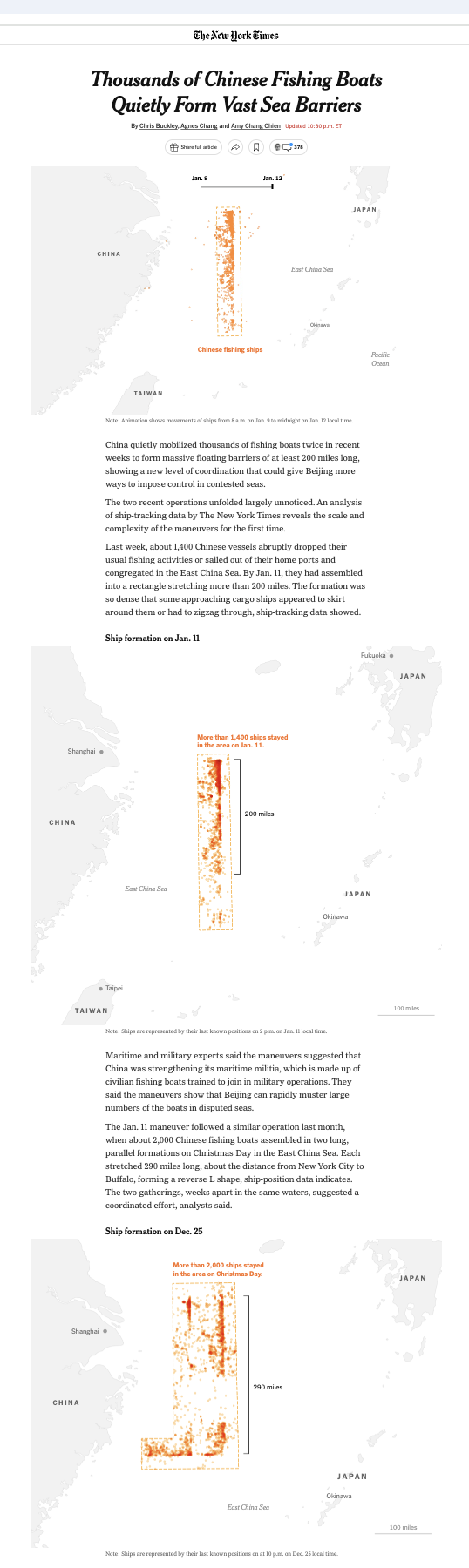
Chris Buckley, Agnes Chang and Amy Chang Chien, “Thousands of Chinese Fishing Boats Quietly Form Vast Sea Barriers,” New York Times, 16 January 2026.
My overall thoughts:
- The vessels’ highly systematic formation cannot be explained by fishing.
- Trawlers would not risk competing for fish or snarling their lines in relatively close quarters.
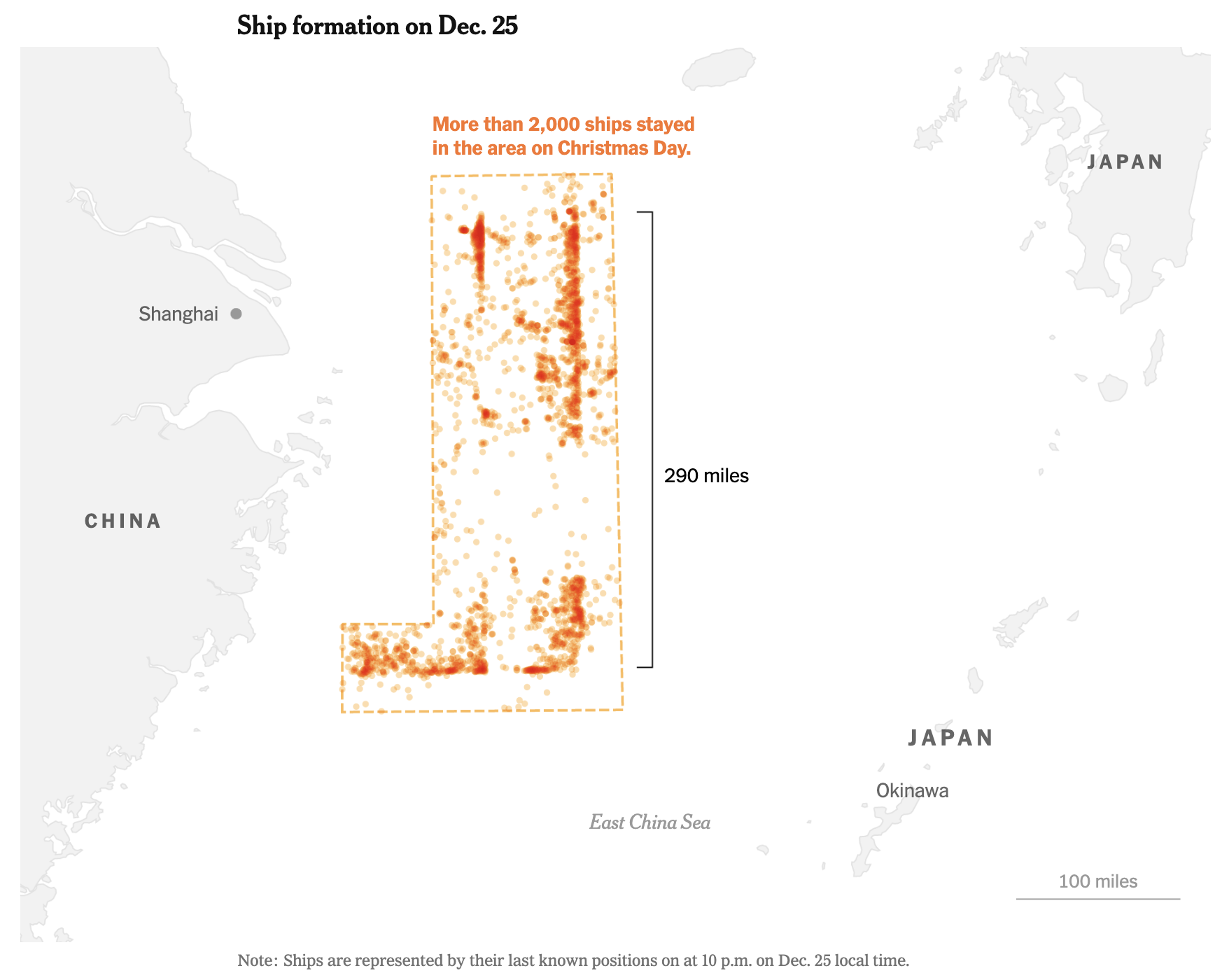
- This blockade-line-type formation seems much more likely to be an at-sea mobilization and exercise of maritime militia forces in the East China Sea.
- It could be an example of signaling opposition to Japan and/or training for East China Sea-related scenarios against Japan and/or Taiwan.
- This offers an important reminder that extensive China maritime militia forces are active not only in the South China Sea but also in the East China Sea.
Possible Taiwan-related implications:
How China under Commander-in-Chief Xi Jinping might adjudicate in real time among different campaign options is a complex question. I think a (*successful*) cross-Strait invasion would be the only way for Beijing to be sure to control Taiwan.
That would be extremely difficult to achieve, however. Among the demanding requirements: a gargantuan amount of cross-Strait force delivery. China has not yet ensured that capability. That’s the overall conclusion of our CMSI volume on “Chinese Amphibious Warfare”—a conclusion I believe still holds true today. See also CMSI Note 14 and CMSI China Maritime Reports 19, 22, and 50.
Nevertheless, with deadly seriousness, China under Xi is rapidly striving to change that equation. And that’s where unconventional lift augmentation comes in. Clearly, China’s world-leading shipbuilding industry could built whatever conventional amphibious platforms might be needed. For some reason, however, Beijing has not done so as yet. Is this lack of conventional construction to date really to avoid appearing “provocative” to regional neighbors, etc.? Anyone who is paying the slightest attention can’t miss seeing China’s massive military buildup—the most dramatic since World War II—as well as China’s large-scale, systematic exercises around Taiwan since 2022.
As U.S. INDOPACOM Commander Admiral Sam Paparo explains, “Beijing’s aggressive maneuvers around Taiwan are not just exercises – they are dress rehearsals for forced unification. The PLA escalated military pressure against Taiwan by 300% in 2024….”
Therefore, to develop sufficient lift for a large-scale amphibious assault, I see China pursuing an unconventional course: not as a temporary placeholder but rather as a consistent approach. As Lonnie Henley argues in CMSI China Maritime Report 21, “the PLA does not regard civilian shipping as a stopgap measure until more PLAN amphibious shipping can be built, but as a central feature of its preferred approach.” Such improvisation draws on the PLA Navy’s operational heritage, as chronicled by Toshi Yoshihara.
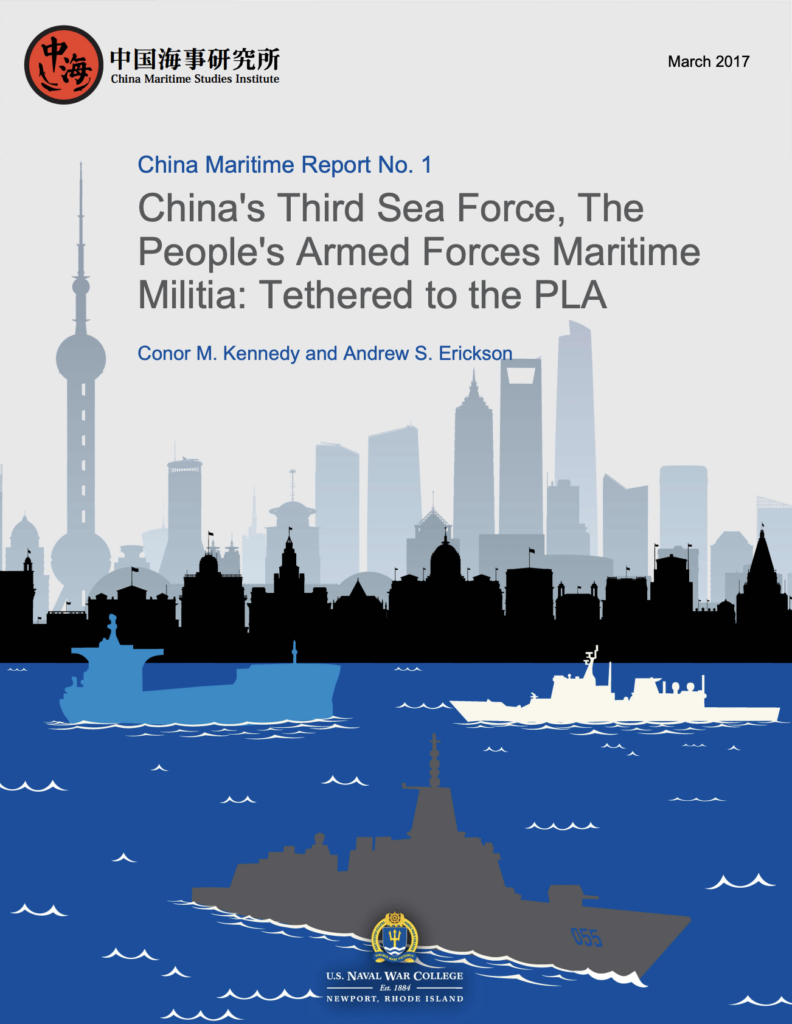
China apparently believes that it can leverage its Maritime Militia—a key component of its Armed Forces—and their dedicated platforms, as well as multifarious “civilian” shipping. This is a vital area that CMSI and its affiliates thus continue to research and publish on extensively. See CMSI Notes 4 and 18, as well as CMSI China Maritime Reports 1, 4, 16, 25, 35, 40, and 46.
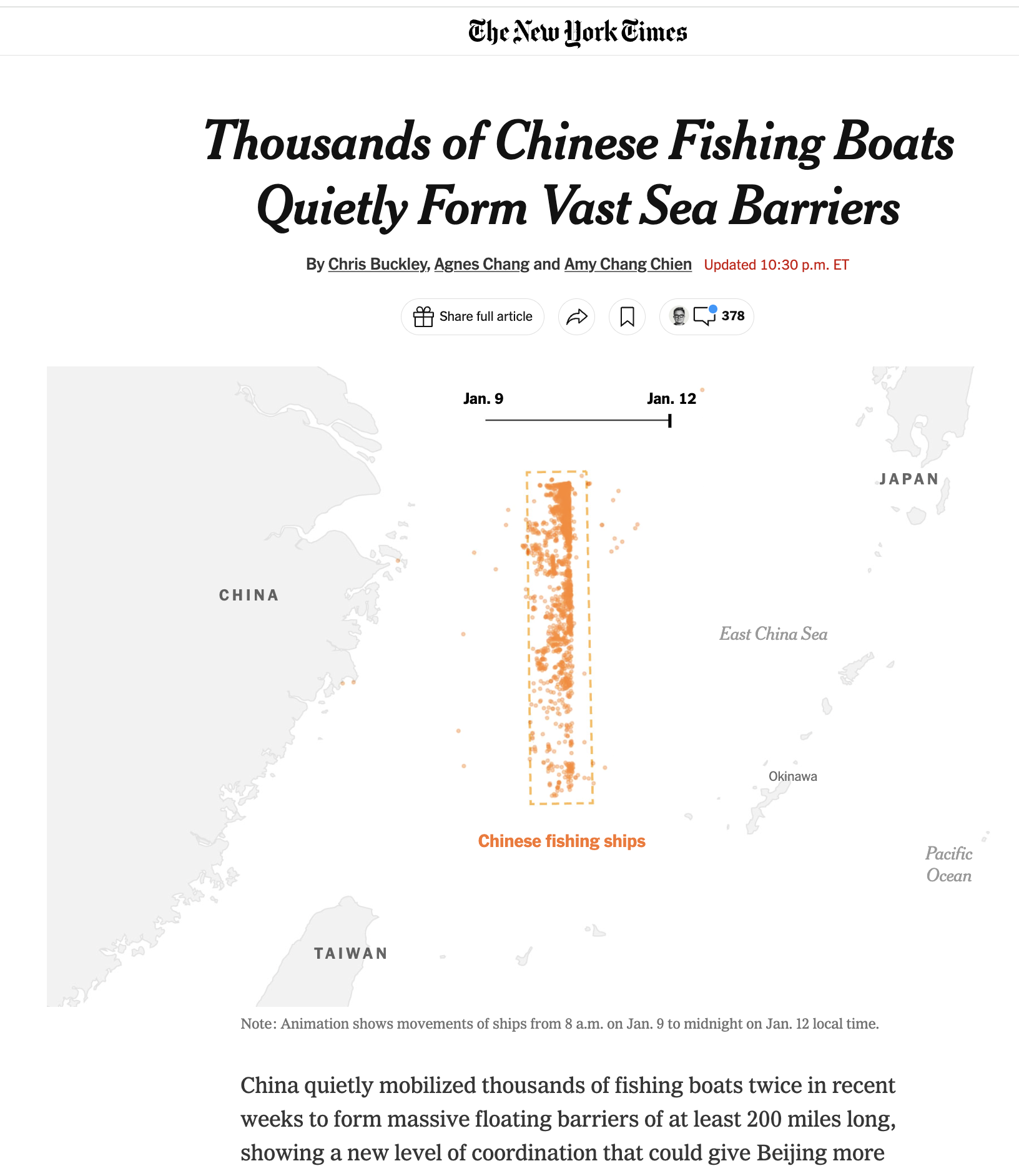
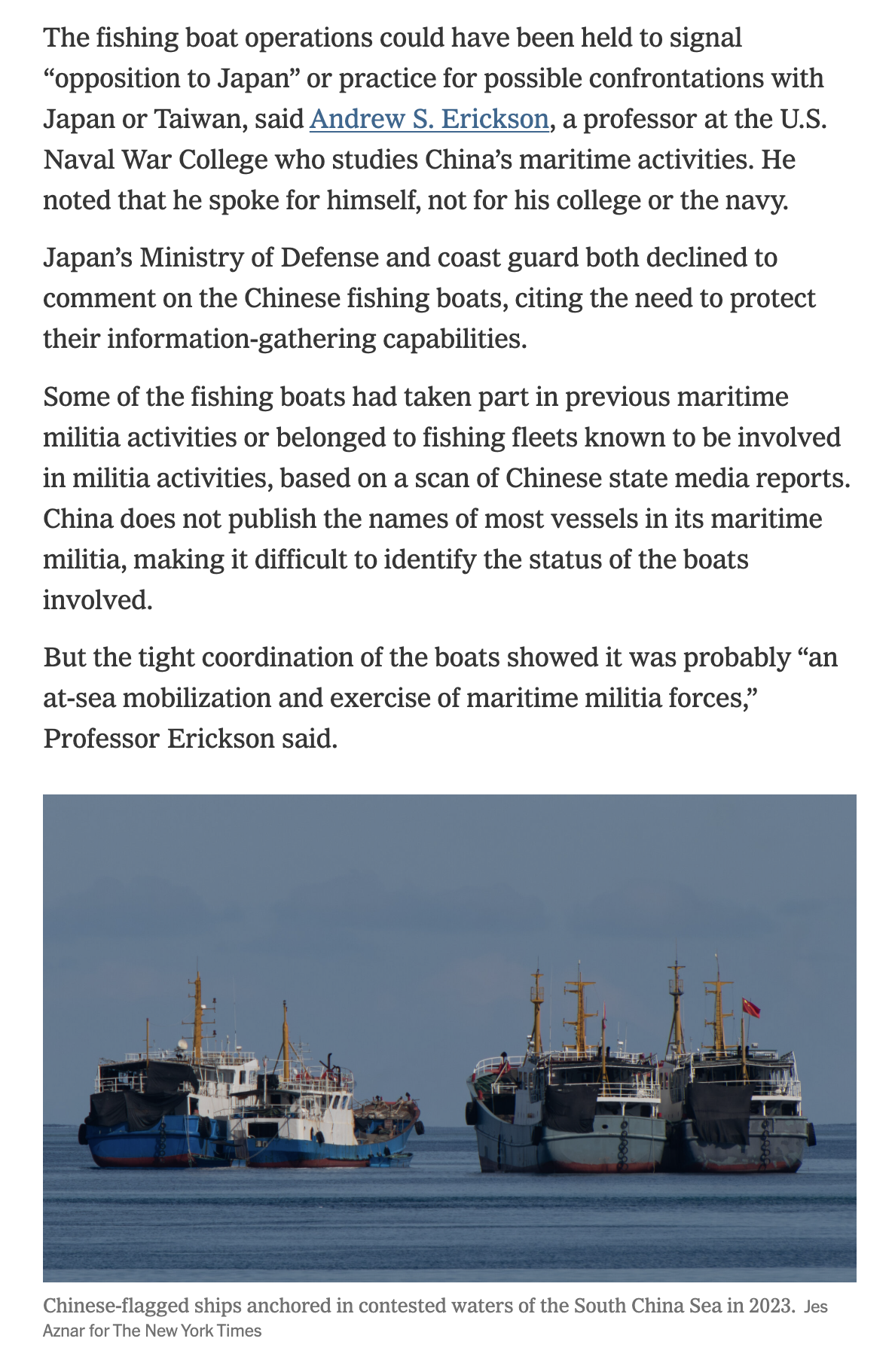
… … … The fishing boat operations could have been held to signal “opposition to Japan” or practice for possible confrontations with Japan or Taiwan, said Andrew S. Erickson, a professor at the U.S. Naval War College who studies China’s maritime activities. He noted that he spoke for himself, not for his college or the navy.
Japan’s Ministry of Defense and coast guard both declined to comment on the Chinese fishing boats, citing the need to protect their information-gathering capabilities.
Some of the fishing boats had taken part in previous maritime militia activities or belonged to fishing fleets known to be involved in militia activities, based on a scan of Chinese state media reports. China does not publish the names of most vessels in its maritime militia, making it difficult to identify the status of the boats involved.
But the tight coordination of the boats showed it was probably “an at-sea mobilization and exercise of maritime militia forces,” Professor Erickson said. … … …