Reflections on Iran: History, Humanity, and Hope
Unfolding events have made me reflect on Iran through both research and personal family history.
My grandfather oversaw Grumman’s F-14 program in Iran in the 1970s. The stories that stayed with him—especially the extraordinary kindness shown by ordinary Iranians during the upheaval of 1979—shaped how I came to understand Iran’s people and culture.
I place those experiences alongside Iran’s rich civilization and technical talent, and contrast them with the political repression and lost potential of 47 years under the disastrously repressive clerical regime and its sectarian straitjacket on Iranian society.
Ultimately, this is about the Iranian people themselves, and my hope that their government can one day truly represent them and reflect their dignity, diverse dynamism, and tremendous promise.
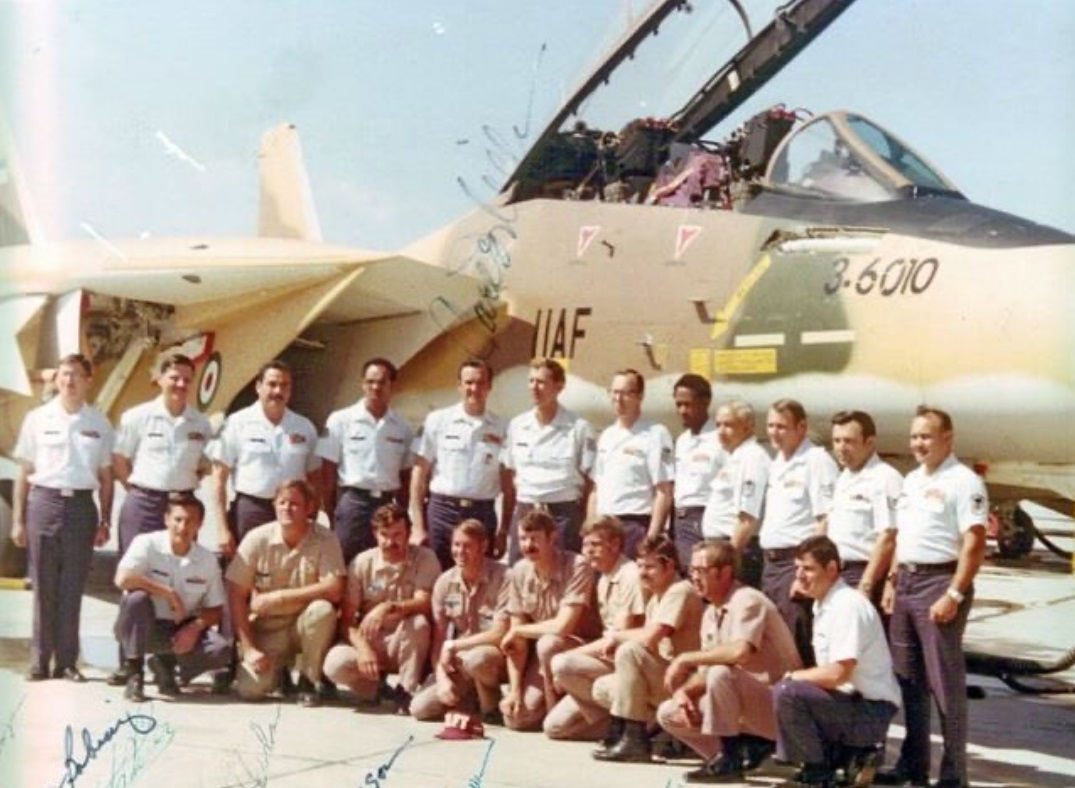
Rare photo of U.S. Personnel and advisors next to an Imperial Iranian Air Force F-14 at Isfahan TAB in the 1970s. From Afshin Dastafshan via Facebook.
Andrew S. Erickson, “Reflections on Iran: History, Humanity, and Hope,” China Analysis from Original Sources 以第一手资料研究中国, 10 January 2026.
In these terrible but hopeful times, my thoughts are with the people of Iran.
Much lies beyond my own expertise, but through research and personal family history I have encountered unmistakable evidence of the depth, sophistication, and humanity of Iranian civilization and society—worth recalling now.
The Persian Empire was one of the earliest great continental empires—and the first on such a scale—to become a sustained maritime power. It remains one of the very few land powers in history to successfully become a sea power on a sustained basis—an extraordinary feat.
During the late Cold War, the Shah of Iran—himself an experienced pilot—sought advanced aircraft to counter high-altitude Soviet incursions that violated Iranian airspace. His efforts intensified after Moscow repeatedly rebuffed his appeals for mutual overflight restraint.
Amid a competitive U.S. selection process, the Shah chose Grumman’s F-14 Tomcat fighter aircraft.
As president of Grumman’s aerospace subsidiary beginning in 1972, and Grumman’s president and chief operating officer starting in 1976, my grandfather Joseph Gavin, Jr. oversaw the contracting and delivery of 79 F-14s to Iran.
To support the program, Grumman sent roughly 2,000 employees and their families to Imperial Iranian Air Force Base Khatami, fifteen miles north of Isfahan. There, a Grumman-U.S. Navy team trained approximately 80 Iranian pilots and 40-50 radar intercept officers. My grandfather personally ensured that all employees and family members received extensive instruction in Persian language and culture as part of a six-month “trans-cultural” program beginning on 20 January 1975. Years later, while reading related materials, I first encountered Iran’s rich heritage and culture myself.
In 1979, just before I was born, my grandfather was preparing to visit his employees in Iran. What followed in the broader sweep of history is well known. Less widely known is the unreserved kindness that ordinary Iranians showed to the guests in their community even as their own lives were thrown into turmoil. Despite having everything to lose, they remained neighbors in the truest sense of the word to foreigners they would never see again.
Local Iranians helped delay the incoming Revolutionary Guards’ focus on the Grumman employees and their families, protecting them long enough for all to reach Tehran’s airport and depart safely aboard aircraft arranged by Grumman. Months later, the personal belongings they had abandoned in haste arrived in Long Island by shipping container, with no valuables missing. My grandfather always credited this humane treatment—and the later return of those effects—to the respect fostered by the cultural training program and reflected in their conduct as guests in Iran.
My grandfather knew key Iranian government and industry leaders of the 1970s and was deeply impressed by their expertise. After 1979, he watched as many oil industry specialists relocated to Houston and communications professionals to Los Angeles, where they went on to make major contributions in their new homes.
Since 1979, Iranian technical talent has produced some of the world’s earliest anti-ship ballistic missiles, but domestic repression and regional warfare have left Iran far short of its potential.
Aggression during the 1981-88 Tanker War proved a disastrous failure.
Iran’s internationally unique possession of two parallel navies—the Islamic Republic of Iran Navy and the Islamic Revolutionary Guard Corps Navy—underscores the abnormal government-military-paramilitary system imposed by its clerical regime today.
Yet the sophisticated promise of Iranian culture has by no means been destroyed. It awaits the chance to flourish anew in unshackled freedom. Analysts of regional and military affairs have long emphasized this enduring Iranian sophistication to me.
Today, more than ever, I see a groundswell of popular determination and a rising tide of resolve. Iran’s current government, which suppresses a diverse and dynamic society within a sectarian straitjacket, does not reflect the will of its people. Forty-seven years of oppression and injustice have only deepened the damage. Iran should—and can—be far better than this.
If someone as distant and tangential as me can witness so much of the goodness inherent in Iranian people, culture, and civilization, I can only imagine what is evident to those truly in the know.
At the end of the day, what matters most are Iranians themselves—and their freedom to live good lives of their own in peace, prosperity, and promise. I hope the people of Iran will soon have a government that truly represents them and is worthy of their rich, highly advanced culture and tremendous positive potential.