CMSI Conference: Probing the People of China’s Navy and Other Maritime Forces
CMSI Conference: Probing the People of China’s Navy and Other Maritime Forces
Dr. Erickson is Professor of Strategy in the U.S. Naval War College’s China Maritime Studies Institute. These are his personal views, based solely on open sources. His research website is www.andrewerickson.com.
By Dr. Andrew S. Erickson
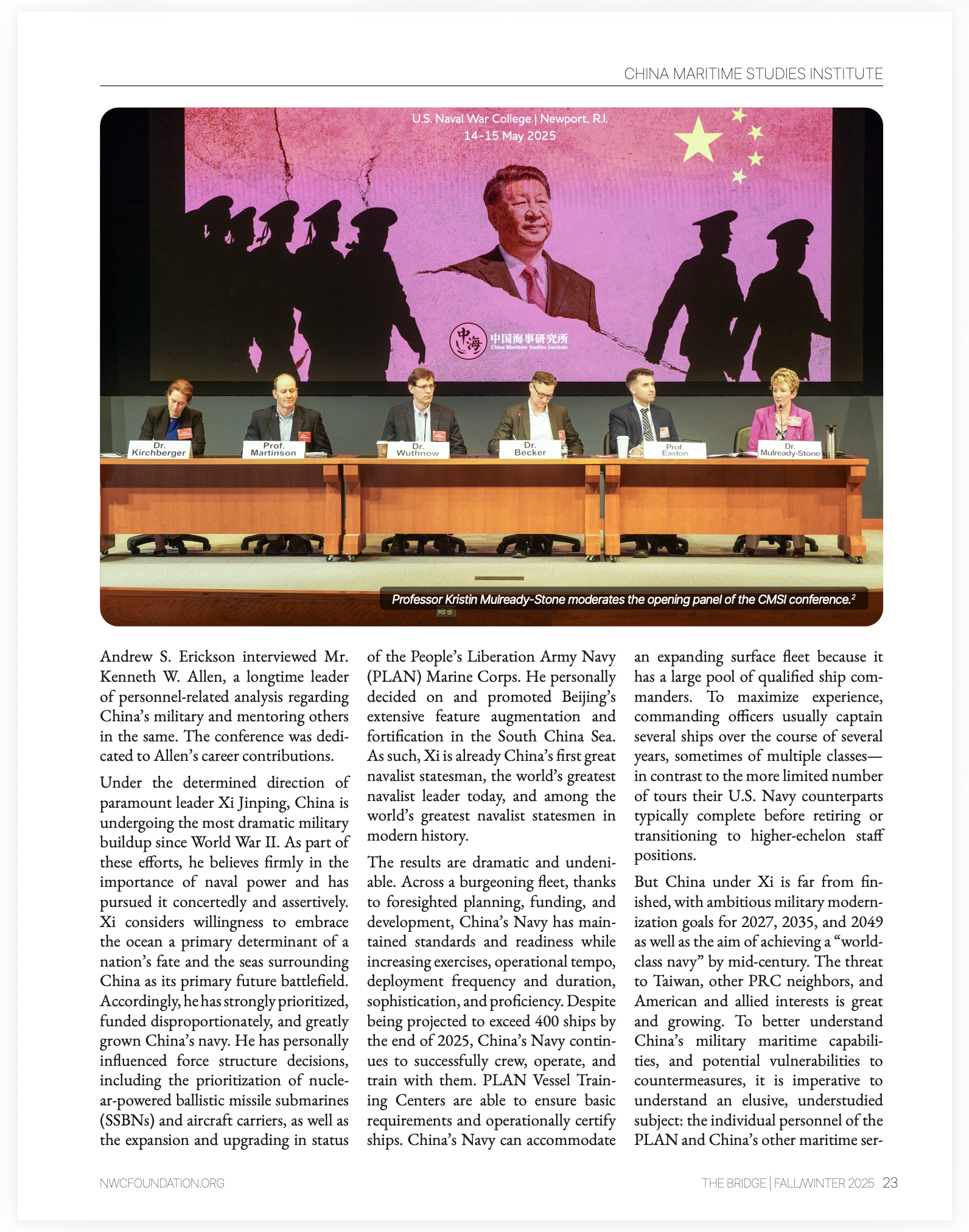
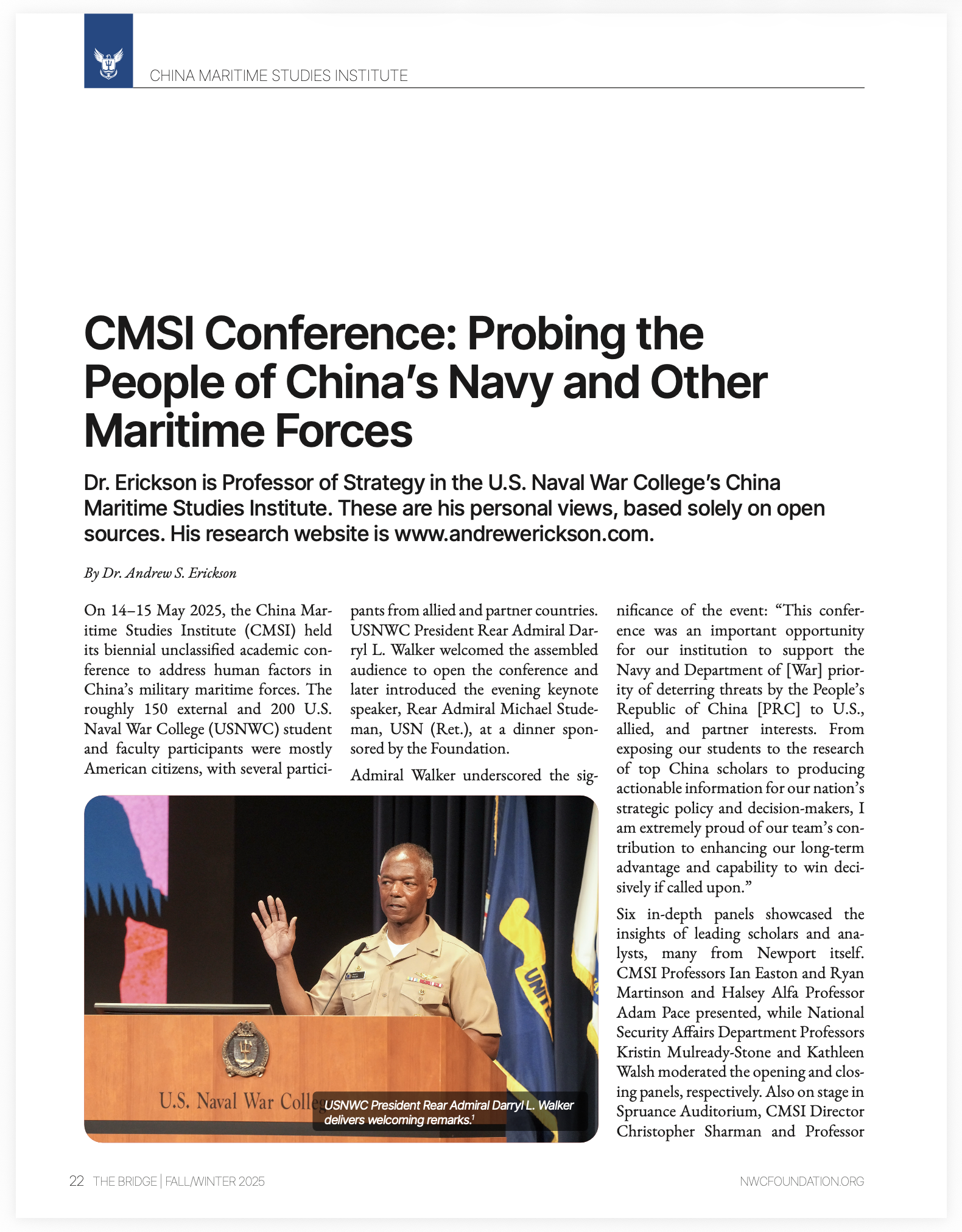
On 14–15 May 2025, the China Maritime Studies Institute (CMSI) held its biennial unclassified academic conference to address human factors in China’s military maritime forces. The roughly 150 external and 200 U.S. Naval War College (USNWC) student and faculty participants were mostly American citizens, with several participants from allied and partner countries. USNWC President Rear Admiral Darryl L. Walker welcomed the assembled audience to open the conference and later introduced the evening keynotespeaker, Rear Admiral Michael Studeman, USN (Ret.), at a dinner sponsored by the Foundation.
Admiral Walker underscored the significance of the event: “This conference was an important opportunity for our institution to support the Navy and Department of [War] priority of deterring threats by the People’s Republic of China [PRC] to U.S., allied, and partner interests. From exposing our students to the research of top China scholars to producing actionable information for our nation’s strategic policy and decision-makers, I am extremely proud of our team’s contribution to enhancing our long-term advantage and capability to win decisively if called upon.”
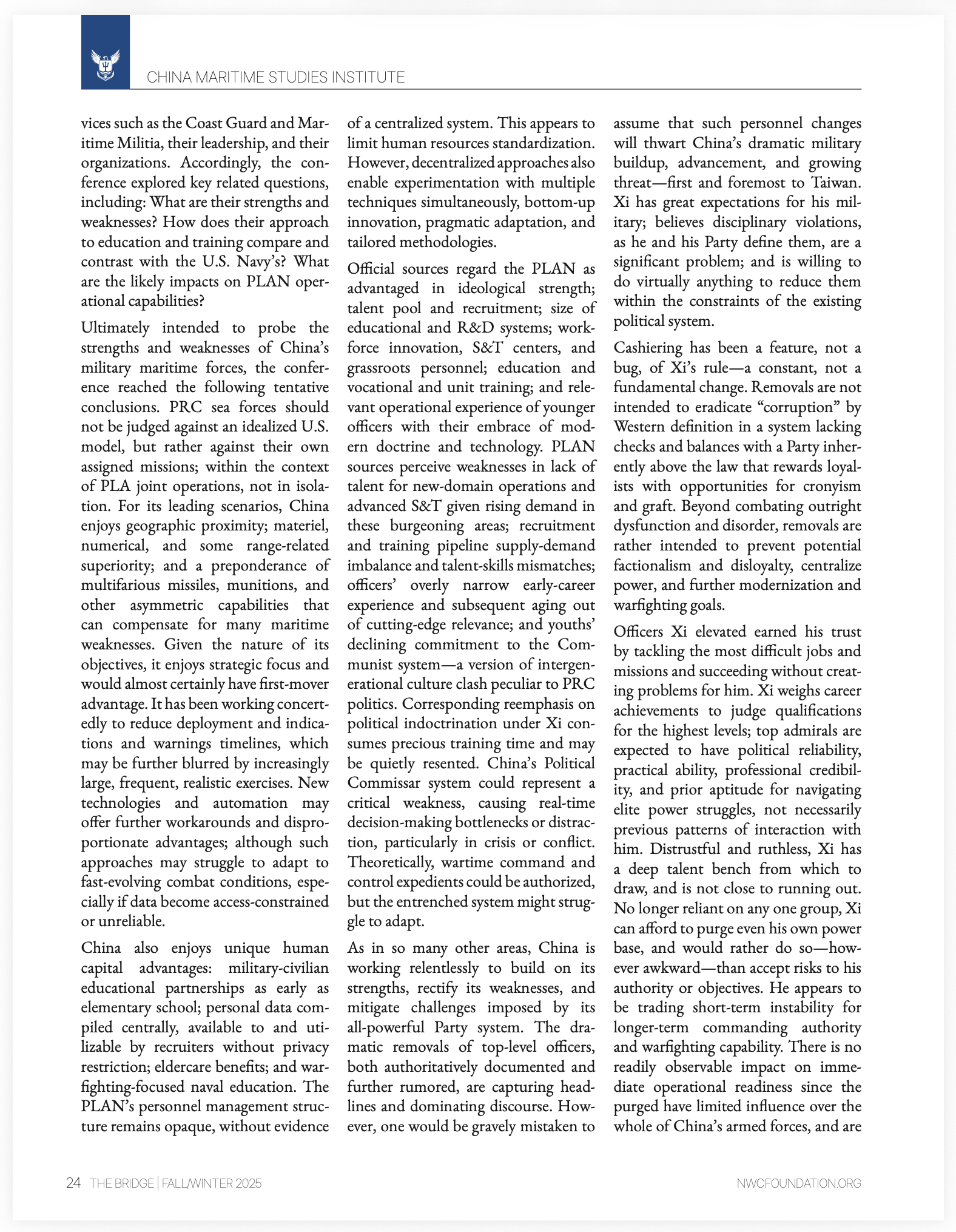
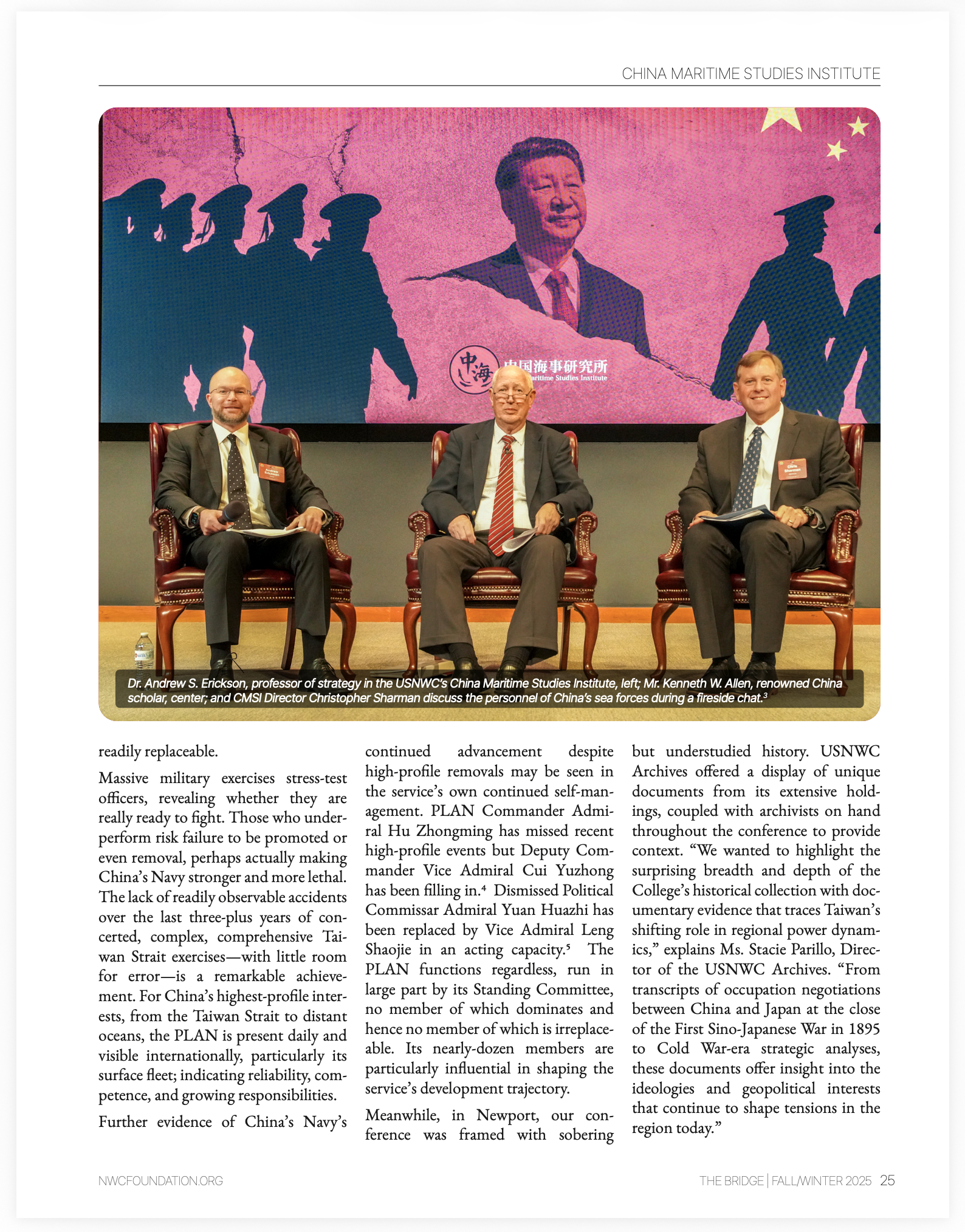
Six in-depth panels showcased the insights of leading scholars and analysts, many from Newport itself. CMSI Professors Ian Easton and Ryan Martinson and Halsey Alfa Professor Adam Pace presented, while National Security Affairs Department Professors Kristin Mulready-Stone and Kathleen Walsh moderated the opening and closing panels, respectively. Also on stage in Spruance Auditorium, CMSI Director Christopher Sharman and Professor Andrew S. Erickson interviewed Mr. Kenneth W. Allen, a longtime leader of personnel-related analysis regarding China’s military and mentoring others in the same. The conference was dedicated to Allen’s career contributions.
Under the determined direction of paramount leader Xi Jinping, China is undergoing the most dramatic military buildup since World War II. As part of these efforts, he believes firmly in the importance of naval power and has pursued it concertedly and assertively. Xi considers willingness to embrace the ocean a primary determinant of a nation’s fate and the seas surrounding China as its primary future battlefield. Accordingly, he has strongly prioritized, funded disproportionately, and greatly grown China’s navy. He has personally influenced force structure decisions, including the prioritization of nuclear-powered ballistic missile submarines (SSBNs) and aircraft carriers, as well as the expansion and upgrading in status of the People’s Liberation Army Navy (PLAN) Marine Corps. He personally decided on and promoted Beijing’s extensive feature augmentation and fortification in the South China Sea. As such, Xi is already China’s first great navalist statesman, the world’s greatest navalist leader today, and among the world’s greatest navalist statesmen in modern history.
The results are dramatic and undeniable. Across a burgeoning fleet, thanks to foresighted planning, funding, and development, China’s Navy has maintained standards and readiness while increasing exercises, operational tempo, deployment frequency and duration, sophistication, and proficiency. Despite being projected to exceed 400 ships by the end of 2025, China’s Navy continues to successfully crew, operate, and train with them. PLAN Vessel Training Centers are able to ensure basic requirements and operationally certify ships. China’s Navy can accommodate an expanding surface fleet because it has a large pool of qualified ship commanders. To maximize experience, commanding officers usually captain several ships over the course of several years, sometimes of multiple classes—in contrast to the more limited number of tours their U.S. Navy counterparts typically complete before retiring or transitioning to higher-echelon staff positions.
But China under Xi is far from finished, with ambitious military modernization goals for 2027, 2035, and 2049 as well as the aim of achieving a “world-class navy” by mid-century. The threat to Taiwan, other PRC neighbors, and American and allied interests is great and growing. To better understand China’s military maritime capabilities, and potential vulnerabilities to countermeasures, it is imperative to understand an elusive, understudied subject: the individual personnel of the PLAN and China’s other maritime services such as the Coast Guard and Maritime Militia, their leadership, and their organizations. Accordingly, the conference explored key related questions, including: What are their strengths and weaknesses? How does their approach to education and training compare and contrast with the U.S. Navy’s? What are the likely impacts on PLAN operational capabilities?
Ultimately intended to probe the strengths and weaknesses of China’s military maritime forces, the conference reached the following tentative conclusions. PRC sea forces should not be judged against an idealized U.S. model, but rather against their own assigned missions; within the context of PLA joint operations, not in isolation. For its leading scenarios, China enjoys geographic proximity; materiel, numerical, and some range-related superiority; and a preponderance of multifarious missiles, munitions, and other asymmetric capabilities that can compensate for many maritime weaknesses. Given the nature of its objectives, it enjoys strategic focus and would almost certainly have first-mover advantage. It has been working concertedly to reduce deployment and indications and warnings timelines, which may be further blurred by increasingly large, frequent, realistic exercises. New technologies and automation may offer further workarounds and disproportionate advantages; although such approaches may struggle to adapt to fast-evolving combat conditions, especially if data become access-constrained or unreliable.
China also enjoys unique human capital advantages: military-civilian educational partnerships as early as elementary school; personal data compiled centrally, available to and utilizable by recruiters without privacy restriction; eldercare benefits; and warfighting-focused naval education. The PLAN’s personnel management structure remains opaque, without evidence of a centralized system. This appears to limit human resources standardization. However, decentralized approaches also enable experimentation with multiple techniques simultaneously, bottom-up innovation, pragmatic adaptation, and tailored methodologies.
Official sources regard the PLAN as advantaged in ideological strength; talent pool and recruitment; size of educational and R&D systems; workforce innovation, S&T centers, and grassroots personnel; education and vocational and unit training; and relevant operational experience of younger officers with their embrace of modern doctrine and technology. PLAN sources perceive weaknesses in lack of talent for new-domain operations and advanced S&T given rising demand in these burgeoning areas; recruitment and training pipeline supply-demand imbalance and talent-skills mismatches; officers’ overly narrow early-career experience and subsequent aging out of cutting-edge relevance; and youths’ declining commitment to the Communist system—a version of intergenerational culture clash peculiar to PRC politics. Corresponding reemphasis on political indoctrination under Xi consumes precious training time and may be quietly resented. China’s Political Commissar system could represent a critical weakness, causing real-time decision-making bottlenecks or distraction, particularly in crisis or conflict. Theoretically, wartime command and control expedients could be authorized, but the entrenched system might struggle to adapt.
As in so many other areas, China is working relentlessly to build on its strengths, rectify its weaknesses, and mitigate challenges imposed by its all-powerful Party system. The dramatic removals of top-level officers, both authoritatively documented and further rumored, are capturing headlines and dominating discourse. However, one would be gravely mistaken to assume that such personnel changes will thwart China’s dramatic military buildup, advancement, and growing threat—first and foremost to Taiwan. Xi has great expectations for his military; believes disciplinary violations, as he and his Party define them, are a significant problem; and is willing to do virtually anything to reduce them within the constraints of the existing political system.
Cashiering has been a feature, not a bug, of Xi’s rule—a constant, not a fundamental change. Removals are not intended to eradicate “corruption” by Western definition in a system lacking checks and balances with a Party inherently above the law that rewards loyalists with opportunities for cronyism and graft. Beyond combating outright dysfunction and disorder, removals are rather intended to prevent potential factionalism and disloyalty, centralize power, and further modernization and warfighting goals.
Officers Xi elevated earned his trust by tackling the most difficult jobs and missions and succeeding without creating problems for him. Xi weighs career achievements to judge qualifications for the highest levels; top admirals are expected to have political reliability, practical ability, professional credibility, and prior aptitude for navigating elite power struggles, not necessarily previous patterns of interaction with him. Distrustful and ruthless, Xi has a deep talent bench from which to draw, and is not close to running out. No longer reliant on any one group, Xi can afford to purge even his own power base, and would rather do so—however awkward—than accept risks to his authority or objectives. He appears to be trading short-term instability for longer-term commanding authority and warfighting capability. There is no readily observable impact on immediate operational readiness since the purged have limited influence over the whole of China’s armed forces, and are readily replaceable.
Massive military exercises stress-test officers, revealing whether they are really ready to fight. Those who underperform risk failure to be promoted or even removal, perhaps actually making China’s Navy stronger and more lethal. The lack of readily observable accidents over the last three-plus years of concerted, complex, comprehensive Taiwan Strait exercises—with little room for error—is a remarkable achievement. For China’s highest-profile interests, from the Taiwan Strait to distant oceans, the PLAN is present daily and visible internationally, particularly its surface fleet; indicating reliability, competence, and growing responsibilities.
Further evidence of China’s Navy’s continued advancement despite high-profile removals may be seen in the service’s own continued self-management. PLAN Commander Admiral Hu Zhongming has missed recent high-profile events but Deputy Commander Vice Admiral Cui Yuzhong has been filling in.4 Dismissed Political Commissar Admiral Yuan Huazhi has been replaced by Vice Admiral Leng Shaojie in an acting capacity.5 The PLAN functions regardless, run in large part by its Standing Committee, no member of which dominates and hence no member of which is irreplaceable. Its nearly-dozen members are particularly influential in shaping the service’s development trajectory.
Meanwhile, in Newport, our conference was framed with sobering but understudied history. USNWC Archives offered a display of unique documents from its extensive holdings, coupled with archivists on hand throughout the conference to provide context. “We wanted to highlight the surprising breadth and depth of the College’s historical collection with documentary evidence that traces Taiwan’s shifting role in regional power dynamics,”explains Ms. Stacie Parillo, Director of the USNWC Archives. “From transcripts of occupation negotiations between China and Japan at the close of the First Sino-Japanese War in 1895 to Cold War-era strategic analyses, these documents offer insight into the ideologies and geopolitical interests that continue to shape tensions in the region today.”
As recounted by USNWC Professor Paul Smith, President Dwight D. Eisenhower turned the tide in resolving the Second Taiwan Strait Crisis (23 August–2 December 1958) from just outside his special office—on the side porch of Navy Building 10, today the USNWC Museum, located just several hundred yards from the conference venue and display outside it.
On what had begun as one of his beloved Newport vacations, Eisenhower summoned Secretary of State John Foster Dulles. Together with Dulles’s special assistant Joseph Greene; and Ike’s principal military aide Brigadier General Andrew Goodpaster, naval aide Captain Evan Peter Aurand, and press secretary James Hagerty; they conferred on 4 September 1958 from 10:29 a.m. to 12:10 p.m. in Ike’s special office. Eisenhower and Dulles then emerged to address newsmen gathered on what is now the driveway to the USNWC President’s residence. Later that day, Dulles issued the Newport Statement, articulating an eight-point American response to PRC aggression in the Taiwan Strait, including emphasis that Washington was “bound by treaty” to help to defend Taiwan—the main island and the Pescadores (Penghu) Islands—from “armed attack,” while the Formosa Resolution of 1955 granted the President additional powers to protect “related positions,” including then-embattled Quemoy and Matsu.
Thanks in part to the Eisenhower Administration’s sophisticated display of resolve, the Second Taiwan Strait Crisis subsided as Communist forces settled for shelling Nationalist convoys on odd-numbered days of the month, while allowing unhindered resupply of offshore island garrisons on even-numbered days. For the next twenty-one years the U.S. Navy patrolled the Taiwan Strait without major incident.
“What we have here is a remarkable confluence of events,” explains Professor Smith. “The Newport Statement could be characterized as the inflection point of the 1958 crisis because it clearly articulated how the Eisenhower administration would respond going forward. On top of that, the 1958 crisis itself was arguably the inflection point of the Cold War because it solidified the breakup of Sino-Soviet relations.” Smith concludes that the Newport meeting between Eisenhower and Dulles was, in essence, the inflection point within the inflection point. “The significance of what happened here—just fifty yards or so from my own office—is absolutely amazing.”
Ike and Dulles’s successors face a far more powerful China today, conducting massive exercises practicing critical components of potential operations against Taiwan. It has thus never been more important to study the people in China’s military maritime forces, particularly their strengths and vulnerabilities should Beijing mobilize them for war. CMSI’s conference offers vital insights, but continued effort is needed against this urgent threat.
“Our location at USNWC, at the center of the College’s applied research efforts, makes CMSI uniquely suited to weave together a rich and diverse tapestry of academics from the public and private sector, warfighters, policy leaders, intelligence analysts, and private industry representatives,” concludes Director Sharman. “Our conference fostered collaboration across this community of interest regarding the nation’s most critical pacing threat. Through this event, CMSI educated tomorrow’s leaders, informed today’s decision-makers, and fostered engagement with allies and partners. The Foundation’s generous support to CMSI enhances both the quality and reach of our scholarship and helps to cement CMSI’s biennial conferences as one of the College’s premier gold-standard events.” CMSI’s research is available at www.usnwc.edu/cmsi.