China Is Rehearsing More Than Amphibious Landings
Jason Wang, Marvin Bernardo, Pei-Jhen Wu, and Andrew S. Erickson, “China Is Rehearsing More Than Amphibious Landings,” Center for International Maritime Security (CIMSEC), 15 June 2026.
For years, the public debate over a possible Chinese Communist invasion of Taiwan has focused on a single question: Does the People’s Liberation Army have sufficient amphibious lift to move an invasion force across the Taiwan Strait? That question remains important. However, recent Chinese exercises suggest that the People’s Liberation Army is not simply trying to solve the problem of getting forces onto a Taiwanese beach. It is rehearsing how to move, sustain, and conceal a large amphibious campaign across multiple locations.
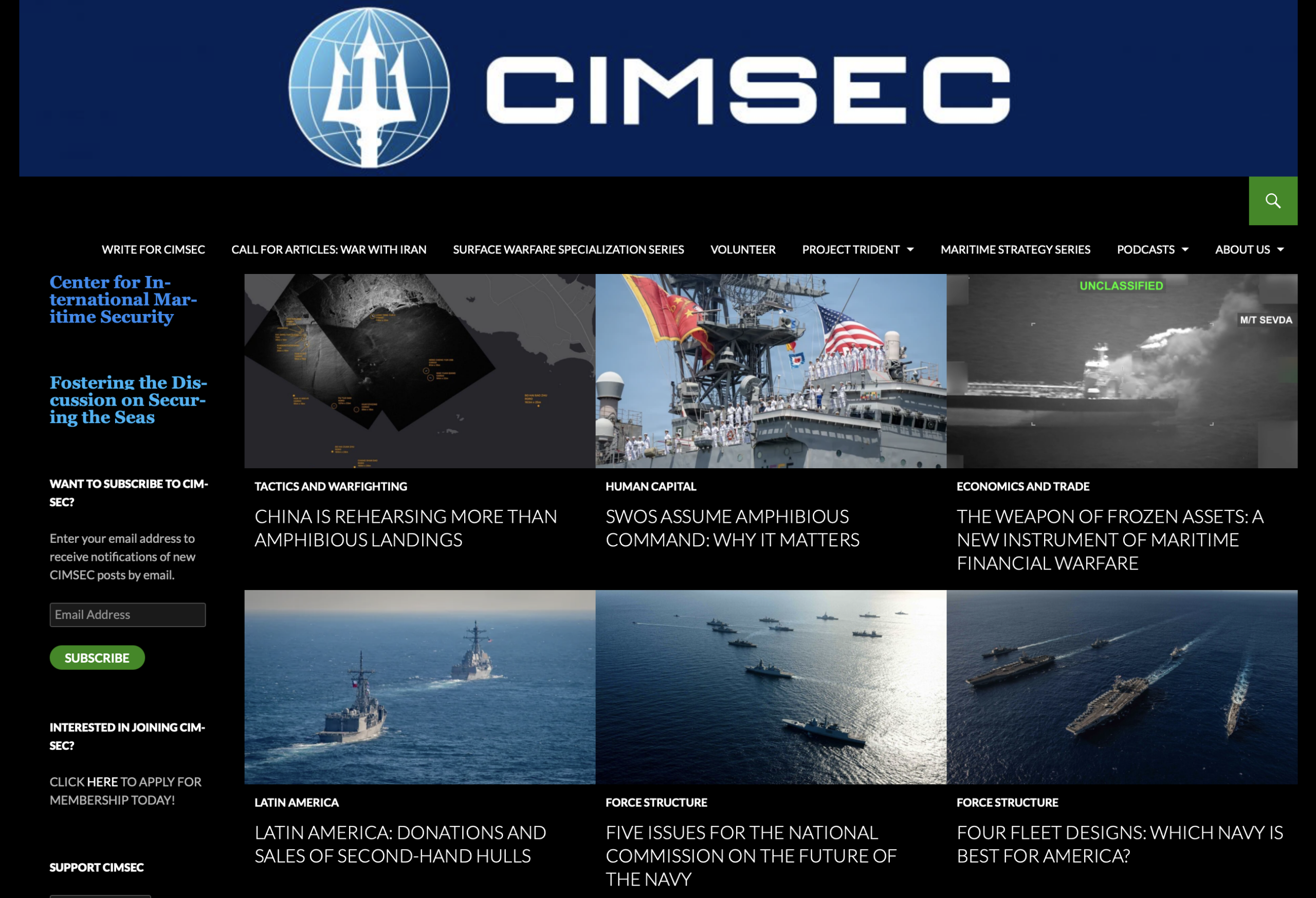
In August 2025, the People’s Liberation Army conducted a large-scale amphibious capstone exercise along China’s southeastern coastline. Commercial satellite imagery and Automatic Identification System data indicates the exercise consolidated several previously separate training exercises into a more coherent campaign simulation. The operation included synchronized amphibious activity across multiple geographic locations, direct-to-shore landing by civilian landing craft tank vessels, use of a floating causeway, offshore deployment of amphibious fighting vehicles from roll-on/roll-off ferries, port offloading, and operations around aquaculture structures and beach obstacles.
The most important lesson is not that China has solved the Taiwan invasion problem. It has not… yet. Amphibious operations remain among the most difficult military operations to conduct, and the 2025 exercise still occurred under favorable sea and weather conditions. The People’s Liberation Army is making visible progress in rehearsing the operational mechanics of a Taiwan-relevant amphibious campaign. Observers should therefore pay less attention to whether any single exercise proves invasion readiness and more attention to what each exercise reveals about evolving Chinese assumptions, logistics concepts, geographic options, and campaign design.
From Lift Gap to Civil-Military Logistics
Much of the debate over China’s amphibious capability centers on the People’s Liberation Army Navy’s shortage of dedicated gray-hull amphibious ships. But the People’s Liberation Army is actively experimenting with and integrating civilian maritime assets into military logistics to solve this limitation for a range of geographic locations. China’s large commercial fleet can at-scale augment the People’s Liberation Army military lift with roll-on/roll-off ferries, deck cargo ships, landing craft tanks, and other vessels.
The 2025 exercise shows that these civilian vessels are no longer peripheral. They are part of the operational concept. During the August capstone exercise, the People’s Liberation Army used multiple categories of dual-use vessels. Civilian roll-on/roll-off ferries supported offshore deployment and recovery of amphibious fighting vehicles. Landing craft tank vessels conducted direct-to-beach offloading. Other civilian vessels worked in concert with military hovercraft to support floating causeway operations. This mix gives the People’s Liberation Army more than additional capacity. It gives Chinese leadership with low-observable options.
Dedicated military amphibious ships are scarce and highly visible. Civilian vessels tasked with military equipment are a different story. In a crisis, their mobilization could complicate indications and warnings. A buildup distributed across multiple smaller commercial ports would be harder to distinguish from routine maritime activity. Invariably, this increases the monitoring cost burden on Taiwan, the United States, and regional partners. The People’s Liberation Army appears to be experimenting with various solutions to this problem: how to generate large-scale lift while minimizing unmistakable military signatures.
A More Complex Campaign Simulation
The 2025 capstone exercise unfolded in two broad phases. The first phase took place around Honghai Bay near Shanwei. There, the People’s Liberation Army practiced several methods of moving vehicles and equipment ashore: direct-to-port unloading, the use of a floating causeway, direct beach landings by shallow-draft landing craft tanks, and probable offshore deployment of amphibious fighting vehicles from a roll-on/roll-off ferry.
The second phase was more revealing. After the first phase, vessels dispersed northward to separate locations along the Fujian coast, including Hougang Bay, Qianhu Bay, and Houcai Bay. At these sites, roll-on/roll-off ferries deployed and recovered amphibious vehicles across geographically separated areas. The exercise thus simulated not only landing at a single beach but coordinating activity across multiple axes. This is a significant evolution. In previous years, People’s Liberation Army amphibious exercises often demonstrated discrete pieces of the sustainment problem: ferry integration, floating causeways, or offshore vehicle deployment. The 2025 exercise brought these pieces together, suggesting a shift from technical experimentation toward operational integration.
The People’s Liberation Army also appears to have rehearsed different solutions for different landing environments. At Honghai Bay, landing craft tanks conducted direct-to-shore landings. At the northern sites, roll-on/roll-off ferries supported amphibious vehicle activity in waters with heavier aquaculture obstacles. This variation suggests the People’s Liberation Army is developing a menu of approaches tailored to different beaches, ports, offshore distances, and obstacle environments.
The Geography Matters
The exercise’s geography is as important as the range of platforms used. Stretching roughly 360 kilometers from the southernmost to northernmost locations, the distance is comparable to Taiwan’s western coastline from Taipei to Kaohsiung. While the exercise locations were not perfect analogues for specific invasion locations on Taiwan, the spacing, orientation, and concentration of activity opposite Taiwan suggest more than generic amphibious training. This matters because militaries train not only tasks, but also campaign geometry. Distance, sequencing, timing, and logistics routes are operational variables. If the People’s Liberation Army practices across distances that approximate Taiwan’s western coastline, it may be testing how to coordinate a distributed amphibious campaign across a Taiwan-relevant battlespace. However, we must caution against direct geographic comparison or expectation of replication of Taiwan’s coastal defense at this stage of development. The insight derived from these exercises is a growing sophistication in the logistical integration of civilian vessels in amphibious lift capacity that is now being rehearsed in a similar geographical scope as its possible target.
Navigating Obstacles Are Becoming Part of the Training
Another important development includes environmental and tactical obstacles. In previous exercises, personnel often removed nearshore aquaculture rafts before amphibious vehicle exercises. In 2025, People’s Liberation Army vehicles appeared to maneuver through or around aquaculture structures at multiple locations. Taiwan’s western coastline features dense aquaculture zones, mudflats, and other features that could complicate amphibious operations. Civilian maritime structures may not be military defenses, but they can still obstruct movement, create navigational hazards disabling vessels even before they reach the beachhead. The People’s Liberation Army also trained near shoreline anti-landing barriers and apparent beach obstacles. All of these features increase realism by forcing amphibious units to deal with cluttered, constrained, and defended littoral environments. Their inclusion suggests the People’s Liberation Army is moving beyond idealized landings toward more realistic invasion conditions.
Even so, there are limits. The exercise took place under relatively calm sea conditions, with ferries remaining offshore while deploying amphibious vehicles in a controlled environment. To date, the People’s Liberation Army has not demonstrated the ability to conduct comparable operations under contested air and maritime conditions. Nevertheless, the exercise still reflects moving from basic training towards integration of elements into a single simulated logistics operation. A logical next step would be more complex scenarios conducted under contested conditions. However, in peacetime training, there are practical limits to how far such exercises are likely to go: commanders would be unlikely to risk personnel and equipment in severe weather or rough sea states merely to replicate the most challenging conditions for a Taiwan Strait crossing. As a result, any near-term exercises are likely to show greater operational complexity, but only within relatively controlled environmental conditions.
What Analysts Should Watch For in 2026
Analysts should understand the 2025 capstone exercise as part of a broader People’s Liberation Army effort to improve realistic combat training, joint command, and civil-military logistics. It does not prove that China can successfully invade Taiwan. But it does show that the People’s Liberation Army’s systematic experimentation working through the practical challenges such a future operation poses.
Observers should scrutinize the next capstone exercise for five indicators. First, does the People’s Liberation Army deploy a wider range of vessels, locations, and dispersion techniques across a wider range of locations? Does the spacing continue to resemble the geography of Taiwan, Japan, or the Philippines? Second, analysts should track civilian roll-on/roll-off ferries, landing barges (a.k.a. Shuiqiaos), and landing craft tanks appear in more complex sealift combinations. Third, they should examine the integrated use of multiple equipment deployment methods by both sea and air. In particular, whether they incorporate heavy airlift or air cavalry insertions at or nearby locations. Fourth, monitor whether future exercises occur under more difficult sea or weather conditions. Finally, they should watch for more deliberate efforts to operate around sophisticated anti-landing techniques beyond aquaculture fields, beach obstacles, and port-denial conditions that include simulated precision-strike capabilities of the Taiwanese.
The point is not to predict an invasion date from an exercise. It is to identify what the People’s Liberation Army is prioritizing, practicing and most importantly, what operational assumptions possibly underlie its campaign design. China’s August 2025 exercise suggests that the People’s Liberation Army is no longer merely demonstrating amphibious capacity in isolated drills. It is rehearsing how civilian lift, military landing forces, offshore deployment, port access, floating infrastructure, and dispersed command and control might fit together in a First Island Chain-relevant campaign. Taiwan is merely one objective in China’s intention to assert control over the Indo-Pacific. That should sharpen the focus of allied intelligence, planning, and denial strategies.
The debate over China’s amphibious lift gap is not obsolete. But it should be reframed. The key question is no longer simply whether China has enough ships. It is whether the People’s Liberation Army can coordinate and sustain its warfighters using a unique combination of military and civilian assets, quickly enough, with minimum signature across enough locations before Taiwan and its partners can disrupt it.
Taiwan and the countries within the First Island Chain must continue investing in traditional and asymmetric capabilities that deter the People’s Liberation Army. Traditional capabilities of course include coastal defense missiles, mines, mobile artillery and drone swarms. However, Taiwan and First Island Chain countries must look beyond traditional kinetic solutions, such as the development of intelligence capabilities that can scale to identify troops and materiel mass at civilian ports. Special attention should be given to capabilities that can identify and disrupt temporary logistic nodes, i.e. smaller civilian ports that can be easily accessed using dual use vessels. Defense planning to address China’s irregular warfare must treat China’s civilian maritime sector as part of the wider strategic problem. This does not mean that every Chinese civilian vessel is a military asset, but certain classes of vessels, companies, ports, and movement patterns should be integrated into surveillance and defense planning. Exposing China’s irregular warfare tactics, techniques, procedures, can create the radical transparency that will asymmetrically complicate PLA war planning and counter CCP narratives.
Disclaimer
This article distills key insights from a detailed study: Jason Wang, Marvin Hamor Bernardo, Pei-Jhen Wu, and Andrew S. Erickson, Everything Everywhere All at Once: The Growing Complexity of PLA Amphibious Exercises, China Maritime Report #52 (Newport, RI: Naval War College China Maritime Studies Institute, 22 April 2026), https://digital-commons.usnwc.edu/cmsi-maritime-reports/52/. The views expressed here, based solely on open-source research, are those of the authors alone and do not represent those of any organization with which they are affiliated.
Jason Wang is a national security researcher and COO of ingeniSPACE, a Silicon Valley geo-intelligence analytics house.
Marvin Hamor Bernardo is a PhD candidate at the National Chengchi University, Taiwan, and serves as a maritime domain analyst at ingeniSPACE.
Pei-Jhen Wu is a national security researcher and imagery analyst at ingeniSPACE.
Andrew S. Erickson, Ph.D. is Professor of Strategy at the Naval War College’s China Maritime Studies Institute and a Visiting Scholar at Harvard University’s Asia Center.
Featured Image: Composite of Honghai Bay on 23 August 2025 at 1004 CST. (ingeniSPACE composite)