China Maritime Report #54—“Chairman Xi’s Navy”
From Xi to the Sea! China’s Paramount Leader is a Navy Lobby of One!
Ryan D. Martinson, Chairman Xi’s Navy, China Maritime Report 54 (Newport, RI: Naval War College China Maritime Studies Institute, 2 June 2026).
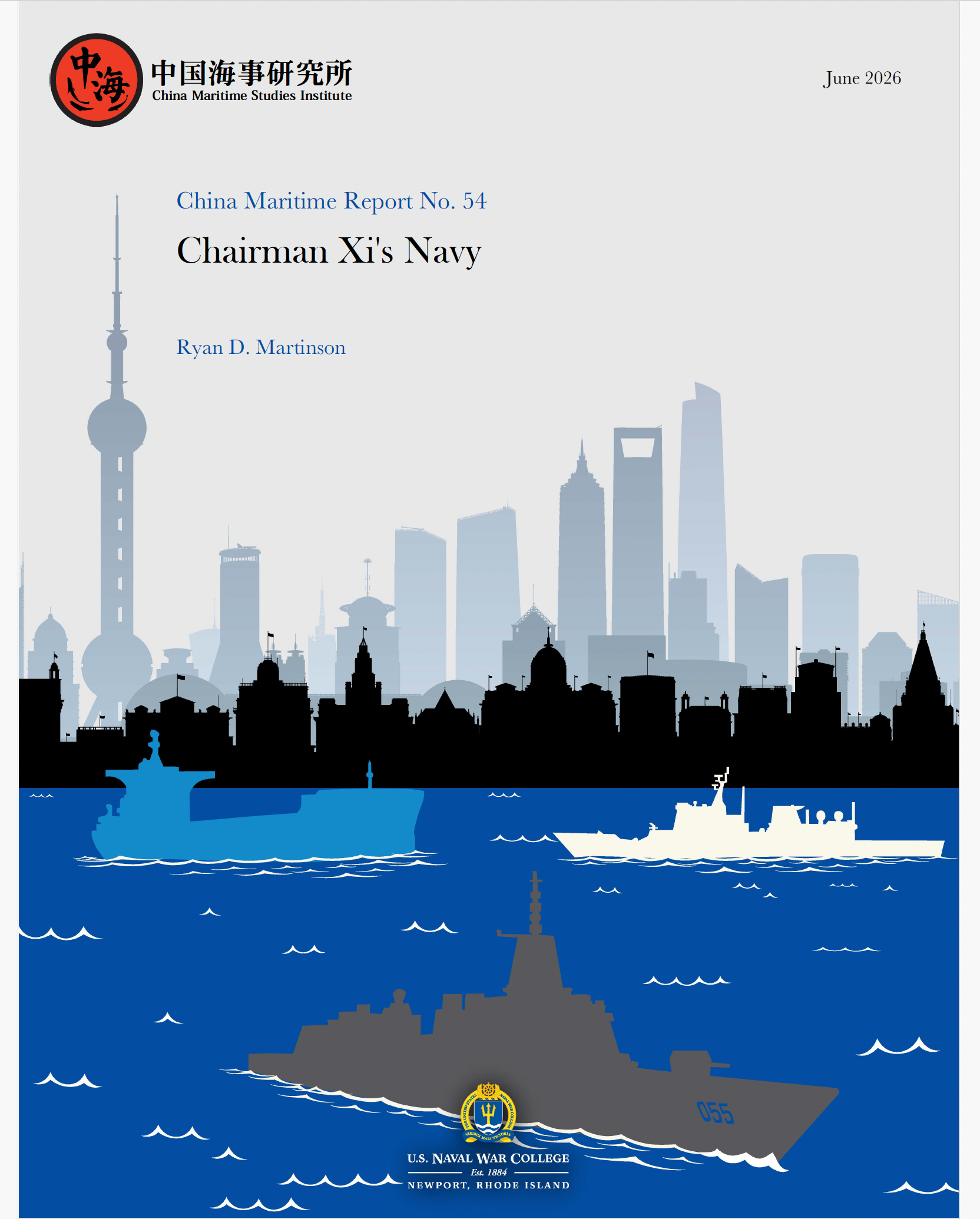
CLICK HERE TO DOWNLOAD A CACHED COPY.
From CMSI Director Christopher Sharman:
China Navy Watchers: How much of China’s Navy (the PLAN’s) rise can be traced directly to Xi Jinping?
In China Maritime Report No. 54, “Chairman Xi’s Navy,” CMSI’s own Professor Ryan Martinson tackles this fundamental question.
Drawing on authoritative Chinese sources, his report argues that Xi has been far more than a passive observer of China’s naval rise—he has been one of its principal architects.
Professor Martinson argues Xi has been a driving force behind the PLAN’s transformation from a regional force into a navy capable of projecting power into the far seas.
The report further contends that Xi is the PRC’s first true “navalist” leader, whose deeply held beliefs about maritime power have directly influenced the PLAN’s modernization, expansion, and employment.
Drawing on authoritative Chinese sources, this CMR details Xi’s personal involvement in key decisions that have reshaped PRC naval power—including military reforms that elevated the PLAN’s status within the PLA, investments in aircraft carriers and nuclear submarine forces, the establishment of China’s first overseas military base, expansion of the PLAN Marine Corps, and efforts to strengthen China’s position in disputed maritime regions.
For naval professionals, policymakers, and analysts seeking to understand the future trajectory of PRC military maritime power, Chairman Xi’s Navy offers a new perspective on the leader whose vision, priorities, and decisions have fundamentally shaped the PLAN’s modernization, missions, and strategic direction.
A must read for those who want to better understand Xi’s vision for the PLAN.
Main Findings
- Xi Jinping has played a critical role in the Chinese Navy’s rapid transformation into a large, technologically advanced sea service capable of conducting an expanding catalog of maritime operations, from the littorals of the People’s Republic of China (PRC) to the Atlantic Ocean.
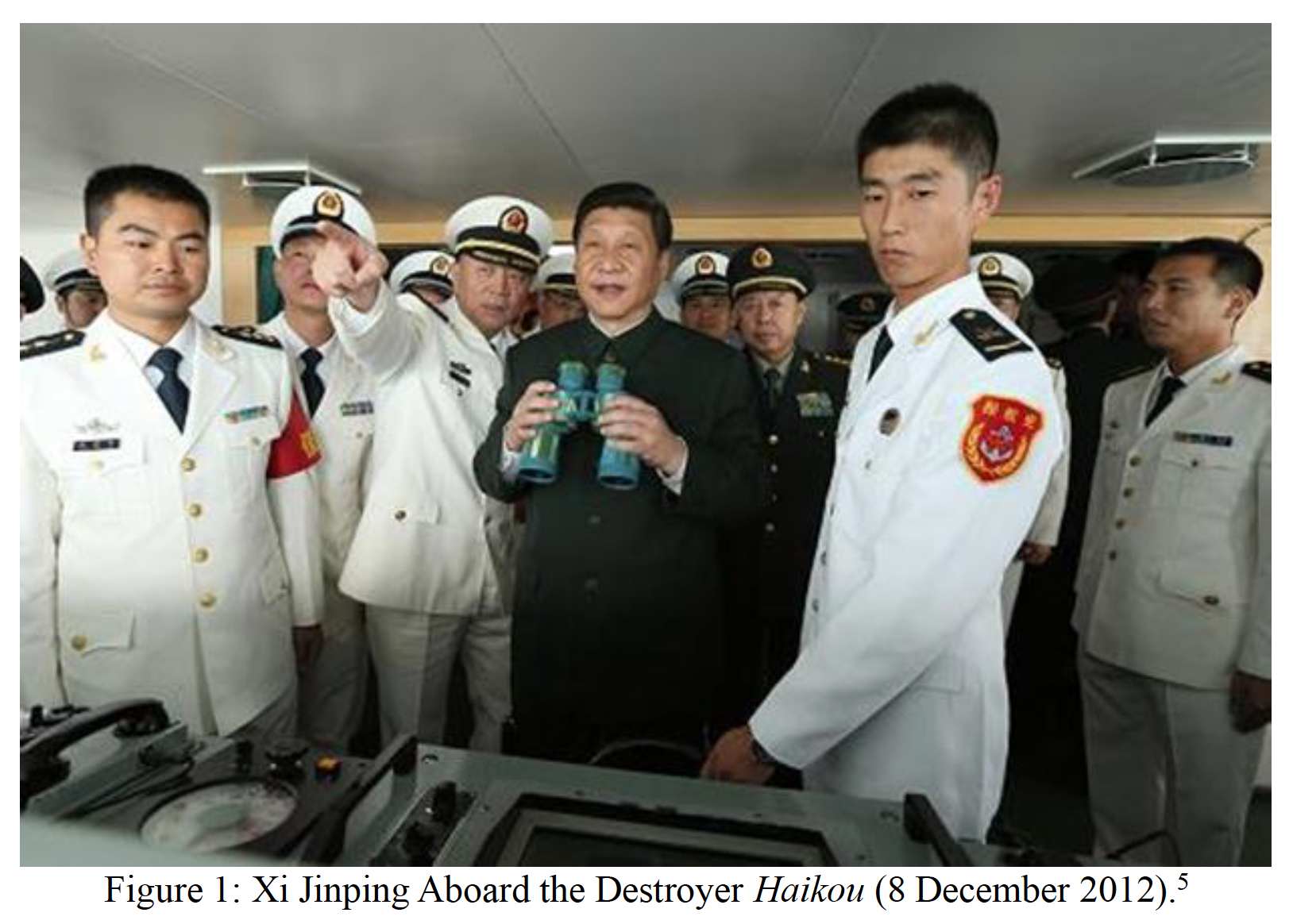
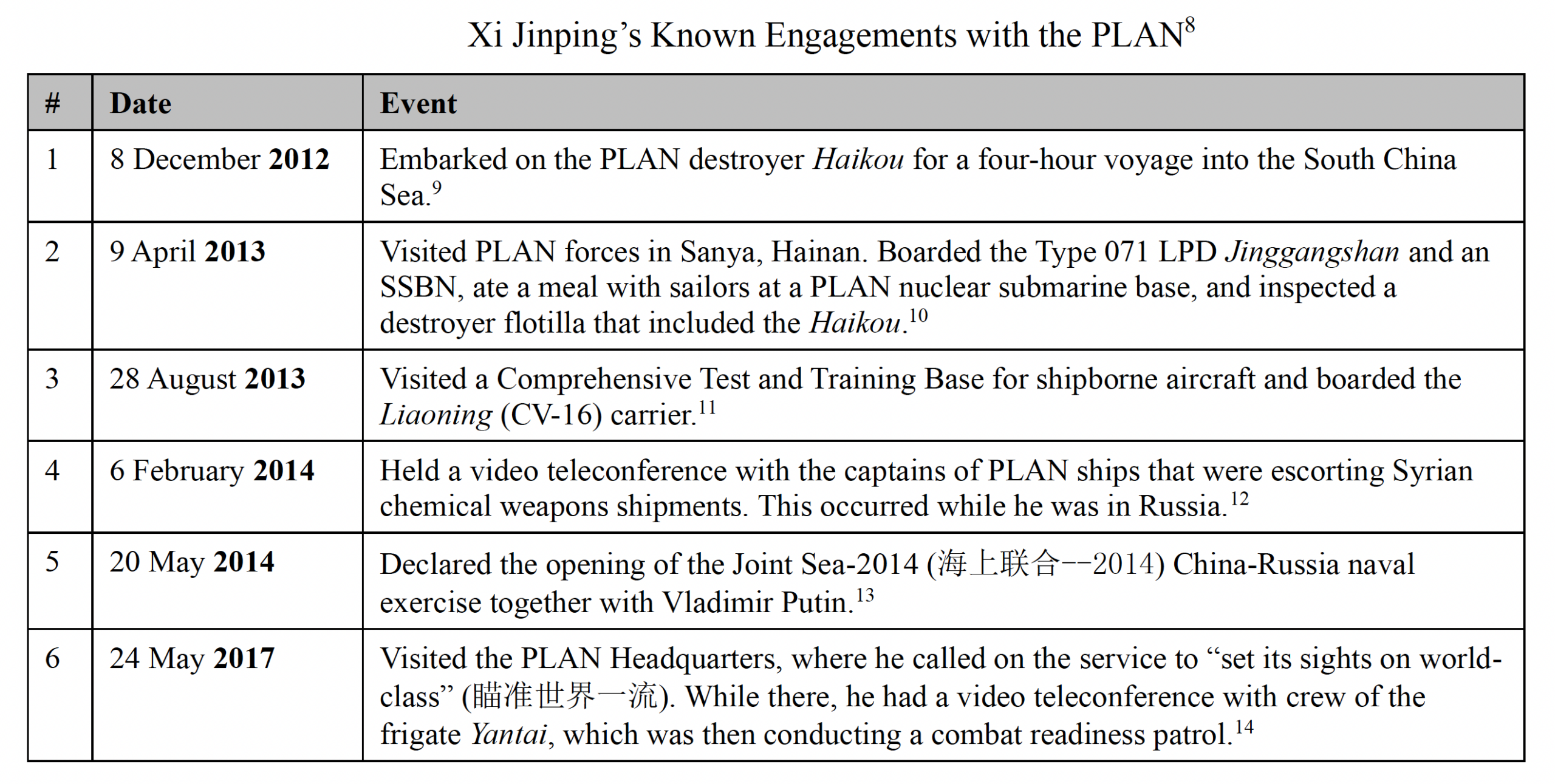
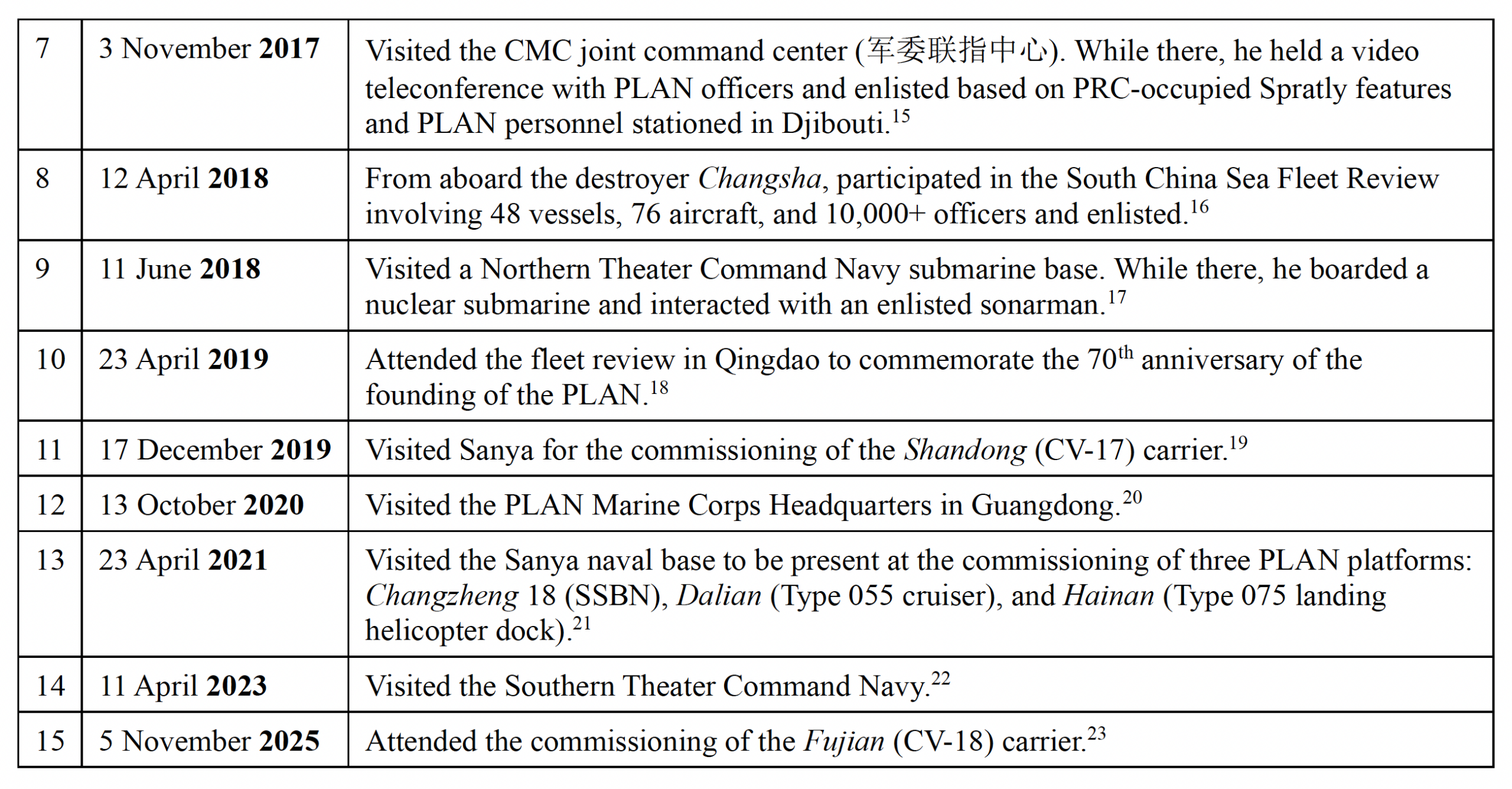
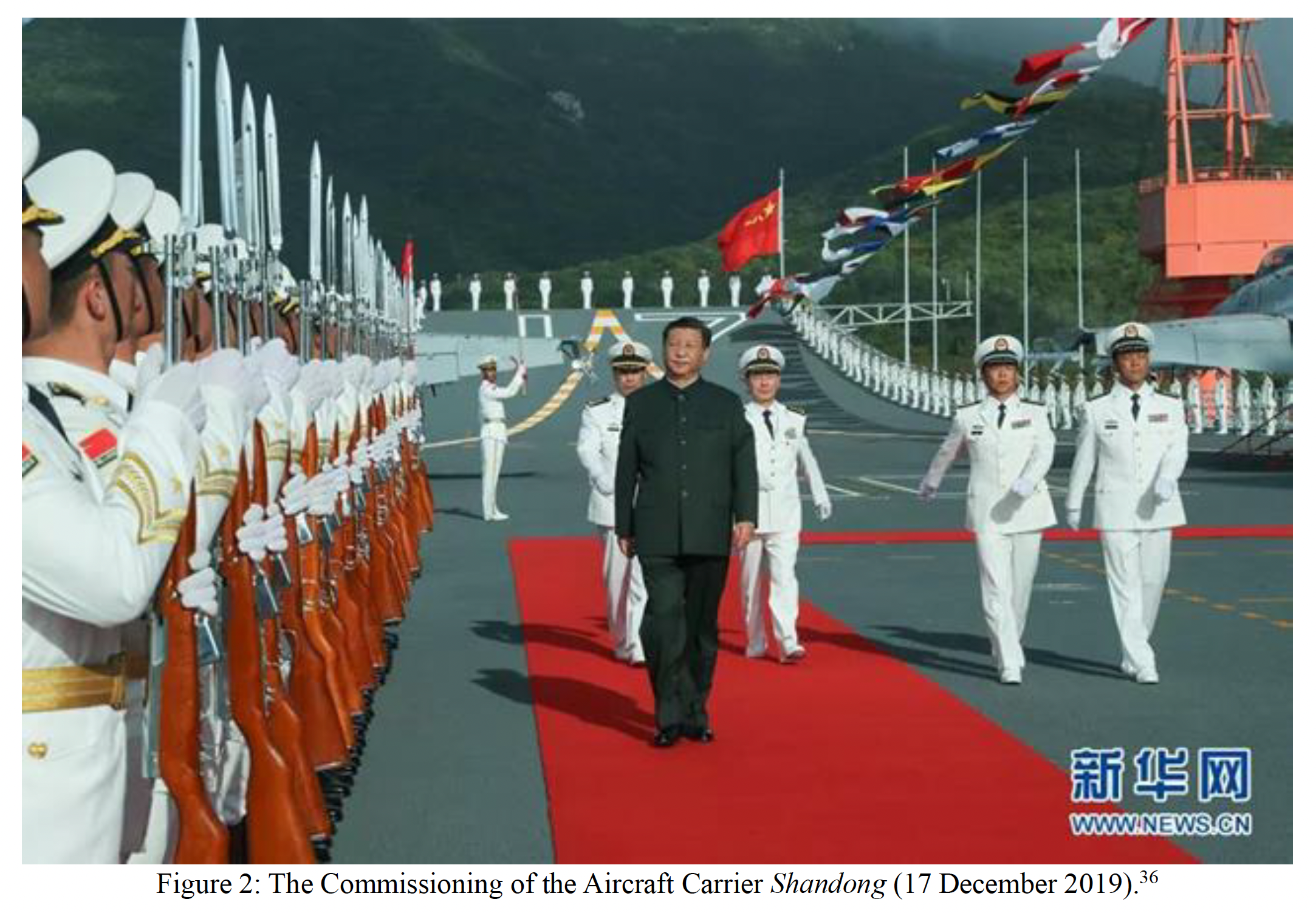
- Since assuming power in November 2012, Xi Jinping has participated in at least 15 engagements with the People’s Liberation Army Navy (PLAN). He has inspected multiple PLAN units, including the Navy’s two nuclear submarine units; attended the commissioning of new naval vessels; visited the PLAN headquarters; and presided over two major fleet reviews.
- In 2014, Xi oversaw the update to the PRC’s military strategy, which placed unprecedented emphasis on maritime operations in defense of Beijing’s territorial claims (especially Taiwan) and protection of China’s growing overseas interests. This paved the way for enormous investments in new naval platforms and increased the PRC’s naval presence around the world.
- From 2015 to 2017, Xi led a sweeping military reform and reorganization campaign. The first phase, which sought to optimize the PLA’s command structure, raised the status of the PLAN and allowed naval officers to hold key positions in the PLA’s three coastal Theater Commands. The second phase strived to streamline the structure of the PLA’s operational forces, and it resulted in the large-scale transfer of personnel from the PLA Army to the PLAN.
- Xi has played a direct role in the formulation of PRC naval strategy and policy. He personally decided to prioritize the construction of nuclear-powered ballistic missile submarines, to build a carrier-centric navy, to establish China’s first overseas military base, and to expand the size of the PLAN Marine Corps (PLANMC).
- Xi’s efforts to build a powerful navy are predicated on a strong, personal belief in the vital importance of maritime power for China’s national “rejuvenation.” In his words, “Strong countries are strong at sea, while weak countries are weak at sea.” Xi’s interest in maritime affairs predates his rise to leadership over the Party, state, and military.
- Early in his tenure as paramount leader, Xi Jinping signaled his intention to reorient the PLA for maritime operations, declaring, “Threats to national security are mainly at sea, the focus of military struggle is mostly at sea, and the center of gravity of the nation’s expanding national interests is at sea.” PLAN leaders commonly refer to this judgement as Xi Jinping’s “three at seas” (三个在海上).
- While continuing to frame China’s maritime dispute strategy as a balancing act between assertiveness (维权) and stability (维稳), Xi seems to believe that China was too conciliatory towards other claimants during the tenure of his predecessor, Hu Jintao. In a July 2013 speech, he called for China to shift the balance in favor of greater assertiveness. PLAN sources show that Xi played an active role in China’s construction of massive military bases on disputed features in the South China Sea.
Conclusion
Since Xi Jinping came to power, the PLAN has made tremendous strides in its efforts to transform itself from a “regional navy” (地区海军) to a “world-class navy” (世界一流海军).91 The credit for this dramatic expansion in the missions, status, and capabilities of the Chinese navy goes first and foremost to the service itself, as well as the engineers, scientists, and workers who have supported its growth. However, the precondition for these advances was political interest and support. As the Secretary General of the CCP and Chairman of the CMC, Xi Jinping has played a critical supporting role.
Indeed, PRC sources reveal that Xi was personally involved in many of the key initiatives that have empowered the PLAN. He chaired the Leading Small Group that oversaw the PLA’s sweeping reform and reorganization program. He put his authority behind the decision to greatly expand the size of the PLANMC, even as other services were reducing the size of their operational forces. Xi oversaw the update to the PLA’s Military Strategic Guidelines, which prioritized preparation for maritime conflict. He convinced leaders in the CMC and the PLAN that China needed to build a carrier-centric navy and that its SSBNs had to play a meaningful role in the PRC’s nuclear force structure. He pushed for the construction of China’s first overseas military base. Xi’s influence has led to an uptick in PRC maritime assertiveness in the East China Sea and South China Sea and an expansion in the PLAN’s global operations.
To a significant extent, Xi’s efforts have been driven by a personal commitment to building maritime and naval power, undergirded by a sophisticated understanding of the importance of the oceans to China’s “national rejuvenation.” Xi believes that the rise and fall of great powers is predicated on their ability to harness the wealth-producing attributes of the ocean and defend their maritime rights and interests. Xi is acutely aware that China’s most likely future conflict will be fought at sea, the most dangerous threats to PRC national security are located in the waters of the Western Pacific, and China’s expanding overseas interests can only be protected with naval power. While Xi seeks to avoid conflict over disputed territories in the East and South China Seas, he believes that China must robustly pursue its maritime claims—which, in his view, his predecessors were not always willing to do. Naval power is the essential solution to all of these fears and concerns. In Xi’s own words, “In the history of China’s rejuvenation the need for a powerful People’s Navy has never been as urgent as it is now.”92