Honored to Review “China’s Mahan: Admiral Liu Huaqing and the Rise of the Modern Chinese Navy”—in China Quarterly!
Andrew S. Erickson, review of Xiaobing Li, China’s Mahan: Admiral Liu Huaqing and the Rise of the Modern Chinese Navy (Annapolis, MD: Naval Institute Press, 2026); in The China Quarterly (2026). DOI: https://doi.org/10.1017/S0305741026102471
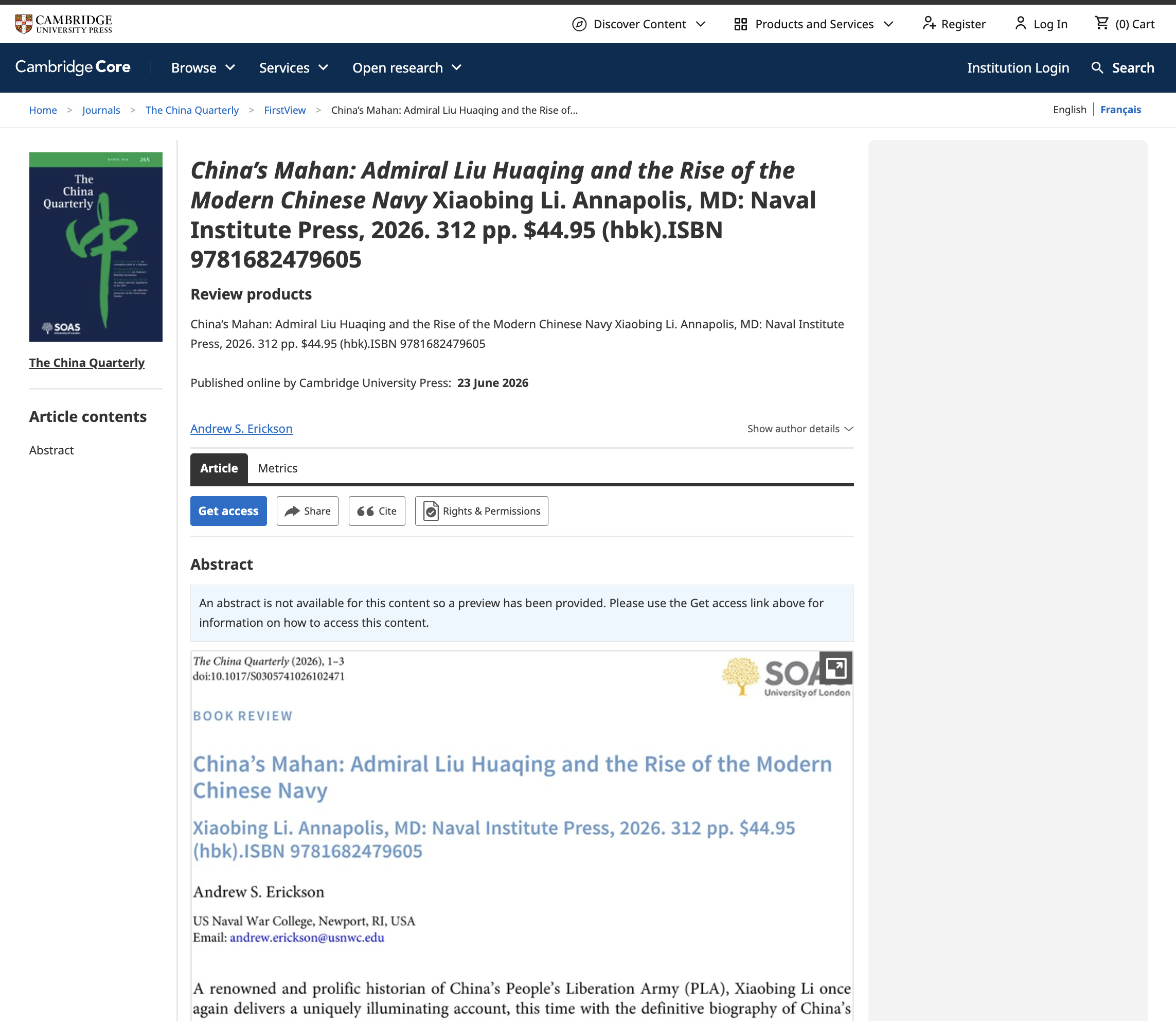
A renowned and prolific historian of China’s People’s Liberation Army (PLA), Xiaobing Li once again delivers a uniquely illuminating account, this time with the definitive biography of China’s most important naval strategist of the 20th century. Admiral Liu Huaqing concluded his long career as PLA Navy (PLAN) Commander (1982–1988), senior-ranking CMC Vice Chairman (1989–1998), and one of just seven Politburo Standing Committee Members (1992–1997) – the last military officer to hold such a position.
Li’s highly accessible work is well worth reading, especially given the importance of China’s dramatic naval development – much of which Liu oversaw, and some for which he laid the groundwork and continued influencing even after retirement. But this book offers a still broader story: that of one of the most powerful and influential bureaucrats in PRC history and a direct participant in the elite decision-making and policy implementation of critical periods. In many ways, Liu’s life is a military-maritime microcosm of the major forces shaping 20th-century Chinese history.
As Li’s title suggests – and as the introduction explicitly asks – was Liu ultimately a “Red Mahan” or “China’s Gorshkov”? Li argues persuasively that while Liu absorbed aspects of Mahanian maritime thinking, his institutional and strategic development often bore at least as much resemblance to the long-dominant Soviet Admiral Sergey Gorshkov. Li demonstrates the extent to which Soviet institutional models, educational systems and operational concepts shaped the formative PLAN. Particularly valuable is Li’s effort to situate Liu within a much longer intellectual and institutional lineage of Chinese maritime thought, extending from late-Qing encounters with Mahan to Soviet naval influence during the early Cold War and close PRC study of American naval gold-standard examples (e.g. nuclear submarine safety procedures).
The cogent result has implications not only for how we may best understand Liu, but – given his exceptional and enduring influence – how we should understand China’s Navy and the currents that shape and propel it to this day. Particularly valuable is Li’s demonstration that many features associated with Xi Jinping’s navy – including maritime rights protection, far-seas operations, aircraft carrier development and nuclear deterrence patrols – rest on conceptual, institutional and bureaucratic foundations Liu spent decades advancing.
Undeniably talented and dedicated, Liu started with the advantage of being unusually well educated for someone of a revolutionary peasant background. In a fortuitous foundation that would later help elevate him to the commanding heights of political-military affairs, he enjoyed exceptionally close relations and trust with (eventual paramount leader) Deng Xiaoping, for whom he worked closely over 14 highly consequential years (1938–1952).
Long after his wartime service, Liu remained willing to take considerable risks to advance as he thought best the principles to which he dedicated his life. In 1975, while leading the PLAN … … …
Disclaimer
The opinions and views expressed are those of the author alone and do not necessarily represent those of the US Government, or US Department of War or its components, to include the Department of the Navy or the US Naval War College.