China’s Nuclear Submarine Development Quest: Strategy, Saga, Significance
China’s successful 6 July 2026 launch into the South Pacific Nuclear Free Zone appears to be its first publicly acknowledged long-range submarine-launched ballistic missile (SLBM) flight from a submarine since the People’s Liberation Army Navy (PLAN)’s successful 12 October 1982 JL-1 developmental launch from the Type 031 (Golf-class) trials submarine Great Wall (Changcheng) 200.
My 83-page study, “China’s Nuclear Submarine Development Quest: Strategy, Saga, Significance”—published just now as a Korea Institute for Maritime Strategy Policy Report—explains how Beijing’s nuclear-powered submarine development went from a 1958 vow by Mao to the third-generation advances now accelerating under Xi. I cover in particular depth the many-decade contributions of Admiral Liu Huaqing, China’s closest equivalent to Admiral Hyman Rickover—and arguably even more influential given how badly naval nuclear propulsion needed a powerful and persistent champion amid PRC Cold War privations.
Fittingly given today’s SLBM launch news, Appendix A provides in English translation the excerpt from Liu’s Memoirs in which he offers his own detailed account of China’s 12 October 1982 JL-1 SLBM test, which he oversaw as PLAN Commander. “China’s success in test launching an SLBM from underwater, the first of its kind for the country, caused an enormous sensation in the world,” Liu recounted. “U.S. Naval Institute Proceedings made the following comment: ‘When China announced her success in test-firing an SLBM, it has become quite clear that the People’s Republic of China is poised to become the world’s fifth nuclear power to possess a sea-based deterrent force …. China’s acquisition of a deterrent capability at sea complicates strategic force assessments not only for the Soviet Union but also for the United States.”
Update: Honored to be quoted and my new report cited by Chris Buckley in The New York Times!
China is building a new generation of submarines that will be stealthier than the Type 094, possibly approaching capabilities achieved by an advanced Russian model, Andrew Erickson, a professor at the U.S. Naval War College, wrote in a study published this week.
“China’s quieting approach remains imperfect but is determined, comprehensive and improving,” Professor Erickson wrote, referring to the technology used to make submarines hard to detect. He emphasized his conclusions were his own, and did not represent the Naval War College or the U.S. Navy.
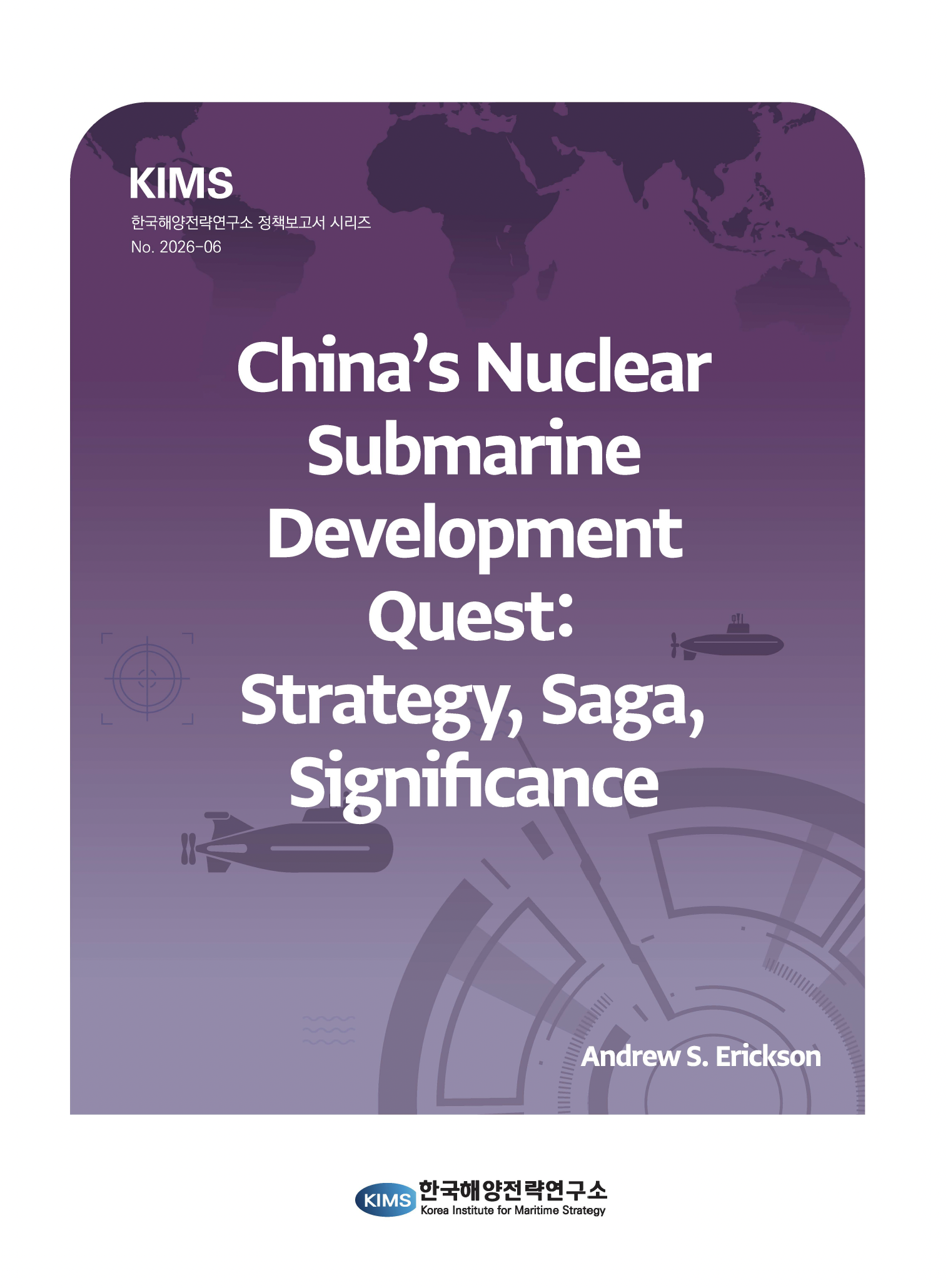
Andrew S. Erickson, China’s Nuclear Submarine Development Quest: Strategy, Saga, Significance (Seoul, South Korea: Korea Institute for Maritime Strategy Policy Report, 6 July 2026), 83 pp.
CLICK HERE TO DOWNLOAD A FULL-TEXT PDF.
This paper surveys the history and background of how the People’s Republic of China (PRC) became one of just six countries so far to possess nuclear-powered submarines, including the core subject of nuclear reactor development and improvement across three submarine generations. If South Korea decides to pursue and successfully develops indigenous nuclear-powered submarines, it will most likely become the seventh country to do so—offering six previous paths to study, of which China is a prominent example. Three-quarters of a century after beginning initial efforts under autarkic austerity, Beijing finally has a capable and growing fleet of modern nuclear-powered attack submarines (SSNs), nuclear-powered guided-missile submarines (SSGNs), and nuclear-powered ballistic missile submarines (SSBNs) equipped with long-range submarine-launched ballistic missiles (SLBMs). What Mao sensed broadly through a geopolitical lens, modern military science shows with technical specificity: nuclear-powered submarines represent the absolute global “gold standard” for which there is no true substitute—with utterly unmatched potential in propulsion, endurance, sensor and weapons operations, and overall performance. As China’s experience shows, however, the road to success can be lengthy, expensive, and arduous. Ability to study preexisting foreign examples from afar helped somewhat, but tremendous national leadership, resources, and effort over decades have been required.
This study begins by examining the historical, political, and technological foundations of China’s quest to develop nuclear-powered submarines, focusing on the domestic constraints, foreign influences, organizational dynamics, and engineering choices that shaped the emergence of its first-generation SSN and SSBN programs. It then explores the pivotal role of key individuals—above all Admiral Liu Huaqing—in sustaining long-term political support, strategic prioritization, operational development, and institutional learning for China’s undersea nuclear enterprise across multiple decades of military modernization. Building on this historical foundation, the paper next analyzes how China’s contemporary leadership under Xi Jinping has elevated nuclear-powered submarines within the broader evolution of the People’s Liberation Army Navy (PLAN)’s maritime strategy, including its geographic expansion from “Near Seas Active Defense” to “Far Seas Protection” and broader global undersea ambitions. The paper next surveys the PLAN’s current SSN, SSGN, and SSBN force structure, capabilities, technological advances, and remaining limitations, with particular attention to propulsion, quieting, sonar systems, and strategic deterrent operations. It then assesses emerging trends in China’s third-generation submarine development trajectory-including the Type 095 SSGN and Type 096 SSBN programs, expanding shipyard infrastructure, evolving Sino-Russian technological interaction, and efforts to close the remaining gap with leading Western undersea warfare capabilities. It concludes by reflecting on the implications of China’s experience and suggesting potential lessons for South Korea.
Key Findings:
- Nuclear submarines are the global “gold standard” of undersea warfare capability, offering unmatched endurance, survivability, and operational reach—there is no true substitute.
- China’s pursuit of nuclear submarines was initially geopolitical-not operationally driven: Mao prioritized them as symbols and instruments of great power status well before naval strategy justified them.
- Project 09, China’s first-generation nuclear submarine program, represents a quintessential case of long-term strategic persistence, surviving extreme political upheaval (Great Leap Forward, Cultural Revolution) and resource scarcity.
- The Sino-Soviet split forced full technological autarky, compelling China to reverse-engineer nuclear propulsion systems using fragmentary open-source and indirect foreign knowledge.
- China benefited significantly from a “second-mover advantage,” selectively drawing on U.S., Soviet, and especially civilian nuclear propulsion models.
- First-generation platforms (Type 091/092) were technically functional but operationally deficient, characterized by high noise, limited reactor performance, and reliability issues.
- The program’s greatest value was not early platforms but accumulated institutional learning, including reactor design, shipbuilding processes, testing regimes, and nuclear safety systems.
- Strong, sustained top-level political backing was decisive, especially from Liu Huaqing, whose multi-decade advocacy ensured continuity across changing leadership eras.
- China’s nuclear submarine enterprise required a full ecosystem, including shipyards, land-based reactor testing, trained personnel, logistics, and nuclear safety infrastructure—not just submarines themselves.
- China has now transitioned from foundational learning to competitive modernization, fielding increasingly capable second- and third-generation SSNs, SSGNs, and SSBNs while narrowing gaps with leading navies.