Honored to Review “Under the Nuclear Shadow: China’s Information-Age Weapons in International Security”—in China Quarterly!
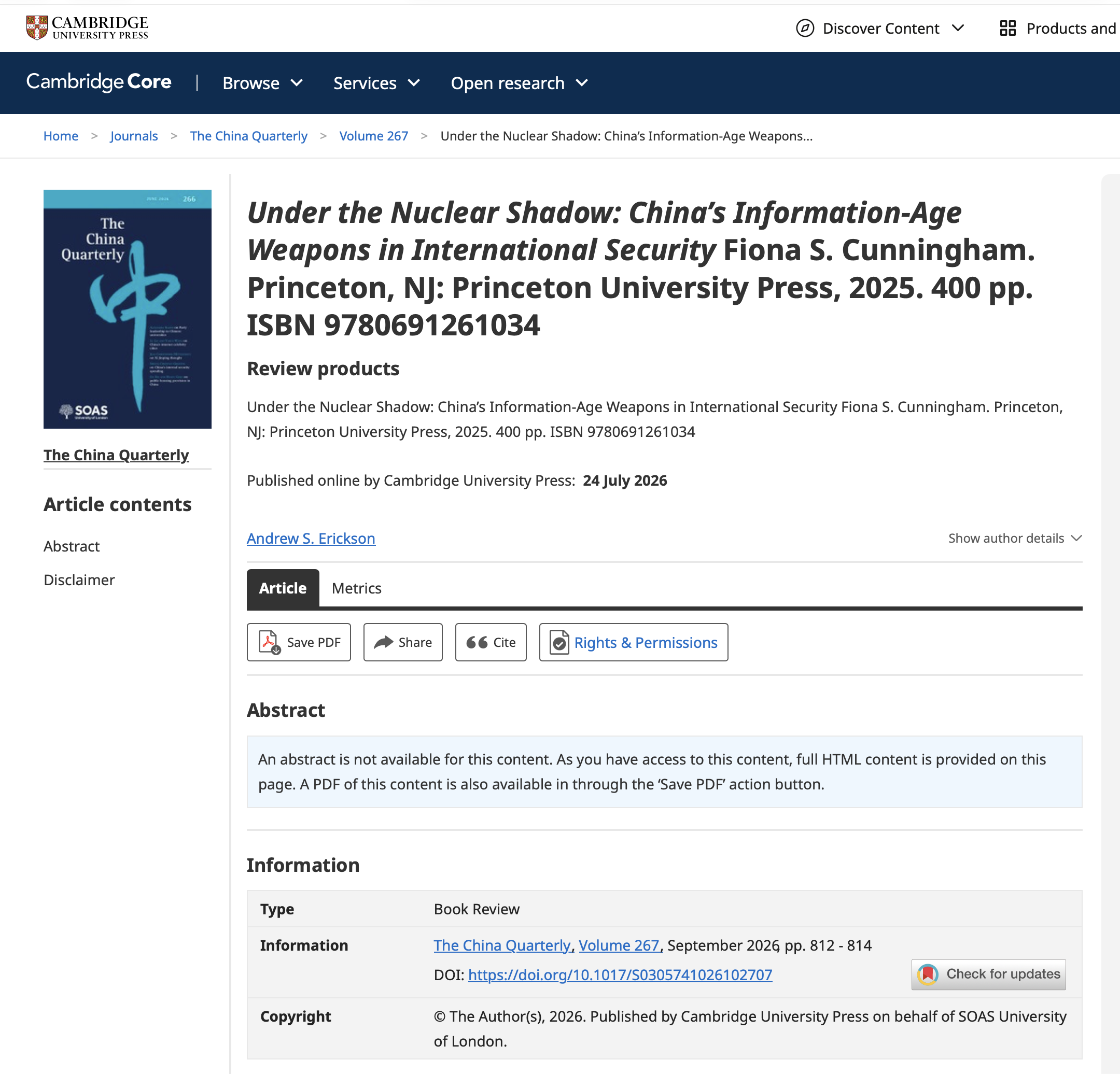
Andrew S. Erickson, Review of Fiona S. Cunningham, Under the Nuclear Shadow: China’s Information-Age Weapons in International Security (Princeton, NJ: Princeton University Press, 2025); in The China Quarterly 267 (September 2026): 812–14. (online 24 July 2026). DOI: https://doi.org/10.1017/S0305741026102707
CLICK HERE TO DOWNLOAD A CACHED FULL-TEXT PDF.
Under the Nuclear Shadow: China’s Information-Age Weapons in International Security Fiona S. Cunningham. Princeton, NJ: Princeton University Press, 2025. 400 pp. ISBN 9780691261034
Review
Published online by Cambridge University Press: 24 July 2026
Like waves generated far from shore, major military capabilities often emerge from strategic choices made years earlier amid technological uncertainty and long development timelines. Cunningham makes a vital contribution by documenting and tracing just how much of China’s ongoing bow wave of military advancements stems from distinctive developmental choices. This ambitious undertaking, commendably executed, brings much-needed nuance and insight into Beijing’s evolving military strategy and coercive posture. Especially powerful historically, it explains important selection effects: why China prioritized certain asymmetric capabilities over others – namely missile, cyber and counterspace development under Jiang Zemin and Hu Jintao. Cunningham’s framework remains highly persuasive in explaining Beijing’s earlier capability prioritization decisions, even as Xi-era developments complicate its predictive implications for future force development.
Many of the choices Cunningham traces were decided and implemented initially under Jiang, who in 1997 envisioned a three-step military modernization strategy out to 2050. Jiang pursued what Cunningham characterizes as strategic substitution – a stopgap approach disproportionately emphasizing key advanced weapons to align PRC strengths with strategic and operational exigencies, catalyse advances in critical areas, and avoid premature arms racing pitfalls before Beijing had the wherewithal to prevail on its own terms. China lacked both the coercive leverage associated with nuclear first-use strategies and the highly survivable retaliatory posture characteristic of mature nuclear powers. It also lacked sufficient conventional capabilities to intervene successfully against, let alone defeat, a superior adversary like the United States. Therefore, beginning especially after the 1995–1996 Taiwan Strait Crisis, Beijing sought coercive leverage below the nuclear threshold with conventional precision-guided missiles, cyber capabilities, and counterspace weapons.
Rather than an exhaustive literature review of foreign scholarship, which tends to be theoretical or general in nature, nuclear-focused, or dated, Cunningham prioritizes citation of original Chinese sources and interviews and reconstructs relevant PRC debates. She does so with highly disciplined methodology, curation and careful attention to source pedigree and relative authoritativeness. In a particularly compelling example of what at least previously might be gleaned from disciplined, determined interviews, Cunningham debunks implausible claims that China’s 2007 ASAT test proceeded without top leadership concurrence.
Cunningham offers particularly persuasive tracing of Cold War and early post-Cold War history. She shows how, at the Cold War’s end, PRC leaders approved a Second Artillery (now PLA Rocket Force) proposal to establish a conventional unit employing missiles not sold to Syria following American pressure. With Washington and Moscow straitjacketed by the INF Treaty, this rapidly grew into the world’s largest, most diverse conventional missile force. Today China fields the world’s most extensive inventory of anti-ship ballistic missiles, hypersonic glide vehicles and other advanced strategic systems (see Office of the Secretary of War, Military and Security Developments Involving the People’s Republic of China 2025, Washington, DC: Department of Defense/War, 23 December 2025).
Cunningham makes an extremely compelling case that China emphasized conventional missiles, counterspace capabilities and cyber activities as relative strengths that matched particular military needs. Conventional bombers, by contrast – as Cunningham rightly underscores – represented deep-seated technological weakness and would not serve a major unique or vital role. Less clear and conceptually categorizable is electronic warfare. China has indeed actively pursued the full spectrum of electronic warfare – not necessarily as what Cunningham terms “a weapon capable of generating coercive leverage in its own right” (p. 237), but certainly as a vital enabler of multifarious military operations. Finally, for many applications against capable adversaries, at least, it is unclear how Special Operations Forces “could have been a plausible substitute source of coercive leverage for the PLA” (p. 292).
Cunningham’s book is strongest in explaining the logic of post-Cold War and especially Jiang- and Hu-era force development choices. She carefully caveats her argument: “strategic substitution does not preclude the pursuit of conventional or nuclear capabilities that could eventually provide a country with the option to adopt another answer to the limited-war dilemma. Strategic substitution can be a stopgap until then” (p. 9).
Indeed, 13 years into Xi’s new era, China’s military position has changed fundamentally. Strategic substitution, having largely run its course, no longer appears sufficient on its own to explain China’s broader military trajectory. Xi’s increasingly all-encompassing buildup is additive rather than substitutive. Strategic substitution explained why China initially prioritized certain weapons but appears increasingly insufficient to explain what Beijing is now prioritizing or may prioritize next. Previously favoured weapons remain valuable but increasingly coexist with expanding conventional and nuclear capabilities as China pursues comprehensive military capability. This dramatic discontinuity, particularly its nuclear component, remains largely unacknowledged in PRC official statements and scholarship alike. … … …