China’s Army in 2025: A Mountain of Open-Source Data
Article Compilations by Ken Allen —
- China’s Army in 2025: Sources & Key Issues
- Overview File: China’s Army in 2025
- English-Language PRC Articles on China’s Army in 2025
- Chinese-Language PRC Articles on China’s Army in 2025
This summary was prepared with AI assistance and vetted by Ken Allen, who contributed key inputs. Unless otherwise specified, “Chinese” means “Chinese-language.”
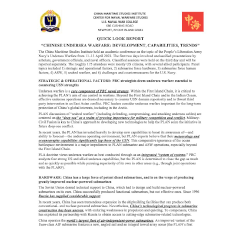
Longtime People’s Liberation Army (PLA) researcher Ken Allen has assembled an exceptionally large body of primary-source material on the PLA Army (PLAA) during 2025. The information was compiled for a project sponsored by Exovera and the simplified data were published for January through July.[1]
Taken together, these resources are valuable not primarily because they offer a top-down description of the Army as an institution, but because they provide something much harder to obtain: a remarkably granular view of how the PLAA’s brigades, battalions, companies, platoons, squads, and individual soldiers actually train, operate, maintain equipment, develop personnel, identify deficiencies, and attempt to remedy them. That distinction is fundamental to understanding both the collection’s value and its limitations. Allen explicitly notes that the underlying articles provide essentially no information about PLAA Headquarters, Theater Command headquarters, or Theater Command Army headquarters; their center of gravity is the brigade and below. They generally identify units by Group Army but do not themselves provide Military Unit Cover Designators (MUCDs), and officer-rank information is strikingly sparse.
Taken together, the files constitute an unusually substantial, chronologically organized corpus of official and quasi-official PRC open-source reporting on China’s ground forces during calendar year 2025. The Overview serves as the principal discovery layer, distilling and indexing the underlying articles, while the English and Chinese compilations preserve the evidentiary material itself. The separate Sources and Key Issues file is particularly useful as a methodological guide: it identifies the principal English-language source streams as the Ministry of National Defense and China Military Online and the Chinese streams as several dedicated PLA Army and MND channels. The disparity in scale between the two language streams is itself revealing. The English collection (186 articles) runs to roughly 180 pages, while the Chinese collection (600 articles) exceeds 2,400 pages and preserves original Chinese reporting together with machine translations. The English collection does not even begin substantive 2025 coverage until February, whereas the Chinese corpus begins on 2 January with reporting on an 82nd Group Army brigade.
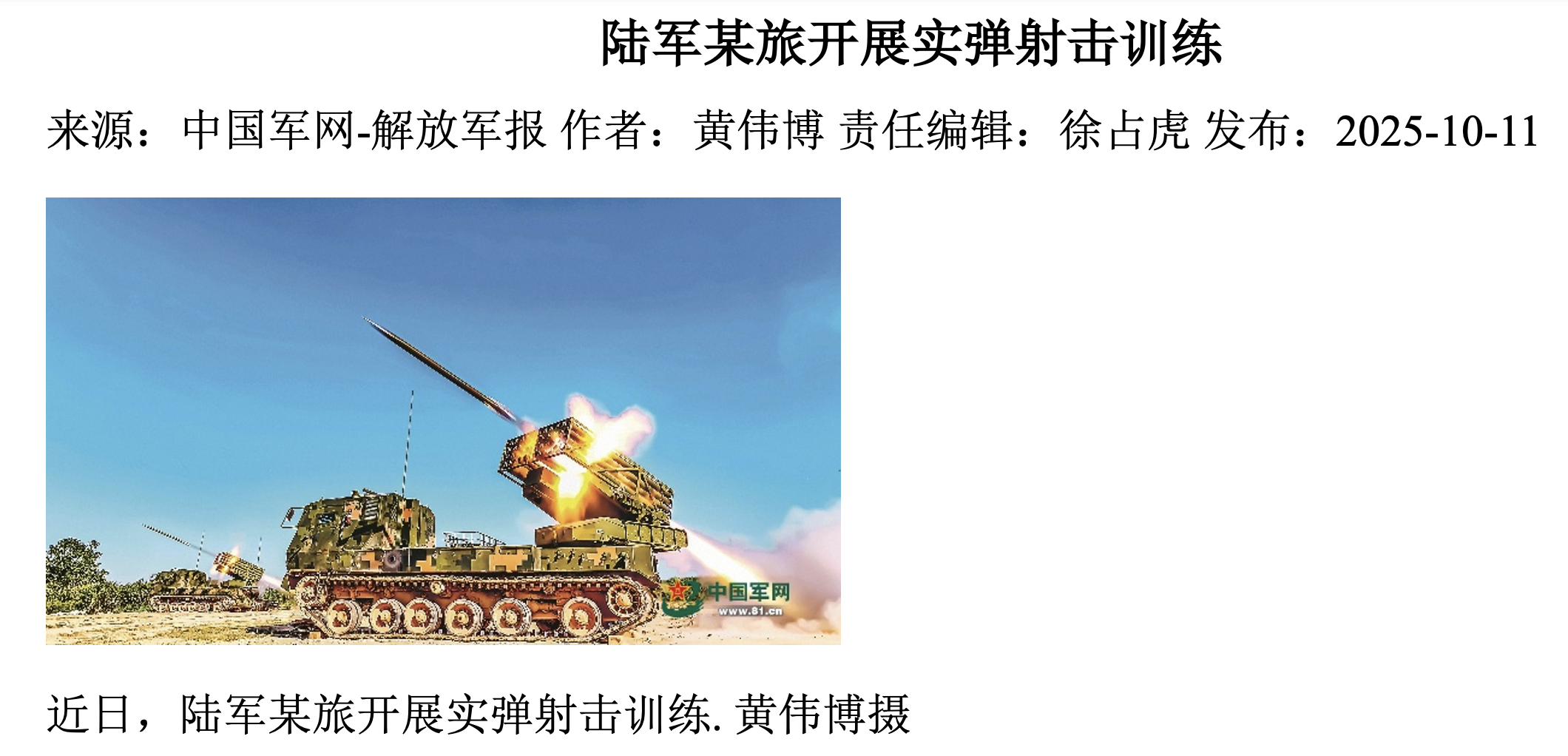
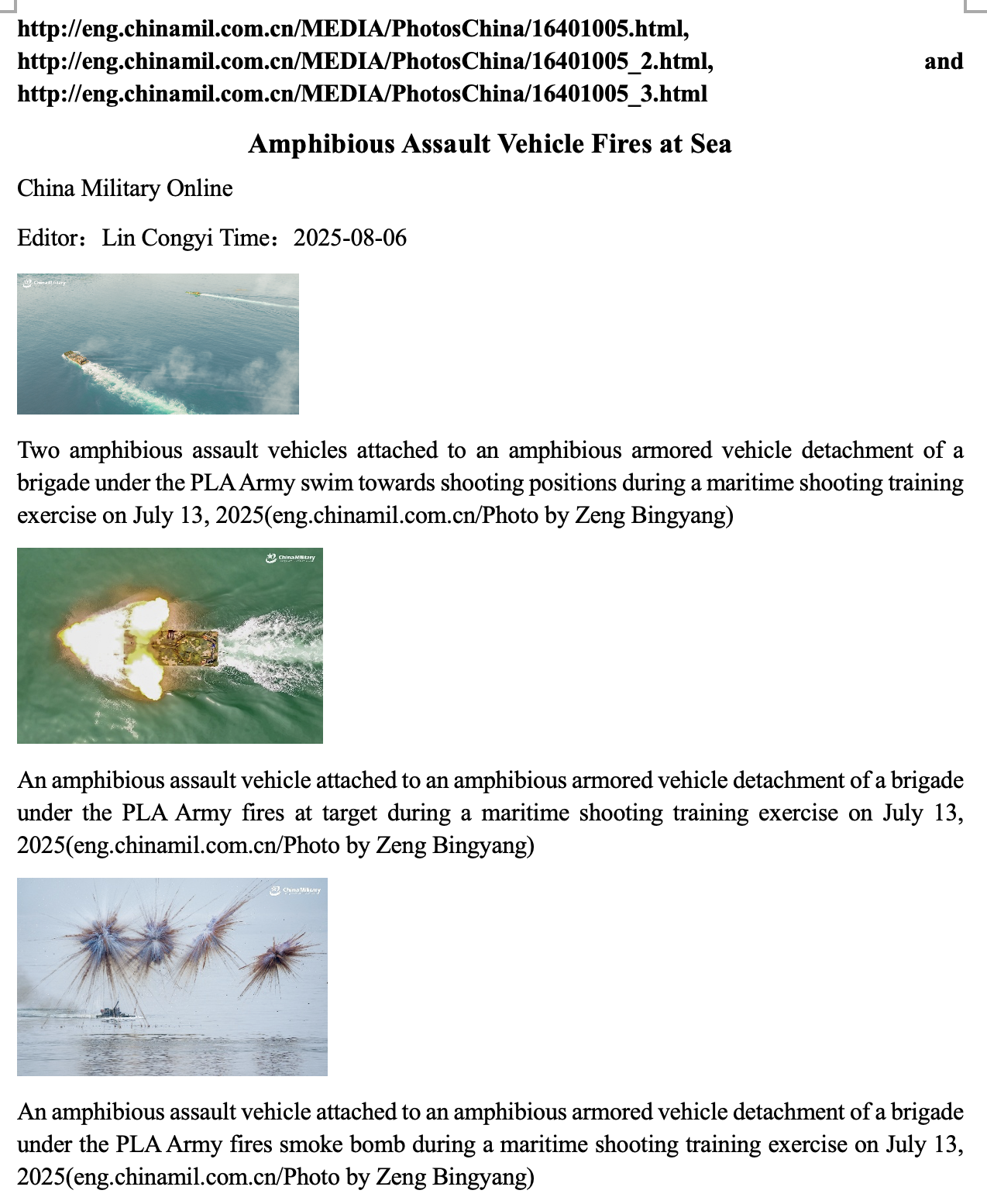
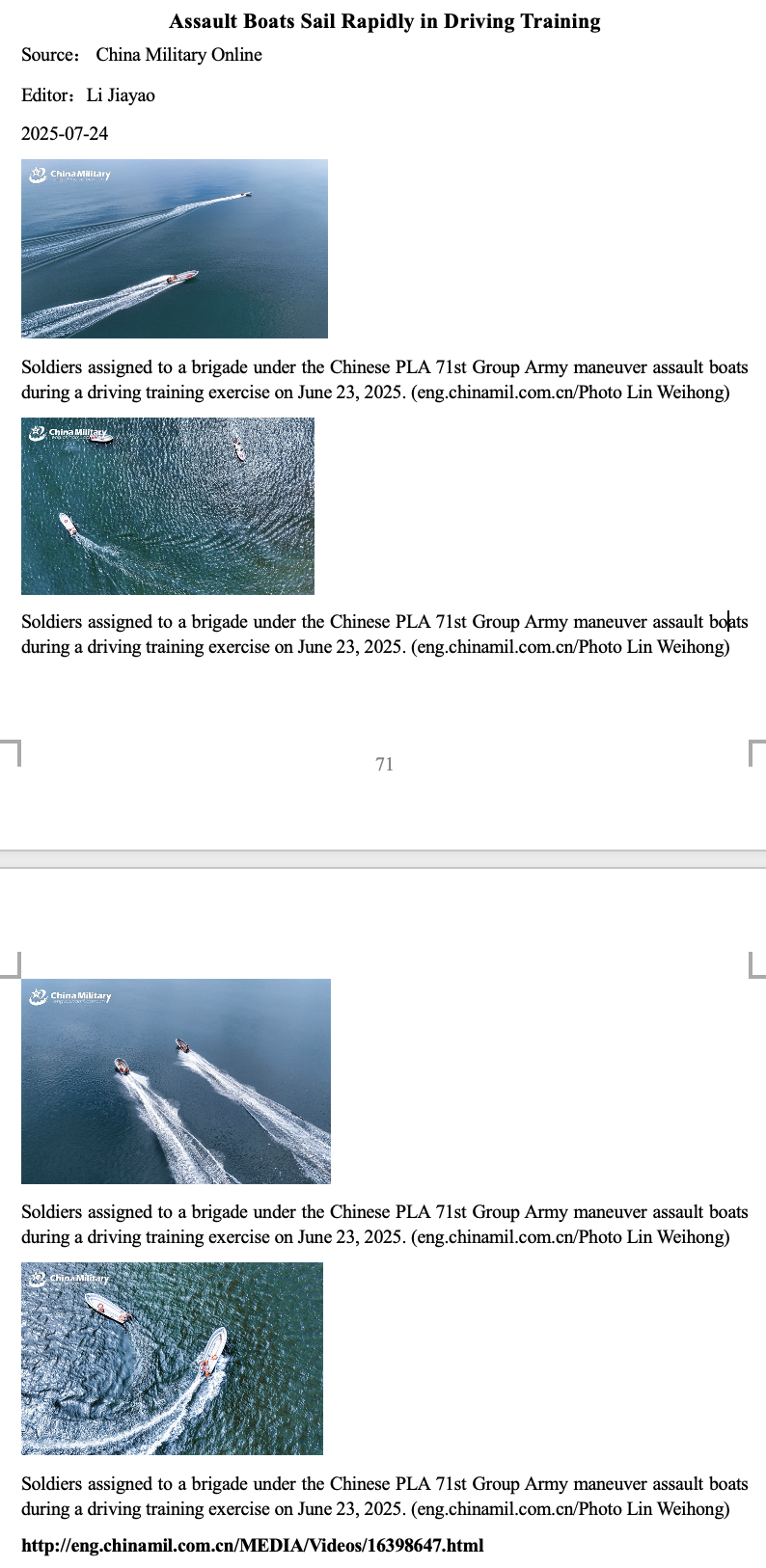
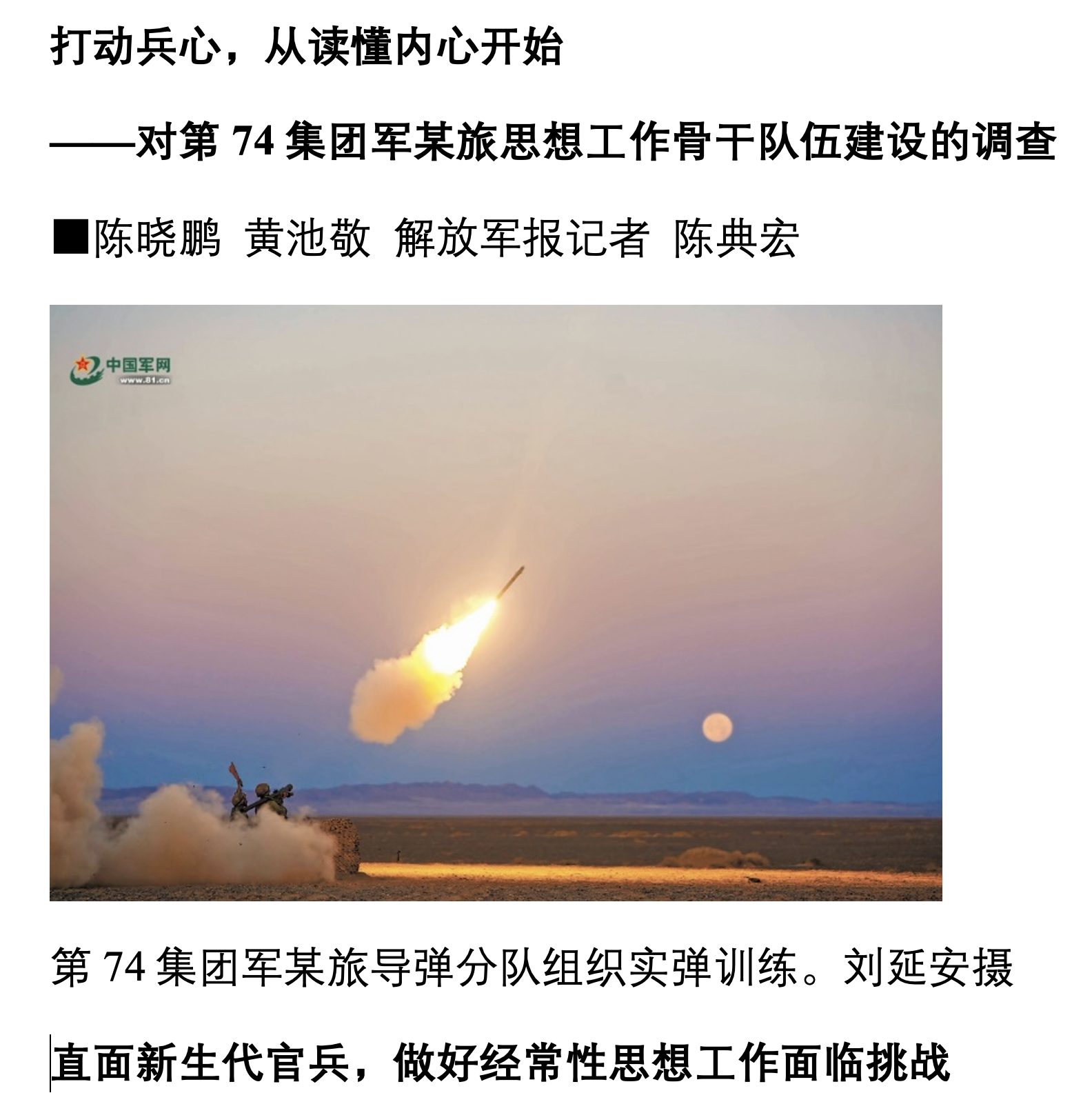
What the corpus contains is extraordinarily broad at the tactical and organizational levels. It documents combined-arms maneuver, armor, artillery and long-range fires, army aviation, air defense, reconnaissance, amphibious operations, engineering, chemical defense, border defense, logistics, military medicine, unmanned aerial vehicles (UAVs), live-fire exercises, mobility, foreign military interaction, and disaster relief. The English material is especially useful for quickly identifying equipment, Group Armies, locations, dates, and observable training activities. It records, for example, ZBL-08 infantry fighting vehicles of the 78th Group Army operating in winter conditions; long-range multiple launch rockets systems (MLRS) training by the 77th Group Army; amphibious Infantry Fighting Vehicles (IFVs) of the 73rd Group Army conducting ferrying and assault-wave formation training; and WZ-10 and Z-20 helicopters participating in Army aviation training. Photographs and links to short videos make this material considerably more valuable than the text alone: seemingly routine captions can associate equipment with particular Group Armies or subordinate formations, establish dates and operating environments, and occasionally expose identifiers or other details useful for order-of-battle research.
The Chinese-language corpus, however, is where much of the collection’s distinctive analytical value lies. These articles routinely move beneath the visible hardware-and-exercise layer and describe how Army units are attempting to generate combat effectiveness: how training is designed and evaluated; how commanders learn combined-arms command; how specialists and noncommissioned officers (NCOs) are developed; how lessons are captured and applied; how equipment problems are diagnosed; how personnel shortages or uneven competence are handled; and how Party organizations intervene in training, management, morale, and personnel development. One article, for example, describes trainers relying excessively on experience or recycling old lesson plans because tightly packed training schedules left insufficient preparation time; the brigade responded by reallocating expert trainers and changing the relationship between higher-level supervision and grassroots training. Another traces an engineer company created during the 2017 reforms that initially suffered from “no equipment and no technical backbone,” uneven personnel drawn from six different grassroots units, poor performance, and later stagnation after initial improvement. These are unusually revealing glimpses into the friction involved in converting organizational reform and new equipment into usable combat capability.
Indeed, perhaps the single most important way to exploit this collection is to search systematically for failure. Allen specifically recommends searching his PLA Army corpus separately for “issue” and “problem,” which occur 194 and 300 times, respectively, calling this the “key issue” for researchers. That recommendation captures an important characteristic of PLA reporting. Many articles follow a recognizable problem-diagnosis-remedy narrative: a unit encounters a deficiency, commanders or Party organizations investigate it, corrective measures are introduced, and the article concludes by asserting improved performance. The propagandistic success story is therefore often less analytically important than the problem the story inadvertently documents. Read backward from the claimed solution, these articles can expose deficiencies in training realism, combined-arms coordination, technical competence, command ability, personnel management, equipment support, or institutional incentives.
A particularly important recurring theme is the difficulty of turning the post-reform PLAA into a genuinely combined-arms and joint force. The corpus contains evidence that modernization is demanding substantially more of relatively junior commanders. One Overview entry describes a brigade expanding combined-arms command training below battalion level because grassroots commanders displayed weak combined-arms awareness and insufficient tactical skills. Exercises exposed poor coordination between air-assault and main-attack elements, ineffective differentiation of fires, and deficiencies in intelligence collection, coordination, and guided strikes. The brigade consequently sought to make lower-level commanders capable of integrating Army aviation, long-range artillery, special operations, and even air and maritime operational elements—effectively creating “plug-and-play” combined-arms command modules. This complements English-language reporting in which a combined-arms battalion commander describes the transition from traditional infantry toward information-enabled, multidomain operations, “information-firepower integration,” helicopter-assisted assault, and cross-service training with naval and air forces. Taken longitudinally, the material therefore allows researchers to study not merely what equipment the PLAA possesses, but whether its people and organizations appear capable of integrating it effectively.
The corpus is similarly valuable for assessing the PLAA’s continuing effort to make training more realistic, adversarial, and diagnostically useful. A 77th Group Army air-defense brigade, for example, trained against a dedicated opposing force employing intensive electromagnetic interference. Rather than depicting an effortless victory, the account describes radar targets disappearing under jamming, operators requesting assistance, electronic air-defense elements coordinating responses, and Red and Blue personnel subsequently reviewing “problems and shortcomings.” The brigade then used accumulated training data and research with equipment manufacturers to refine tactics and training methods. Such accounts are especially valuable when compared across units and over time: recurring acknowledgment of the same deficiency is stronger evidence of an institutional problem than any single article, while the disappearance, transformation, or persistence of a problem may offer clues about whether corrective measures are actually working.
Personnel development emerges as another major research opportunity. The material reaches remarkably far down the organizational hierarchy, illuminating subjects that conventional studies of PLA modernization often treat only abstractly: selection and development of squad leaders, vocational qualifications, promotion prerequisites, instructor quality, technical backbones, education, morale, family support, and career planning. The Sources and Key Issues file highlights a particularly revealing 74th Group Army case in which an otherwise highly qualified deputy squad leader could not become squad leader because he lacked the required advanced vocational-skills certificate. Subsequent investigation found that soldiers often poorly understood advancement requirements and that existing career “roadmaps” had become formalistic documents that were filled out, filed away, insufficiently updated, and poorly integrated with everyday personnel management. The battalion responded by shifting toward individualized, continuously monitored development plans. Such material permits researchers to examine the human-capital machinery beneath PLAA modernization, including the extent to which a more technically demanding force is creating new credentialing, training, retention, and leadership problems.
The contrast between the English- and Chinese-language streams should itself be treated as an analytical variable. English reporting tends toward visually compelling, externally legible manifestations of military capability—tanks firing, helicopters flying, artillery and MLRS launches, amphibious vehicles maneuvering, reconnaissance troops operating in difficult terrain, and polished descriptions of increasingly realistic training. The Chinese material is vastly larger and generally more useful for reconstructing the organizational processes behind those images: experimentation, evaluation, personnel development, political work, training management, command adaptation, and acknowledged deficiencies. This does not mean that the English material is mere propaganda or the Chinese material is candid internal reporting; both are selected official products. Rather, systematic comparison can help distinguish external strategic messaging from the PLAA’s domestic professional and organizational discourse, while identifying details that appear in one language stream but not the other.
For researchers, the strongest workflow is therefore to treat the Sources and Key Issues file as the methodological orientation, the Overview as the discovery and indexing layer, and the two article compilations as the evidentiary layer. Begin with a specific analytical problem—combined-arms command, NCO development, artillery, amphibious operations, army aviation, air defense, electronic warfare, logistics, border operations, equipment maintenance, training realism, or a particular Group Army—and use the Overview to construct a chronology and identify relevant entries. Then return to the complete articles, especially the original Chinese. Machine translations are extremely useful for discovery and triage, but consequential terminology concerning operational concepts, organizational relationships, personnel categories, training methods, and command should be checked against the Chinese before publication. Researchers should also search explicitly for diagnostic vocabulary—problem, issue, shortcoming, weakness, bottleneck, difficulty, contradiction, insufficient, unable, failure, lesson, rectification, improvement and their Chinese equivalents—rather than searching only for weapons or unit names.
An even more powerful use would be to convert the corpus into a structured longitudinal PLAA dataset. Records could be coded by date, source, language, Theater Command, Group Army, brigade or lower echelon when identifiable, equipment, branch or specialty, geographic environment, training type, combined-arms or joint participation, adversarial element, personnel issue, maintenance or logistics issue, identified deficiency, proposed remedy, and presence of photographs or video. Researchers could then ask questions that individual articles cannot answer: Which Group Armies appear most frequently in amphibious or high-altitude training? Which deficiencies recur across unrelated formations? How frequently do units acknowledge coordination failures? Which capabilities are being pushed downward to battalion and company commanders? How often are new weapons accompanied by evidence of experimentation or difficulty generating proficiency? Are particular training problems declining, persisting, or simply being redescribed? The English imagery and captions can simultaneously support equipment identification and order-of-battle reconstruction, although Allen’s warning is important: the source articles identify Group Armies but do not themselves provide MUCDs, so those associations must be supplied and corroborated from other datasets rather than attributed to the articles.
Finally, the corpus demands an explicit source-critical methodology. It is neither a comprehensive log of PLAA activity nor a representative sample of everything occurring within the ground force. Publication is selective; silence about a unit, capability, headquarters, or problem cannot safely be treated as evidence of absence. The almost complete lack of senior headquarters information, officer ranks, and MUCDs establishes important boundaries on what this particular source base can answer. Conversely, official propaganda should not be discarded simply because it is propaganda. Repeated acknowledgment of the same training problem, changing terminology, photographs and captions, named Group Armies, equipment associations, descriptions of corrective measures, and differences between Chinese- and English-language presentation can generate robust findings when aggregated and triangulated.
The collection’s distinctive value, then, lies in changing the scale at which the PLA Army can be studied. Much Western analysis understandably approaches the PLAA from the top down—doctrine, reforms, force structure, equipment inventories, theater commands, and Taiwan contingencies. These resources enable a complementary bottom-up approach: examining how modernization is actually being absorbed by the formations and people expected to fight. They reveal an Army simultaneously fielding increasingly sophisticated capabilities and wrestling with the much harder organizational task of making those capabilities function together under realistic conditions. Used comparatively and longitudinally—not as thousands of isolated propaganda stories—Allen’s corpus offers an unusually powerful empirical foundation for reconstructing how the PLAA was training, adapting, identifying weaknesses, developing its personnel, and attempting to translate modernization into combat effectiveness in 2025.
It is important to note that only one article even mentioned the annual two-cycle conscription system (March and September), which is one of the weakest components of the entire PLA, whereby one-quarter of all conscripts leave on the last day of their two-year service and their replacements do not replace them for 3-4 months after receiving basic training at new-soldier training bases. “Soldiers assigned to various border patrol posts deal with daily life and the change of personnel due to the annual two-cycle conscription system, which is likened to “migratory bird sentry posts.”
[1] PLA Service Monthly Report
- PLA Service and Theater Command Articles Published in January 2025, https://exovera.com/news-releases/pla-service-and-theater-command-articles-published-in-january-2025/.
- PLA Service and Theater Command Articles Published in February 2025, https://exovera.com/reports/pla-service-and-theater-command-articles-published-in-february-2025/.
- PLA Service Articles Published in March 2025, https://exovera.com/reports/pla-service-articles-published-in-march-2025/
- PLA Service Articles Published in April 2025, https://exovera.com/reports/pla-service-articles-published-in-april-2025/
- PLA Service Articles Published in May 2025, https://exovera.com/reports/pla-service-articles-published-in-may-2025/
- PLA Service Articles Published in June 2025, https://exovera.com/reports/pla-services-articles-published-in-june-2025/
- PLA Service Articles Published in July 2025, https://exovera.com/reports/pla-service-articles-published-in-july-2025/