Special Feature—Twenty Years of the China Maritime Studies Institute
Hot off the NWC Press! In the new Autumn 2026 issue of Naval War College Review, I’m honored to publish a “Special Feature—Twenty Years of the China Maritime Studies Institute.”
Andrew S. Erickson, “Special Feature—Twenty Years of the China Maritime Studies Institute,” Naval War College Review 79.4 (Autumn 2026): 182–86.
In the words of Professor Sam J. Tangredi, Editor-in-Chief, Naval War College Press, “we present a retrospective essay from Professor Andrew Erickson on the twentieth anniversary of the official launch of the College’s China Maritime Studies Institute (CMSI). Very quickly, CMSI established itself as an indispensable center of gravity for thought on China’s broader maritime ambitions and activities and their implications, as well as a vital repository of translations of Chinese sources to illuminate and enable research in the broader community of interest. CMSI’s conferences and publications, outreach, and expertise have helped steer national conversation and help ensure that Navy leadership and the broader government are equipped with the knowledge they need in this vital arena, a mission CMSI and the community of researchers it supports look forward to pursuing for many years to come.”
Click here to access the full Autumn 2026 issue of Naval War College Review.
Andrew S. Erickson, “Special Feature—Twenty Years of the China Maritime Studies Institute,” Naval War College Review 79.4 (Autumn 2026): 182–86.
Twenty Years of the China Maritime Studies Institute
Andrew S. Erickson
Naval War College Review | Volume 79, Number 4 (Autumn 2026), Article 16
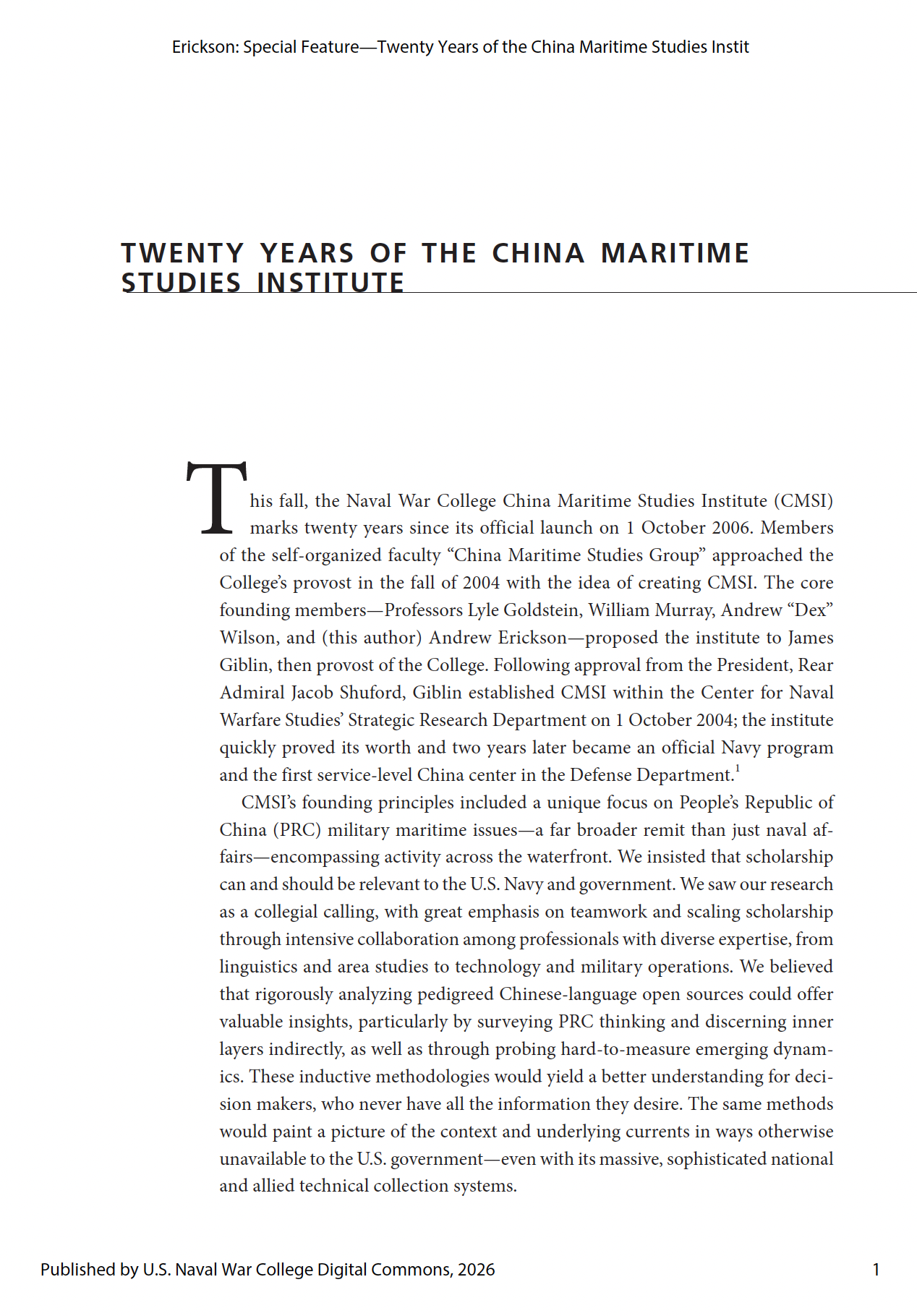
This fall, the Naval War College China Maritime Studies Institute (CMSI) marks twenty years since its official launch on 1 October 2006. Members of the self-organized faculty “China Maritime Studies Group” approached the College’s provost in the fall of 2004 with the idea of creating CMSI. The core founding members—Professors Lyle Goldstein, William Murray, Andrew “Dex” Wilson, and (this author) Andrew Erickson—proposed the institute to James Giblin, then provost of the College. Following approval from the President, Rear Admiral Jacob Shuford, Giblin established CMSI within the Center for Naval Warfare Studies’ Strategic Research Department on 1 October 2004; the institute quickly proved its worth and two years later became an official Navy program and the first service-level China center in the Defense Department.1
CMSI’s founding principles included a unique focus on People’s Republic of China (PRC) military maritime issues—a far broader remit than just naval affairs—encompassing activity across the waterfront. We insisted that scholarship can and should be relevant to the U.S. Navy and government. We saw our research as a collegial calling, with great emphasis on teamwork and scaling scholarship through intensive collaboration among professionals with diverse expertise, from linguistics and area studies to technology and military operations. We believed that rigorously analyzing pedigreed Chinese-language open sources could offer valuable insights, particularly by surveying PRC thinking and discerning inner layers indirectly, as well as through probing hard-to-measure emerging dynamics. These inductive methodologies would yield a better understanding for decision makers, who never have all the information they desire. The same methods would paint a picture of the context and underlying currents in ways otherwise unavailable to the U.S. government—even with its massive, sophisticated national and allied technical collection systems.
At our best, we have been analytic Wayne Gretzkys, “skating to where the puck is going to be,” by offering answers to questions that the Navy or government as a whole did not yet know to ask. We have provided particularly transformative insights about China’s naval leadership, naval and maritime strategy, undersea warfare, amphibious capabilities, sovereignty disputes, maritime militia, and gray-zone operations, many of which have helped motivate and lead national conversations. Engaging the broader analytic community in and out of government enriches our effort, and we have always pursued productive symbiosis with the civilian China studies community, in part by utilizing Newport’s proximity to some of the world’s leading universities. But we are conscious, too, that we have a customer and seek inputs from key principals on relevant research topics to support their decision-making to prioritize our projects. We do so in particularly close consultation with leading stakeholders, including the Office of the Chief of Na val Operations, the interagency, geographic combatant commanders, and the fleet.
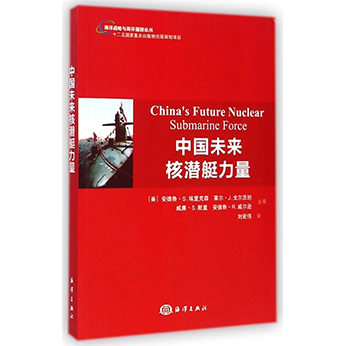
The institute was written up as an issue for the College’s 2008 program objective memorandum submission (i.e., the College’s part of the future defense budget), which secured the Chief of Naval Operations’ personal approval to formally inaugurate CMSI as a part of the College and to provide funding to hire four additional faculty members during fiscal year 2008, meaning CMSI would have its own programmed research faculty and not simply borrow people and resources from other departments. In April 2008, Secretary of Defense Robert Gates in voked CMSI as a model for the Minerva Research Initiative.2 By December 2008, CMSI had held four influential confer ences, with edited Studies in Chinese Maritime Development volumes fol lowing each iteration. These included CMSI’s inaugural event, “China’s Future Nuclear Submarine Force” (26–27 October 2005). That event, in turn, yielded CMSI’s first edited volume, which helped validate the institute’s opensource methodology.3 Among CMSI’s early publications, Chinese Mine Warfare further underscored the potential of open-source analysis and remains a foundational study in the field.4
Early on, we received substantial funding from the longtime director of the Pentagon’s Office of Net Assessment, Andrew Marshall.5 His generous support paid for publication and database subscriptions and enabled my own shift from being a contractor supporting the College to being named a U.S. government research fellow before joining the faculty formally. Other key CMSI supporters included Naval Undersea Warfare Center engineer and program manager Kyrill Korolenko, who was instrumental in bringing our early undersea warfare research to Navy leadership’s attention—including at the National Defense Industry Association’s annual clambake in New London, Connecticut.6
As the U.S. military’s first service-specific China center, CMSI inspired the founding of other analytic organizations, which we have advised and supported since their creation. These include a panoply of Naval War College centers, such as the Russia Maritime Studies Institute, as well as centers elsewhere within the armed services, including the Air Force’s China Aerospace Studies Institute, the Army’s China Landpower Studies Center, and the Marine Corps’s China Warfight ing Initiative. All employ valued colleagues, and all our nation’s China centers col laborate and meet regularly to share best practices and advance the field together.
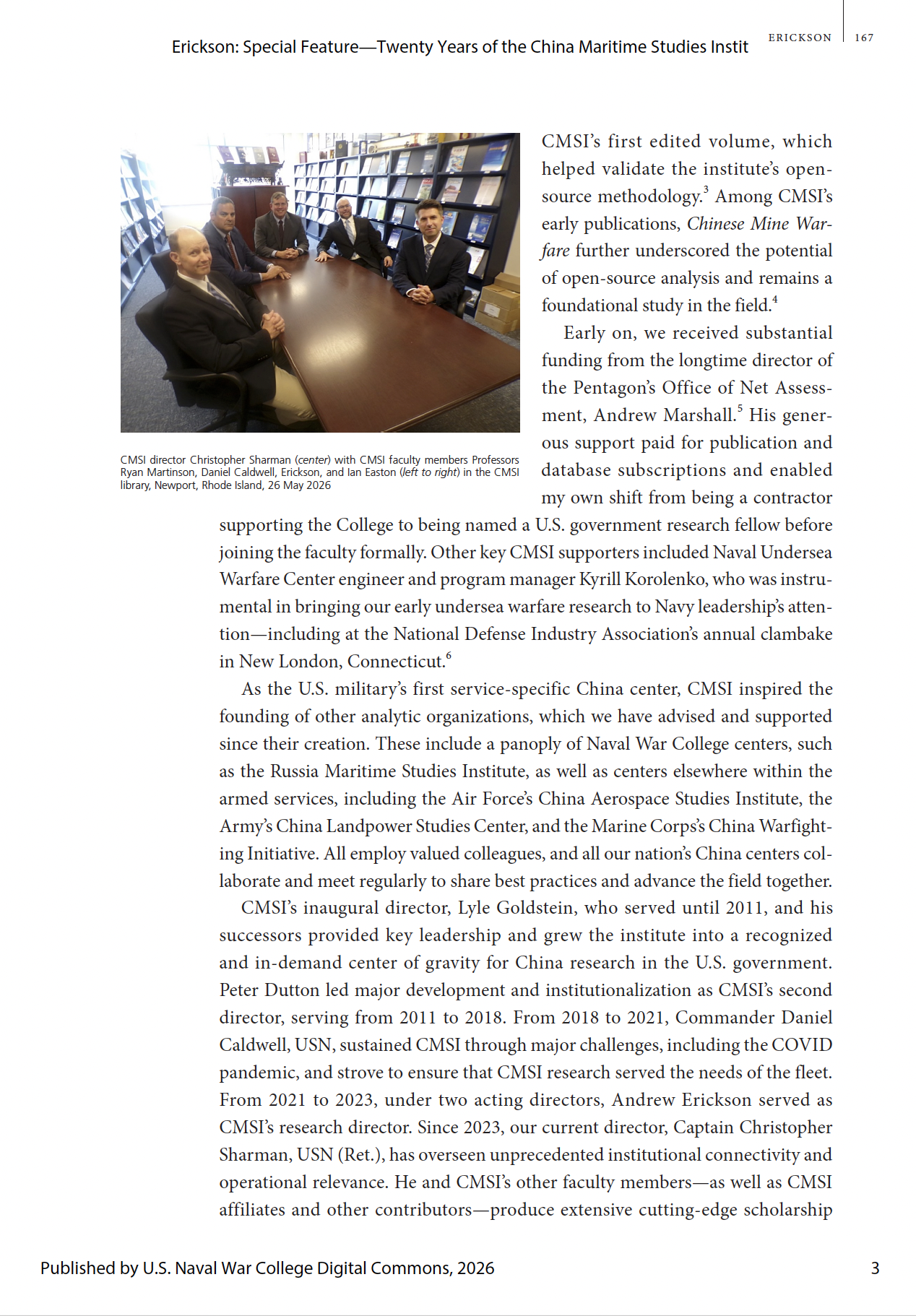
CMSI’s inaugural director, Lyle Goldstein, who served until 2011, and his successors provided key leadership and grew the institute into a recognized and in-demand center of gravity for China research in the U.S. government. Peter Dutton led major development and institutionalization as CMSI’s second director, serving from 2011 to 2018. From 2018 to 2021, Commander Daniel Caldwell, USN, sustained CMSI through major challenges, including the COVID pandemic, and strove to ensure that CMSI research served the needs of the fleet. From 2021 to 2023, under two acting directors, Andrew Erickson served as CMSI’s research director. Since 2023, our current director, Captain Christopher Sharman, USN (Ret.), has overseen unprecedented institutional connectivity and operational relevance. He and CMSI’s other faculty members—as well as CMSI affiliates and other contributors—produce extensive cutting-edge scholarship boresighted on China’s military maritime development as part of CMSI’s longstanding missions to research, write, advise, educate, and engage.7
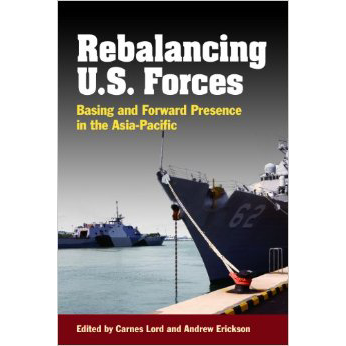
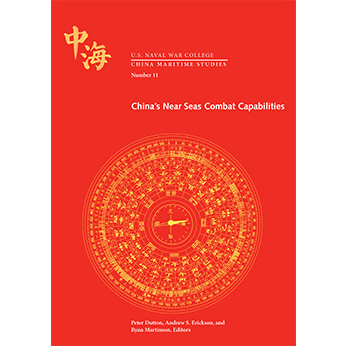
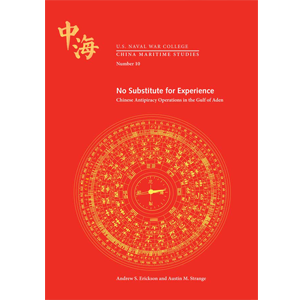
CMSI’s six product lines now include edited conference volumes (Studies in Chinese Maritime Development), China Maritime Studies (“Red Books”), China Maritime Reports, CMSI Notes, CMSI Translations, and the CMSI Quarterly Review, which includes the publication of CMSI archived translations through special editions of the Quarterly Review.8 Among these, our flagship event and output is our conference, with papers and a resulting edited volume, now held biennially for best effect. Our award-winning 2024 volume, Chinese Amphibious Warfare: Prospects for a Cross-Strait Invasion, has been named the Samuel B. Griffith Foundation’s 2025 Publication of the Year and selected for the Commandant of the Marine Corps Professional Reading Program’s 2025 and 2026 Reading Lists.9 In 2023, we revisited PRC undersea warfare, coming full circle since our first CMSI conference in 2005 on that very subject.10 The sobering comparison revealed Beijing’s two decades of progress in sharp relief. From 14 to 15 May 2025, CMSI held its fourteenth conference—to assess human factors in China’s military maritime forces.11
In the realm of advising, CMSI continues to inform USN and government stakeholders (current leaders) and Naval War College and Navy students (future leaders), as well as allies and partners. Through teaching and education more broadly, we provide curricular instruction, inputs, and guidance to the Naval War College, Navy commands across Naval Station Newport, and other professional military education institutions. We contribute directly to and support Naval War College education, with particular focus on instructing rising USN, Marine Corps, and joint flag and general officers through the College of Maritime Operational Warfare. We provide tailored flag-officer education, both on campus in Newport and around the world. We also furnish substantial support to the Joint Military Operations Department and all areas of the curriculum. Finally, we use our research and writing as a basis for highly substantive, targeted engagement with the U.S. Navy, the interagency, and allies and partners.
CMSI continues to illuminate Beijing’s meteoric oceanic advances; our next conference, to be held 11–12 May 2027, will probe military-civil fusion at sea. Two decades on, the Navy’s need to understand China’s sea forces and where they are going has never been more urgent.
Author Biography
Andrew S. Erickson is professor of strategy in the China Maritime Studies Institute (CMSI) at the Naval War College. A core founding member, he helped establish CMSI and stand it up officially in 2006 and played an integral role in its development; from 2021 to 2023 he served as research director. CMSI inspired the creation of other research centers, which Erickson has advised and supported; he is a China Aerospace Studies Institute associate. Erickson is also an adjunct professor at the Daniel K. Inouye Asia-Pacific Center for Security Studies. Erickson is currently a visiting scholar at Harvard University’s Asia Center, and he has been an associate in research at Harvard’s John King Fairbank Center for Chinese Studies since 2008. In 2024, Erickson was awarded the Navy Superior Civilian Service Medal. His research website is www.andrewerickson.com.
Photograph Captions
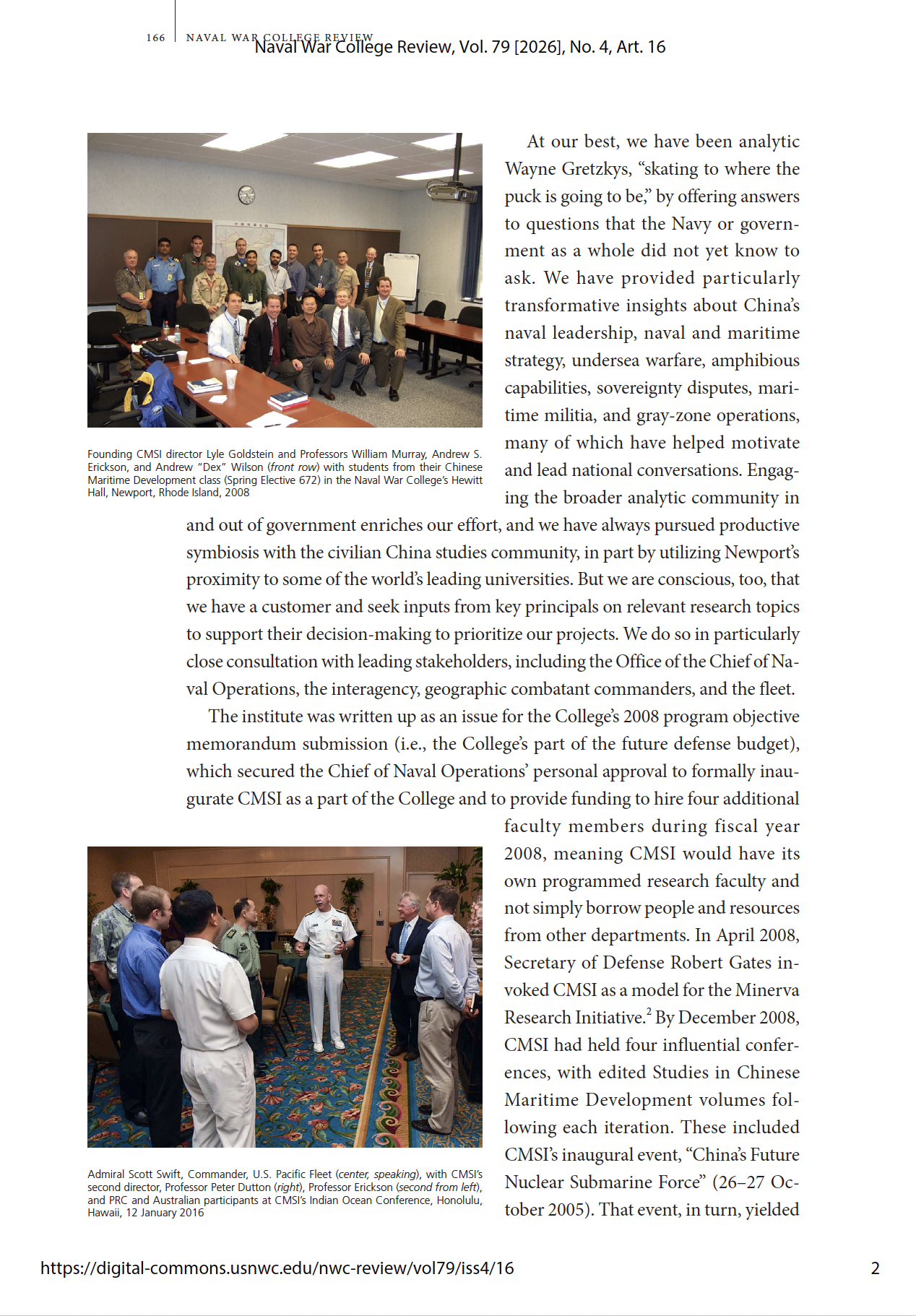
Founding CMSI director Lyle Goldstein and Professors William Murray, Andrew S. Erickson, and Andrew “Dex” Wilson (front row) with students from their Chinese Maritime Development class (Spring Elective 672) in the Naval War College’s Hewitt Hall, Newport, Rhode Island, 2008
Admiral Scott Swift, Commander, U.S. Pacific Fleet (center, speaking), with CMSI’s second director, Professor Peter Dutton (right), Professor Erickson (second from left), and PRC and Australian participants at CMSI’s Indian Ocean Conference, Honolulu, Hawaii, 12 January 2016
CMSI director Christopher Sharman (center) with CMSI faculty members Professors Ryan Martinson, Daniel Caldwell, Erickson, and Ian Easton (left to right) in the CMSI library, Newport, Rhode Island, 26 May 2026
Notes
- In 2015 the Strategic Research Department merged with the Warfare Analysis and Research Department to form the present-day Strategic and Operational Research Department. This essay draws in part on Andrew S. Erickson, “CMSI’s 20th Anniversary! China Maritime Studies Institute Established Two Decades Ago within Naval War College,” China Analysis from Original Sources, 2 October 2024, www.andrewerickson.com/; and John B. Hattendorf, 1984–2009, vol. 2 of Sailors and Scholars: The History of the U.S. Naval War College, 1884–2009, 2nd ed. (Naval War College Press, 2025), pp. 546–49, 553–54, 412–13, 418, 468, 530, 640, 649, 695–96, 729.
- Robert M. Gates, speech to Association of American Universities (Washington, DC, 14 April 2008), transcript available at www.andrewerickson.com/.
- Andrew S. Erickson et al., eds., China’s Future Nuclear Submarine Force (Naval Institute Press, 2007); Raymond Pritchett (Galrahn), “Reading Bliss for Observers of Submarines and China,” Information Dissemination, 3 January 2008, available at www.andrewerickson.com/; Raymond Pritchett (Galrahn), “It’s Always Nice to Get the Chinese Perspective,” Information Dissemination, 8 January 2008, available at www.andrewerickson.com/.
- Andrew S. Erickson, Lyle J. Goldstein, and William S. Murray, Chinese Mine Warfare: A PLA Navy “Assassin’s Mace” Capability, China Maritime Study 3 (Naval War College Press, June 2009), available at digital-commons.usnwc.edu/.
- Andrew S. Erickson, “Honoring the Many Contributions of Andrew Marshall, an Early Supporter and Sponsor of CMSI,” China Analysis from Original Sources, 26 March 2019, www.andrewerickson.com/.
- Andrew S. Erickson, “In Loving Memory: A Tribute to CMSI Founding Supporter Kyrill Korolenko,” China Analysis from Original Sources, 19 March 2019, www.andrewerickson.com/.
- DVIDS HUB, “CLSC Dialogues—Ep 7—Christopher Sharman and Dr. Andrew S. Erickson—China Center Director Series—China Maritime Studies Institute,” 30 May 2024, YouTube video, 14:42, www.youtube.com/.
- “China Maritime Studies Institute,” U.S. Naval War College, www.usnwc.edu/.
- Eric M. Smith [Gen., USMC], “Update to the Commandant’s Professional Reading List for Fiscal Year 26,” ALMAR 024/25, 12 December 2025, available at www.marines.mil/; Andrew S. Erickson, “Two Years Running! ‘Chinese Amphibious Warfare’ Selected for Commandant of the Marine Corps Professional Reading Program’s 2025 & 2026 Reading Lists,” China Analysis from Original Sources, 14 December 2025, www.andrewerickson.com/.
- China Maritime Studies Institute, “Chinese Undersea Warfare: Development, Capabilities, Trends,” Quick Look Report (U.S. Naval War College, 5 May 2023), available at www.andrewerickson.com/.
- China Maritime Studies Institute, “The People of China’s Navy and Other Maritime Forces,” Quick Look Report (U.S. Naval War College, 22 May 2025), available at www.andrewerickson.com/.
Source: https://digital-commons.usnwc.edu/nwc-review/vol79/iss4/16