New! CMSI Quarterly Review 1.3 (February 2026)—The Legal Struggle for China’s Maritime Power: Strategy, Sovereignty, and Enforcement
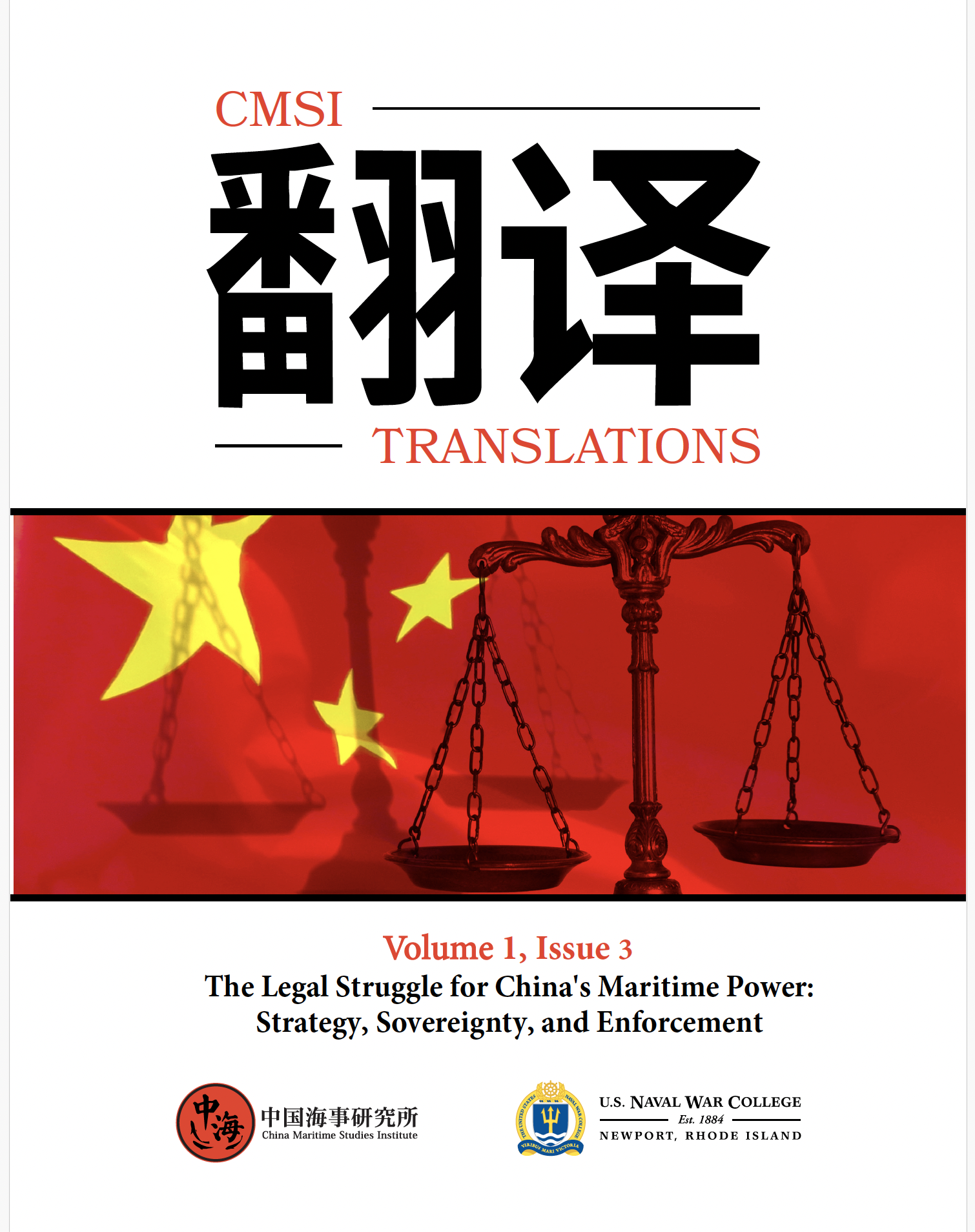
The Legal Struggle for China’s Maritime Power: Strategy, Sovereignty, and Enforcement, CMSI Quarterly Review 1.3 (February 2026) (Newport, RI: Naval War College China Maritime Studies Institute, 17 February 2026).
CLICK HERE TO DOWNLOAD A CACHED PDF COPY.
From CMSI Director Christopher Sharman:
China Military Maritime Watchers: How does maritime law become an instrument of power and influence?
The China Maritime Studies Institute (CMSI) is pleased to announce the publication of our latest CMSI Quarterly Review – Translation Special Edition.
This volume brings together 20 archived CMSI translations to trace how the People’s Republic of China (PRC) built and operationalized a robust legal architecture in support of its strategic transition from a large maritime country to a maritime power.
Drawn from official and unofficial PRC journals, these articles reveal how maritime law has been used to legitimize expansive extraterritorial claims, establish legal “red lines,” and shape competitive behavior at sea.
Rather than reading history backward, the volume treats each article as a snapshot in time, capturing evolving PRC thinking—from China’s role in international maritime negotiations to the modern employment of law as an operational instrument.
As PRC maritime disputes intensify, understanding how China arrived at its legal positions—and how it intends to use them—matters more than ever.
We hope this collection of archived translations proves a valuable resource for scholars, warfighters, and policymakers navigating the Indo-Pacific’s increasingly contested legal terrain.
FROM THE DIRECTOR
The Legal Struggle for China’s Maritime Power: Strategy, Sovereignty, and Enforcement contains a curated collection of open-source Chinese-language journal and newspaper articles originally published in the People’s Republic of China (PRC). Translated by the China Maritime Studies Institute (CMSI) over the last thirteen years, the 20 articles contained in this volume are structured around how the PRC employs legal frameworks, strategies, and enforcement to safeguard its national maritime rights and interests. The volume progresses thematically from the highest level of legal authority to domestic legal strategy and concludes with practical enforcement.
- Part I: Foundations in International Maritime Law: China and UNCLOS establishes the historical context of China’s participation in international law, focusing on the debates and compromises of UNCLOS III, where China consistently advocated positions favoring its sovereignty claims, such as the 12 nautical mile territorial sea and legal retention of the continental shelf.
- Part II: Domestic Legal System: The Pursuit of Comprehensive Maritime Law addresses the fragmentation of China’s existing legal structure, arguing for the urgent formulation of a centralized Maritime Basic Law or Ocean Defense Law to legalize its strategic objectives and provide a constitutional basis for administrative actions.
- Part III: Sovereignty Claims, Legal Strategies, and Contestation then delves into the legal doctrines and diplomatic struggles related to disputed waters, examining the PRC’s position on “historical rights” and the use of straight baselines for mid-ocean archipelagos like the Paracel and Spratly Islands, and the country’s rejection of third-party arbitration, such as the China-Philippines case.
The remaining sections focus on the implementation of these legal and strategic policies.
- Part IV: Law Enforcement Agencies, Operations, and Civilian Mobilization detail show China equips and organizes its forces, including the legal powers granted to theChina Coast Guard Bureau (CCGB) through the draft Coast Guard Law, and the imperative to improve the legal basis for mobilizing civilian vessels and wharves for national defense and rights protection operations.
- Part V: Legal Analysis of Force, Self-Defense, and Jurisdiction rounds out this volume by analyzing specific legal ambiguities concerning the use of force in maritime military actions, distinguishing between prohibited military force and regulated law enforcement force, and exploring jurisdictional issues related to overseas military bases and the role of the Maritime Militia in legal warfare.
This organizational approach demonstrates how China moves from international legal diplomacy to domestic legislation and, ultimately, to on-the-scene legal enforcement and strategic confrontation, all unified by the goal of safeguarding national interests and security.
About the China Maritime Studies Institute (CMSI) Translation Vault Series
Each volume in the series is loosely organized by theme, featuring articles that address strategic, operational, and tactical dimensions of the PRC’s maritime military affairs. Selection of articles for inclusion in this volume was guided by operational or policy relevance at the time of translation, with some articles anticipating key shifts in Chinese policy or doctrine, and others offering rare glimpses into both official narratives and unofficial discourse.
Though historical in origin, many of these sources remain timely. Readers may uncover enduring patterns, early indicators of current trends, or fresh perspectives on the PRC’s long-term military maritime ambitions. CMSI will continue publishing volumes in this series until its archive of previously translated materials is fully released.
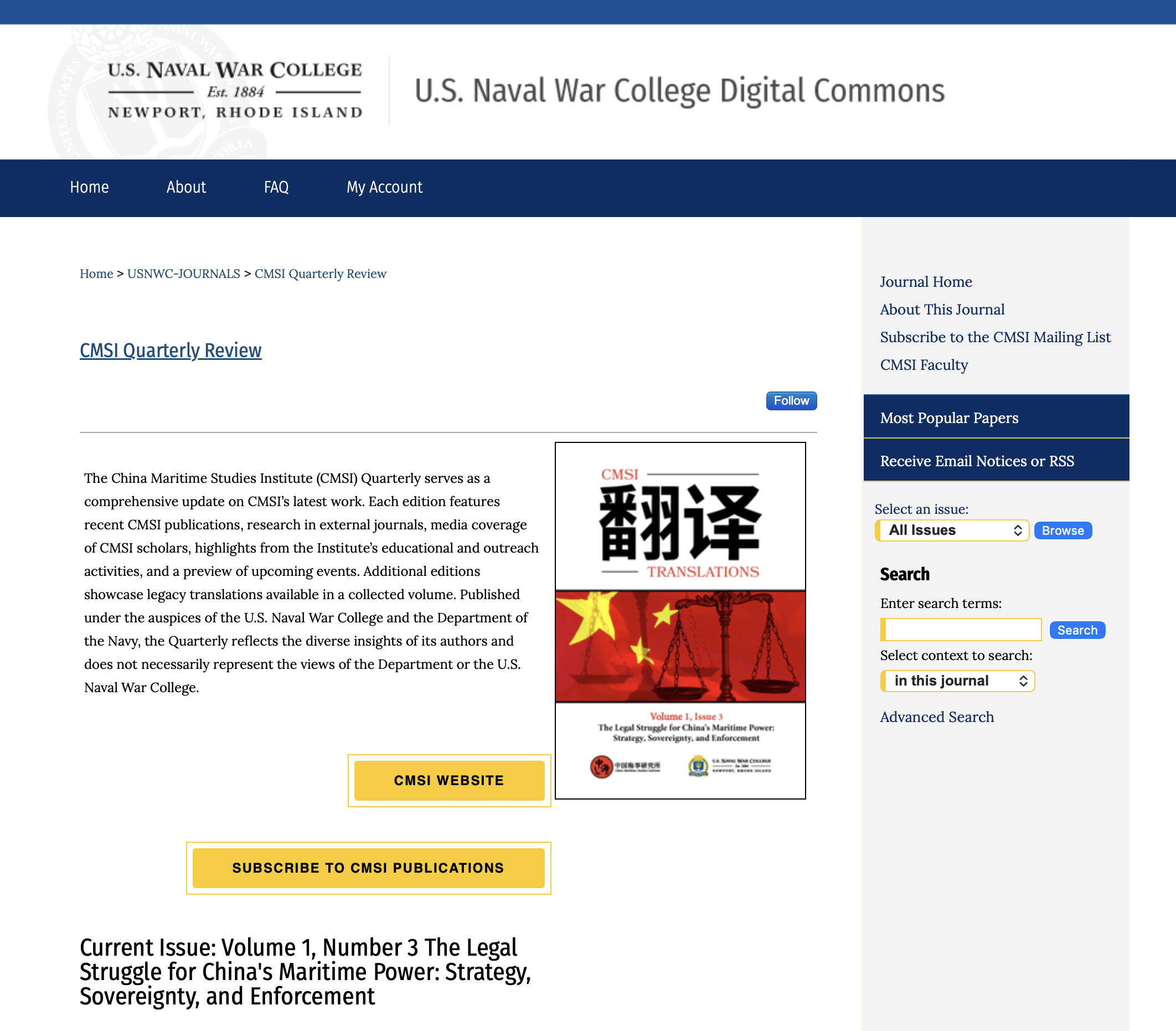
Current Issue: Volume 1, Number 3
The Legal Struggle for China’s Maritime Power: Strategy, Sovereignty, and Enforcement
Translated by the China Maritime Studies Institute (CMSI) over the last thirteen years, the 20 articles contained in this volume are structured around how the PRC employs legal frameworks, strategies, and enforcement to safeguard its national maritime rights and interests. The volume progresses thematically from the highest level of legal authority to domestic legal strategy and concludes with practical enforcement.
Full Issue
Table of Contents
From the Director
Volume 1, Number 3 – From the Director
Christopher Sharman
CMSI Translations
CMSI Archive Translation: From Yan’an to the United Nations: The Diplomatic Career of Ling Qing
Ling Qing
CMSI Archive Translation: Accelerate the Formulation of a National Maritime Strategy and Maritime Basic Law
Wang Hanlin
CMSI Archive Translation: Thoughts on Advancing Ocean Defense Construction Work in the New Situation
Wu Jianhong, Huang Chunyu, and Liu Changlong
CMSI Archive Translation: PRC Coast Guard Law (Draft)
Standing Committee of the National People’s Congress
CMSI Archive Translation: Research on Requirements and Measures in Civilian Vessel Mobilization for Maritime Rights Protection
Dai Jiachen and Geng Yueting
CMSI Archive Translation: Legal Problems Regarding the Use of Force in Military Actions at Sea
Lin Tianjie
CMSI Archive Translation: Tasks and Operations of the Maritime Militia When Participating in Maritime Combat
Liu Zili and Chen Qingsong
CMSI Archive Translation: Research on Legal Issues Related to Security and Defense of China’s Overseas Military Bases
Zou Ligang and Wang Zhangping
***
PREVIOUS VOLUMES IN THE SERIES:
The China Maritime Studies Institute (CMSI) Quarterly serves as a comprehensive update on CMSI’s latest work. Each edition features recent CMSI publications, research in external journals, media coverage of CMSI scholars, highlights from the Institute’s educational and outreach activities, and a preview of upcoming events. Additional editions showcase legacy translations available in a collected volume. Published under the auspices of the U.S. Naval War College and the Department of the Navy, the Quarterly reflects the diverse insights of its authors and does not necessarily represent the views of the Department or the U.S. Naval War College.
CMSI Quarterly Review 1.2 (Winter 2026) (Newport, RI: Naval War College China Maritime Studies Institute, 8 January 2026).
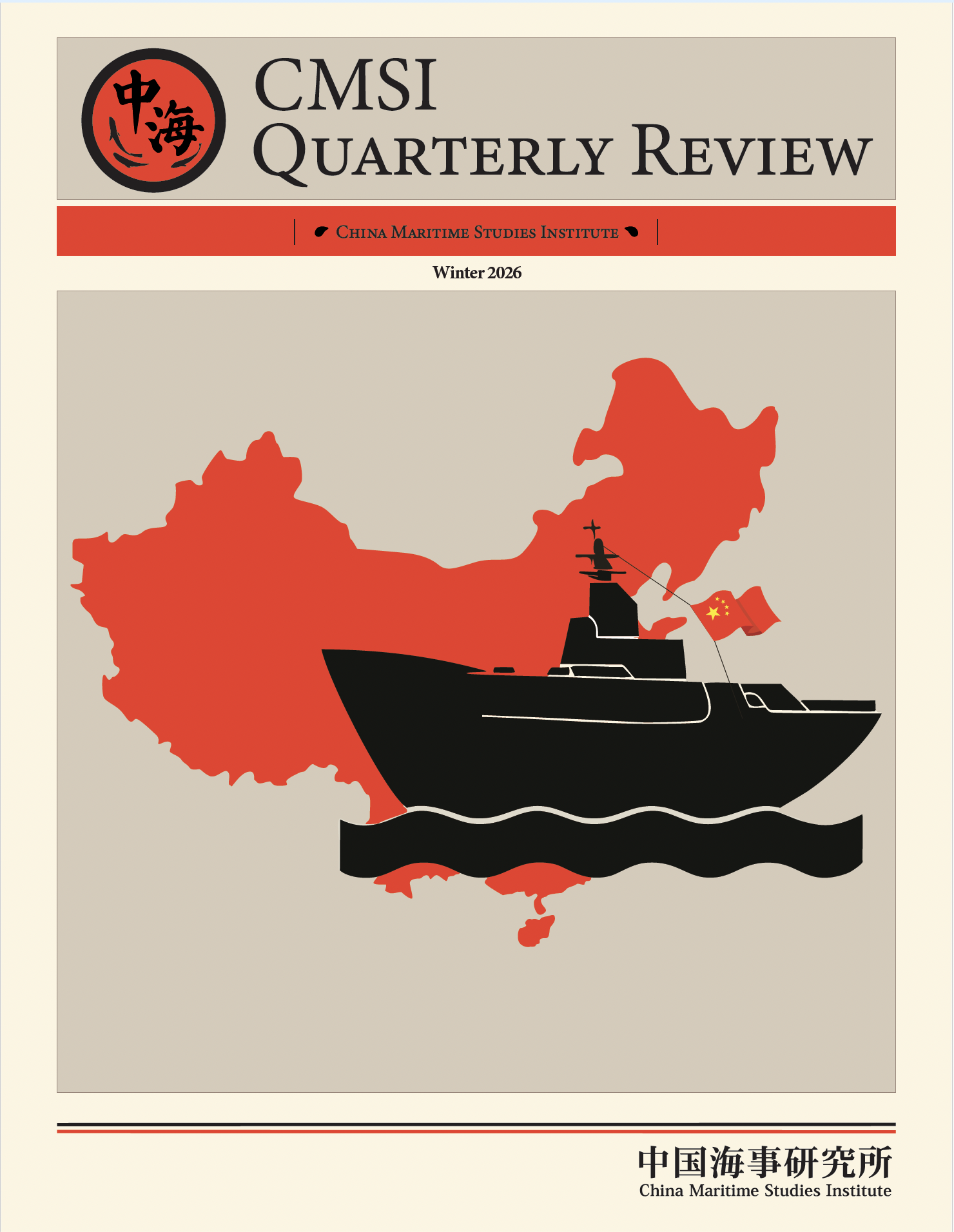
CLICK HERE TO DOWNLOAD A CACHED PDF COPY.
From CMSI Director Christopher Sharman:
We are pleased to share the Fall/Winter double issue of the CMSI Quarterly Review, highlighting the China Maritime Studies Institute’s latest scholarship, media engagement, and institutional activities from August through December 2025.
The full volume is available for download at the link HERE, which also provides direct access to all China Maritime Reports, CMSI Notes, and CMSI Translations published during this period.
This issue features several notable highlights, including:
- CMSI Professor Ryan Martinson’s article, “Exposed Undersea: PLA Navy Officer Reflections on China’s Not-So-Silent Service,” which was the most viewed article at the Center for International Maritime Security in 2025.
- For the second consecutive year, CMSI’s edited volume, Chinese Amphibious Warfare: Prospects for a Cross-Strait Invasion, was selected for inclusion in the 2026 Commandant of the Marine Corps Professional Reading Program.
- It highlights CMSI’s newest publication line—our legacy translations—along with information on how to access these resources.
The CMSI Quarterly Review also includes links to all CMSI publications and to news articles featuring CMSI research and commentary.
Much more to come from CMSI in 2026!
The China Maritime Studies Institute (CMSI) Quarterly serves as a comprehensive update on CMSI’s latest work. Each edition features recent CMSI publications, research in external journals, media coverage of CMSI scholars, highlights from the Institute’s educational and outreach activities, and a preview of upcoming events. Additional editions showcase legacy translations available in a collected volume. Published under the auspices of the U.S. Naval War College and the Department of the Navy, the Quarterly reflects the diverse insights of its authors and does not necessarily represent the views of the Department or the U.S. Naval War College.
• New Quarterly Review. Last month, CMSI launched the CMSI Quarterly Review, a new publication series. Volume 1 opened with eight legacy translations focused on the maritime geopolitics of the Belt and Road Initiative. Going forward, CMSI will release special thematic editions each quarter, alongside regular issues showcasing CMSI’s latest scholarship, media engagement, and activities. Issues of the CMSI Quarterly Review are available for download on the CMSI website—visit https://usnwc.edu/cmsi to access them.
• Congratulations to Professor Ryan Martinson. CMSI Professor Martinson was promoted to Associate Professor this past fall – a long overdue promotion! In addition, he authored the most viewed article at the Center for International Maritime Security for 2025. His article, “Exposed Undersea: PLA Navy Officer Reflections on China’s Not-So-Silent Service” is well worth reading. Congratulations, Ryan!
• The Commandant’s List (Again). CMSI is proud to have our edited volume, “Chinese Amphibious Warfare: Prospects for a Cross-Straits Invasion” selected for the 2026 Commandant of the Marine Corps Professional Reading Program. First included in 2025, the volume has gained significant traction, with nearly 13,000 downloads from the Naval War College website. Download your free copy today!
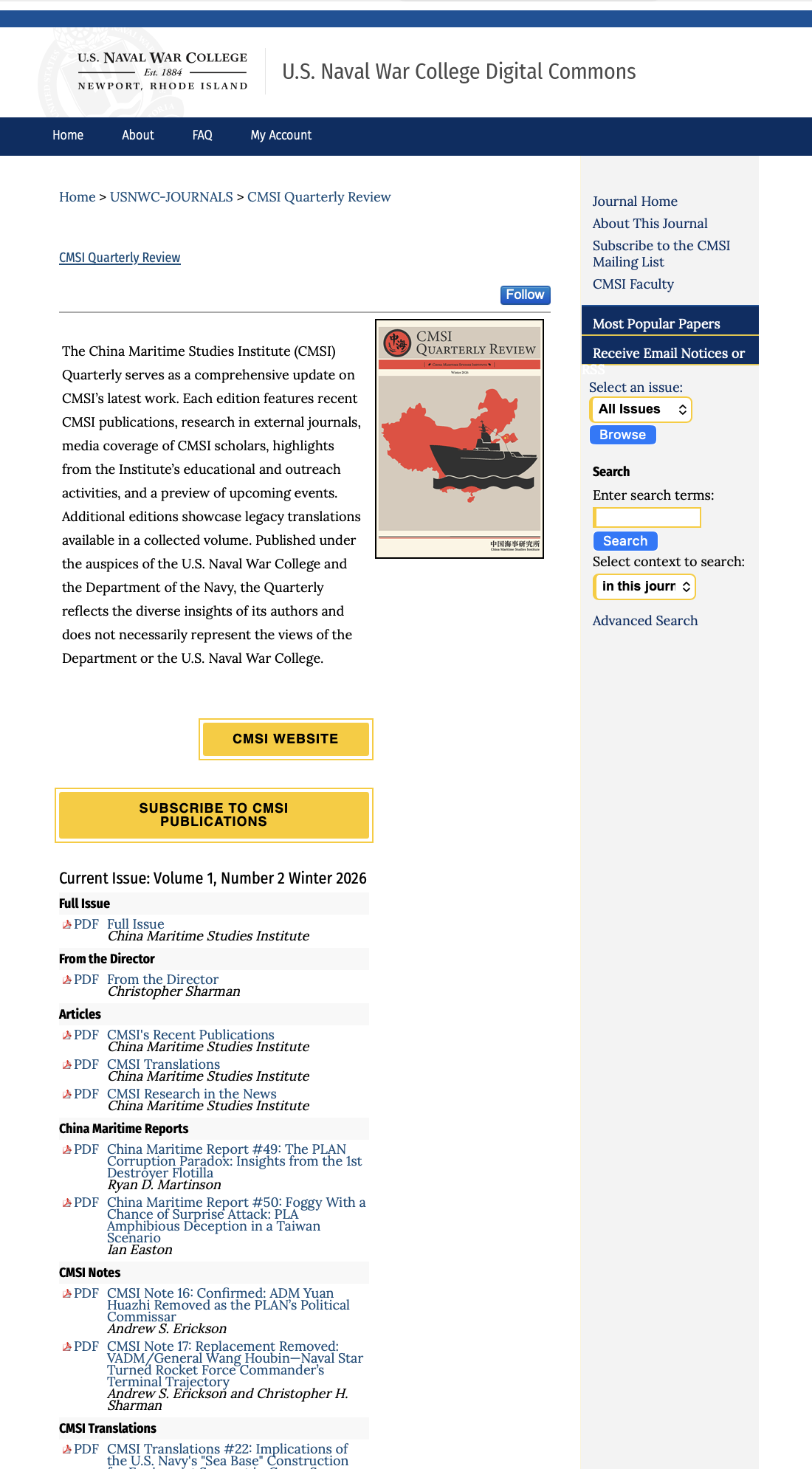
Volume 1, Number 2 Winter 2026
Full Issue
Full Issue
China Maritime Studies Institute
From the Director
From the Director
Christopher Sharman
Articles
CMSI’s Recent Publications
China Maritime Studies Institute
CMSI Translations
China Maritime Studies Institute
CMSI Research in the News
China Maritime Studies Institute
China Maritime Reports
China Maritime Report #49: The PLAN Corruption Paradox: Insights from the 1st Destroyer Flotilla
Ryan D. Martinson
CMSI Notes
CMSI Note 16: Confirmed: ADM Yuan Huazhi Removed as the PLAN’s Political Commissar
Andrew S. Erickson
CMSI Note 17: Replacement Removed: VADM/General Wang Houbin—Naval Star Turned Rocket Force Commander’s Terminal Trajectory
Andrew S. Erickson and Christopher H. Sharman
CMSI Translations
***

FROM THE DIRECTOR
The China Maritime Studies Institute (CMSI) Translation Vault
This series presents a curated collection of open-source Chinese-language journal and newspaper articles that were originally published in the People’s Republic of China (PRC). Hand-selected for their relevance to PRC military maritime affairs and translated by CMSI researchers over the past thirteen years, these materials were previously only available for limited distribution. CMSI is now pleased to open access to these translations and offer them to a broader community of defense professionals and scholars seeking deeper insights into evolving PRC military maritime developments.
Each volume in the series is loosely organized by theme, featuring articles that address strategic, operational, and tactical dimensions of the PRC’s maritime military affairs. Selection was guided by operational or policy relevance at the time of translation, with some articles anticipating key shifts in Chinese policy or doctrine, and others offering rare glimpses into both official narratives and unofficial discourse.
Though historical in origin, many of these sources remain timely. Readers may uncover enduring patterns, early indicators of current trends, or fresh perspectives on the PRC’s long-term military maritime ambitions. CMSI will continue publishing volumes in this series until its archive of previously translated materials is fully released.
About This Volume
Volume 1 of this series, Maritime Geopolitics of the Belt and Road Initiative, features eight translated articles examining China’s expanding interests beyond the western Pacific and the strategies it is developing to protect them—particularly along the 21st Century Maritime Silk Road corridors. President Xi Jinping first announced the overland Silk Road Economic Belt and the Maritime Silk Road during an official visit to Indonesia in 2013. Initially referred to as One Belt, One Road (OBOR), the initiative was later rebranded as the Belt and Road Initiative (BRI).
The opening article, “A Summary of Chinese Research on the Construction of the 21st Century Maritime Silk Road,” surveys PRC academic literature on the 21st Century Maritime Silk Road. It highlights key challenges, including geopolitical rivalry, uneven development, and non-traditional security threats along these corridors. The piece identifies gaps in existing PRC research, calling for empirical studies, sector-specific analysis, and broader regional coverage to inform policymaking and strategic planning.
“‘One Belt, One Road’ and Grand Border Defense,” published in the People’s Liberation Army’s (PLA) official military journal National Defense in 2016, presents the initiative as both an economic and security framework. It argues that OBOR necessitates a shift from inward-focused defense to an outward-looking, integrated approach—termed “grand border defense”—combining military, diplomatic, and political tools to secure China’s interests along its periphery and maritime routes.
The subsequent article, “‘Marching West’: The Rebalance of China’s Geo-Strategy,” was authored in 2012 by Wang Jisi, then Dean of Peking University’s School of International Studies, and originally published in the nationalist Global Times newspaper. The article is noteworthy for anticipating the logic that would later underpin BRI. Wang articulates a strategic rationale for the PRC to orient itself westward in order to secure energy supply chains, expand access to emerging markets, and counterbalance the U.S. “pivot to Asia.” He underscores the importance of long-term planning, sustained diplomatic engagement, and the cultivation of regional expertise.
The next three articles explore China’s efforts to establish overseas strategic footholds. “Strategic Strongpoints along the ‘Belt and Road’ and Building Military Diplomacy” examines the role of military (i.e., PLA Navy, PLAN) diplomacy in selecting and developing overseas bases. “National Maritime Strategy Founded on Seapower Theory” draws on Mahanian theory to argue for far-seas training, overseas basing, and a national maritime consciousness. It identifies key priorities: securing the South China Sea, projecting influence in Southeast Asia and protecting energy routes to the Indian Ocean. “Making and Breaking the Status Quo: China’s Overseas Strategic Support Points” offers case studies of China’s overseas facilities and analyzes its long-term basing strategy.
The final two articles assess PLAN operations in the far seas. “Chinese Sea Power Expansion and the State of Sea Power in the Indian Ocean” focuses on strategic competition with India and the race to control key chokepoints. “Five Major Implications of Chinese Surface Task Forces Crossing the International Date Line” evaluates the operational and strategic significance of the PLAN’s first eastward crossing in a combat-ready posture, highlighting implications for deterrence, regional dynamics, and maritime power projection.
Together, the articles within this volume provide a window into the PRC’s evolving strategic thought as it seeks to protect its expanding global interests. They reveal a concerted effort to integrate economic initiatives like BRI with expanded military, diplomatic, and infrastructural capabilities, particularly across the Indian Ocean region. By analyzing how Chinese scholars and strategists conceptualize maritime power, overseas basing, and geopolitical competition, this volume offers valuable and timeless insights into the drivers of the PRC’s external posture and the potential implications for regional and global security as Beijing seeks to transform the PLAN into a “world-class” navy.
Volume 1 (2025) Maritime Geopolitics of the Belt and Road Initiative
This volume features eight translated articles examining China’s expanding interests beyond the western Pacific and the strategies it is developing to protect them—particularly along the 21st Century Maritime Silk Road corridors. President Xi Jinping first announced the overland Silk Road Economic Belt and the Maritime Silk Road during an official visit to Indonesia in 2013. Initially referred to as One Belt, One Road (OBOR), the initiative was later rebranded as the Belt and Road Initiative (BRI).
Full Issue
Volume One Full Issue
China Maritime Studies Institute
Table of Contents
Table of Contents
China Maritime Studies Institute
From the Director
From the Director
China Maritime Studies Institute
Articles
CMSI Archive Translation: A Summary of Chinese Research on the Construction of the 21st Century Maritime Silk Road
Tan S. Yao [谭瑶]
CMSI Archive Translation: Strategic Strongpoints along the “Belt and Road” and Building Military Diplomacy
Liu Lin [刘琳}
CMSI Archive Translation: Making and Breaking the Status Quo: China’s Overseas Strategic Support Points
Hu Zhongjian [胡中建]