The Pentagon’s New China Report: ‘Conventional’ ICBMs, More Nuclear Weapons and New Aircraft Carriers on the Horizon
Andrew S. Erickson, “The Pentagon’s New China Report: ‘Conventional’ ICBMs, More Nuclear Weapons and New Aircraft Carriers on the Horizon,” 19FortyFive, 29 December 2025.
Disclaimer: The perspectives expressed here are those of the author alone, based solely on open sources. They do not represent the views, policies, or positions of the Naval War College, the Department of the Navy, or any other organization of the US government.
Key Findings
Where possible, my distillation of the report’s findings focuses on those that are truly revealed for the first time (not previously published anywhere else, to my knowledge) or authoritatively confirmed when reliable sourcing was previously unavailable. Among the most significant disclosures:
- A variant of China’s DF-27 is now assessed as a fielded conventionally armed ICBM (5,000-8,000 km); an anti-ship ballistic missile (ASBM) variant is also operational.
- China’s operational nuclear warheads numbered in the “low 600s” through 2024, on track toward >1,000 by 2030.
- Beijing’s Early-Warning Counterstrike (EWCS) nuclear posture includes 90-second ICBM detection, 3-4-minute alert, >100 silos loaded with DF-31-class ICBMs, and December 2024 rapid-launch training.
- China’s 2024 Pacific DF-31B ICBM test rehearsed nuclear signaling launches into broad ocean areas.
- The DF-26 intermediate-range ballistic missile (IRBM) and the H-6N bomber’s air-launched ballistic missile (ALBM) offer logical delivery systems for low-yield (<10 kt) precision nuclear strikes.
- Since November 2023, PRC-based companies have sold dual-use components that Houthi fighters have used in Red Sea attacks.
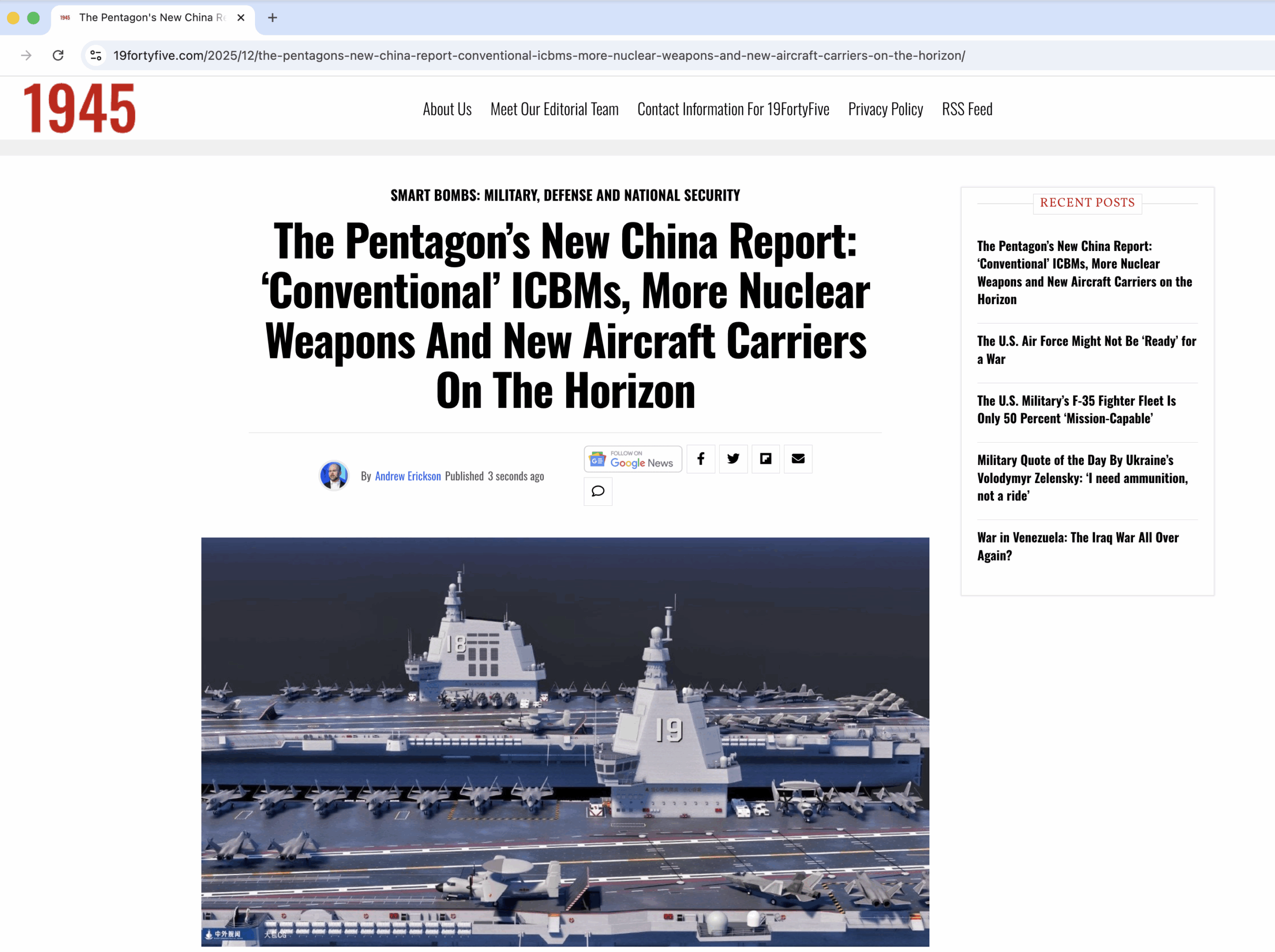
- By 2035, China seeks to build 6 aircraft carriers beyond the 3 it already has.
- China’s dominance in rare earths facilitates advanced armaments production (e.g., of directed-energy weapons).
- Beijing’s aim to be able to fight and win a war on Taiwan by the end of 2027 requires three “strategic capabilities” (strategic decisive victory, counterbalance—requiring ongoing nuclear modernization —and deterrence and control).
- Despite widespread removals of People’s Liberation Army (PLA) and defense industry leaders, China continues to make steady progress toward its 2027 goals.
America Within Reach
Arguably, one of the most significant revelations is that America’s homeland is not a sanctuary from either nuclear or conventional missiles. Per the report’s “Fielded Conventional Strike” graphic, China has deployed a conventional ICBM capable of partially ranging America’s homeland. This year’s report is the first to treat the DF-27 as a fielded system in the ICBM range band and to depict it as a conventional ICBM with an ASBM variant, building on the 2024 report’s assessment that the DF-27 may have hypersonic glide vehicle (HGV), conventional land-attack, anti-ship, and nuclear payload options. The report underscores that “China has the world’s leading hypersonic missile arsenal.” It highlights land-attack and anti-ship missile families—including DF-17 and YJ-21—as well as longer-range ballistic missile families (DF-21, DF-26, DF-27) whose reentry vehicles or glide payloads can maneuver at hypersonic speeds.
Tracking Beijing’s nuclear weapons buildup, by far the world’s fastest, the report tallies PRC operational nuclear warheads “in the low 600s through 2024,” and judges that the PLA remains on track to field “over 1,000 warheads by 2030.”
Regarding nuclear force architecture and performance, the report provides exclusive technical details on China’s developing EWCS (essentially launch-on-warning) capability, including associated detection and reporting times. In early-warning advances, China’s Tongxun Jishu Shiyan (TJS/Huoyan-1) geosynchronous early-warning satellites can reportedly detect an incoming ICBM within ~90 seconds of launch; an alert can be sent to a command center within 3-4 minutes. Corroborating and supplementing space-based warning, ground-based large phased-array radars can probably detect incoming ballistic missiles at high altitudes thousands of kilometers away and feed information to a command authority, potentially enabling a counterstrike before inbound detonation.
To further support an EWCS posture, “the PLA has likely loaded more than 100 solid-propellant ICBM missile silos at its three silo fields with DF-31 class ICBMs.” The report documents EWCS-relevant training: a December 2024 exercise where “the PLA launched several ICBMs in quick succession from a training center into Western China, indicating the ability to rapidly launch multiple silo-based ICBMs.”
Proven ICBMs
The report officially identifies and details a landmark Pacific ICBM test and interprets it in terms of doctrine and signaling. On September 25, 2024, the PLA Rocket Force (PLARF) launched a DF-31B from northern Hainan Island, which impacted ~11,000 km away near French Polynesia. This first PRC open-sea ICBM test since 1980 likely facilitated training on procedures for “medium-to-high intensity nuclear deterrence operations” involving launches into broad ocean areas during crises or conflict.
Tracing China’s nuclear triad development, the report identifies the employment of the H-6N nuclear-capable bomber in combined patrols with Russia. H-6Ns participated in Sino-Russian strategic patrols in 2024, the first deployment of nuclear-capable PLA bombers in such a bilateral operation. The report asserts that China is probably pursuing sub-10-kiloton warheads, and specifies logical delivery systems for limited nuclear strikes: the DF-26 IRBM and the H-6N bomber’s ALBM are “both highly precise theater weapons … well suited for delivering a low-yield nuclear weapon.”
Strengthening Supply Chain
The report provides unparalleled detail on China’s potential weapons-grade plutonium production, including reactor status, additional reprocessing capacity, and defense industry investigations. Fueling China’s massive nuclear weapons buildup, the report updates the status of its two CFR-600 fast breeder reactors at Xiapu, noting that the first unit—planned to be online in 2023—”is probably still undergoing testing,” while the second remains under construction. The report discloses a third 200-ton/year reprocessing plant being built at China National Nuclear Corporation (CNNC)’s Gansu Nuclear Technology Industrial Park in Jinta County. Once online, the CFR-600s will reestablish China’s ability to produce weapons-grade plutonium, at significant scale given their design and associated reprocessing capacity.
In its extensive coverage of the Xiapu reactors, the 2024 report underscored their scale: “the quantity of HEU [highly enriched uranium] transferred from Russia to the PRC for its CFR-600 reactors is more than the entire amount of HEU removed worldwide under US and International Atomic Energy Agency (IAEA) auspices in the last three decades.” Progress continues despite CNNC scrutiny. In the twelve months after December 2023, “the Central Commission for Discipline Investigation announced investigations of at least two former division chiefs, one former deputy division chief, and former heads of two CNNC subsidiaries,” the report documents. “Yu Jianfeng, the head of CNNC, has missed public activities since at least January 2025, including the March 2025 NPC meeting, indicating that he may also be under investigation,” the report assesses. “Other personnel moves within CNNC may indicate additional investigations are ongoing.”
Relaunching a Corrupted Force
Regarding widespread PLARF corruption, cross-service appointments, and readiness impact, the report offers the most comprehensive, authoritative public assessment yet of scale, causes, and capability implications, as well as how Commander-in-Chief Xi Jinping is managing the PLARF through cashiering, appointments, and inspections. Open source research by the China Maritime Studies Institute (CMSI) and others previously documented the removal of two PLARF commanders and multiple deputy commanders and chiefs of staff as well as senior engineers tied to nuclear weapons; the unprecedented 2023 replacement of the PLARF’s Commander and Political Commissar with PLA Navy (PLAN) and PLA Air Force officers (the former himself later removed); and Xi’s October 2024 inspection of the PLARF’s 611th Brigade. What the report contributes with unique authority is an overall assessment that this “may be raising questions among leadership about force readiness,” while also potentially setting the stage for longer-term improvements, and how Xi’s first PLARF visit since the corruption allegations surfaced in 2023 demonstrates his personal focus on the service and its reliability.
Other areas of emphasis in the report are sprinkled with fresh insights and uniquely authoritative assessments. Regarding the maritime domain, the report offers little data regarding the PLAN’s burgeoning force structure. Still, it provides extensive detail on Coast Guard and Maritime Militia operations, particularly aggressive moves against rival claimants in the South China Sea, increasingly supported by fortified outposts there. To broker a separate peace securing the safety of its commercial shipping in the Red Sea and Gulf of Aden, “Beijing has privately engaged with the Houthis.” Moreover, “Since November 2023, China-based companies have sold dual-use components that Houthi fighters have used in attacks in the Red Sea, while China’s officials have denied responsibility.”
Overseas Operations
To undergird and sustain operations abroad, China already operates a PLA Support Base in Djibouti and is assessed by the Pentagon to be developing a Joint Logistics and Training Center at Cambodia’s Ream Naval Base. The report finds that Beijing is actively considering establishing additional overseas logistics sites in some combination of 21 countries across the Indian Ocean, Africa, and the Western Pacific, building on previous editions that identified more than a dozen candidate host nations. By 2035, the report asserts, China seeks to build six aircraft carriers beyond the three it already has.
Regarding other advanced armaments, in addition to numerous aerospace systems debuted at the 2024 Zhuhai Airshow, the report outlines an array of counterspace capabilities. Updates are available from the US Space Force. Additionally, “China controls the majority of critical rare earth elements associated with DEW [directed-energy weapons] development and production, partially contributing to Beijing’s domestic capacity to unilaterally develop and produce such weapons.”
The report’s extensive discussion of PRC technology development is substantively important but, given prior coverage in commercial and media reporting, generally not revelatory. What is most worth examining in this regard is cyber activity, which open-source research typically struggles to attribute conclusively. It is therefore significant that the report judges that PRC campaigns like Volt Typhoon (2024) have “burrowed into US critical infrastructure” in ways that could disrupt US operations in a crisis or conflict, particularly concerning Taiwan. “China compromises and prepositions itself within networks of US space and defense organizations,” the report explains, “likely for both intelligence collection and preparation for cyberattacks that could disable or disrupt space systems during conflict.”
A Threatening Bottom Line
Putting it all together where it matters most, the report concludes that by 2027, the PLA expects to be able to “fight and win a war on Taiwan,” with three capabilities serving as the overarching criteria for realizing Xi’s Centennial Military Building Goal. The report outlines three underpinning “strategic capabilities” (三大战略能力):
1. Strategic decisive victory (战略决胜)—prevail in a Taiwan-plus-US war at acceptable cost;
2. Strategic counterbalance (战略制衡)—build up nuclear and other strategic deterrent means to offset US advantages;
3. Strategic deterrence and control (战略慑控)—manage escalation and dissuade opportunistic actions by others.
This cogently explains why China has already pursued (successfully) the world’s most dramatic military buildup since World War II, why it continues to advance rapidly today, and why, under Xi, the aforementioned nuclear developments are a prioritized component thereof. It explains why announced defense spending nearly doubled under Xi to $231 billion (2024), which the report estimates to be 32-63% higher ($304-377 billion) in actuality.
Returning to today’s headlines regarding ongoing exercises against Taiwan, the report offers specific assessments vis-à-vis PRC capabilities in its major anti-Taiwan campaigns. Regarding four major campaign scenarios, Coercion Short of War “would be highly dependent on Taiwan’s resilience and will to resist … as well as external support from the United States and others. Such a strategy also lacks the decisiveness of a direct military campaign and thus poses serious downsides.”
Regarding a Joint Firepower Strike Campaign, land-based “C4ISR architecture includes the vast network of dedicated PLA fiber-optic cabling across mainland China and into the PLA’s artificial island-reefs in the South China Sea. Additional land-based sensors, including Skywave Over-the-Horizon radars, can probably detect ships and aircraft between the first and second island chains.”
“In an operation to counter foreign military involvement,” drawing on this and other infrastructure, “PLA kinetic strikes would probably be effective within 1,500-2,000 nautical miles from the Chinese mainland.” However, China likely faces “challenges in effective coordination for” the requisite “multiservice strikes” and “struggle with performing … in a time-sensitive manner….”
For a Joint Blockade Campaign, “The PLA probably would posture air and naval forces to conduct weeks or months of blockade operations while conducting missile strikes and possible seizures of Taiwan’s offshore islands in an attempt to compel Taiwan to negotiate or surrender.” Short of island seizures, “Justice Mission 2025” may rehearse key aspects.
Finally, a Joint Island Landing Campaign “would be one of the most complicated and difficult military operations for the PLA….” It “would carry both enormous risks for China as well as providing the most decisive potential option for forcing unification on Taiwan.”
Moving forward, Xi’s “anti-corruption” campaign demanding discipline and loyalty creates short-term churn but may maximize longer-term capability. Whatever the specific costs of widespread investigations and removals across China’s Party-State-Military bureaucracy, the report’s Executive Summary starkly underscores Beijing’s relentless advances: “The PLA continues to make steady progress toward its 2027 goals…China expects to be able to fight and win a war on Taiwan by the end of 2027.”
About the Author: Dr. Andrew Erickson
Dr. Andrew S. Erickson (@AndrewSErickson) is Professor of Strategy (tenured full professor) in the US Naval War College’s China Maritime Studies Institute. A core founding member, he helped establish CMSI in 2004 and stand it up officially in 2006, and has played an integral role in its development; from 2021–23 he was its Research Director. Erickson serves on the editorial boards of Naval War College Review and Asia Policy and is a Contributing Editor at 19FortyFive. He blogs at www.andrewerickson.com.